
Securing Hybrid Work: Combining NAC with ZTNA for Seamless Access
This authoritative technical guide covers the architectural convergence of Network Access Control (NAC) and Zero Trust Network Access (ZTNA) to secure hybrid work environments across corporate, retail, hospitality, and public-sector venues. It provides a phased deployment blueprint, real-world case studies, and compliance guidance for IT architects and CTOs who need to eliminate the security gaps created by isolated on-premises and cloud access domains.
Video overview
Listen to this guide
View podcast transcript
Part of our core series: Enterprise WiFi Security Guide →

Executive Summary
For enterprise network architects and CTOs managing distributed environments, the network perimeter no longer exists. The traditional model of protecting corporate headquarters with robust Network Access Control (NAC) while relying on legacy VPNs for remote access is no longer viable. Modern enterprises need a unified security posture that seamlessly bridges on-premises infrastructure with cloud-native applications. This guide details the architectural convergence of NAC and Zero Trust Network Access (ZTNA), providing a blueprint for securing hybrid work environments without compromising user experience or network throughput.
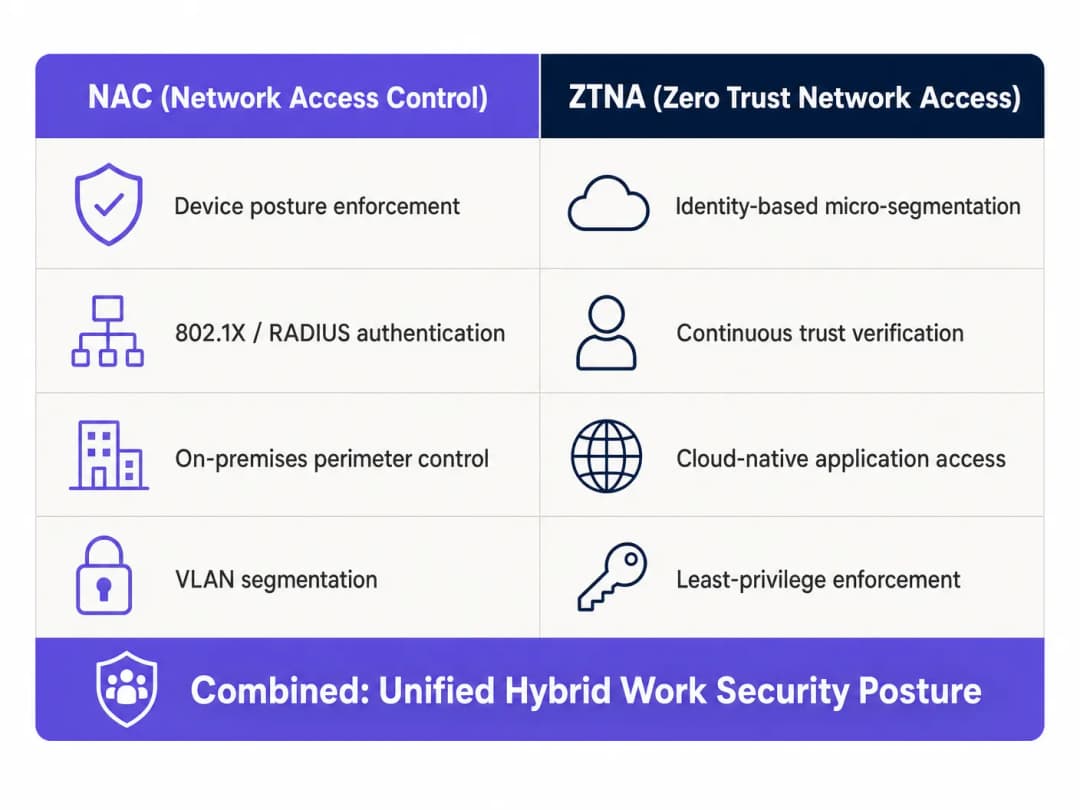
By combining NAC's device-level posture enforcement with ZTNA's identity-centric micro-segmentation, enterprises can achieve continuous trust verification regardless of where users are located. This convergence is especially critical in industries with high footfall and complex compliance requirements, such as retail, healthcare and hospitality. Furthermore, leveraging platforms such as Purple's Guest WiFi infrastructure allows these zero-trust principles to be extended to guest networks, ensuring robust isolation and data protection in line with CCPA/CPRA and PCI-DSS obligations.
Technical Deep-Dive: The Converged Architecture
The Limitations of Isolated Security Domains
Historically, NAC and ZTNA have operated as isolated security domains. NAC, leveraging IEEE 802.1X and RADIUS, excels at controlling physical and wireless access within the corporate perimeter. It provides robust device profiling, posture assessment and VLAN assignment. ZTNA, by contrast, emerged to secure remote access to cloud and on-premises applications, operating on the principle of "never trust, always verify" based on user identity and context rather than network location.
Friction arises when hybrid workers move between these domains. A user authenticates seamlessly at home via ZTNA on a daily basis, but on entering the corporate office often faces a disjointed experience, because local NAC policies may not align with their ZTNA context. This fragmentation introduces security blind spots and operational overhead, directly affecting IT efficiency and end-user productivity.
The Unified Identity and Context Broker
The architectural solution lies in establishing a unified identity and context brokerage layer that synchronizes telemetry between the NAC and ZTNA policy engines. This integration allows for continuous posture assessment that persists across network boundaries.
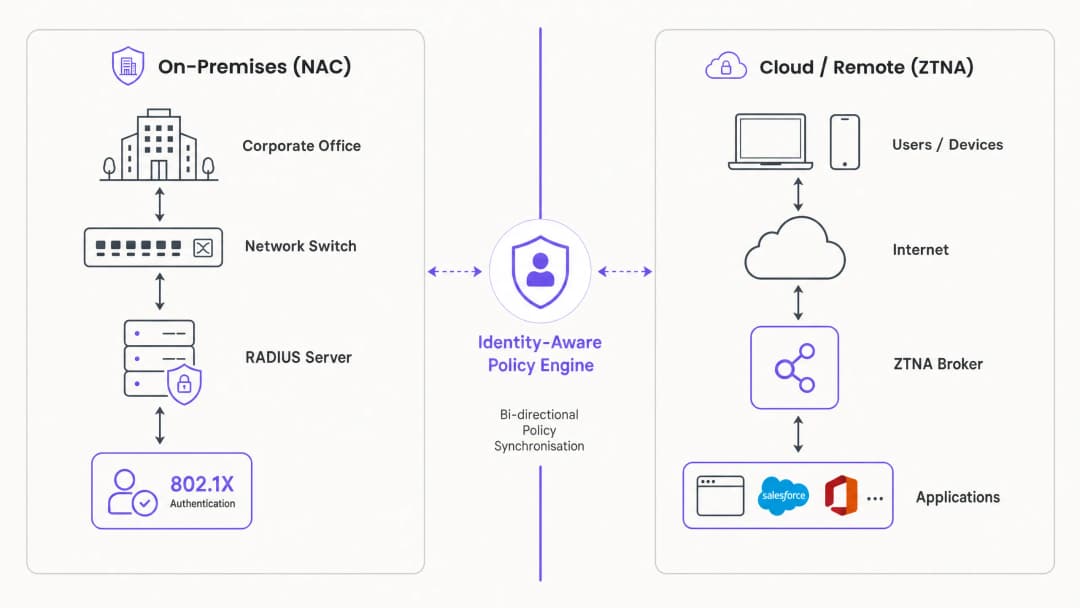
This integration operates through three key mechanisms. First, continuous posture assessment: when a device connects to the corporate network, the NAC solution performs a comprehensive posture check covering OS version, antivirus status and certificate validation. This context is immediately shared with the ZTNA broker via API integration. Second, dynamic policy enforcement: if a device's security posture degrades (for example, malware is detected), the NAC system quarantines the device on the local network while simultaneously instructing the ZTNA broker to revoke access to critical cloud applications. Third, seamless transition: as the user moves from the office to a remote location, the ZTNA client maintains the established trust context, eliminating the need for re-authentication and ensuring uninterrupted access to authorized resources.
For a deeper look at the underlying wireless technologies supporting these deployments, see our guide: WiFi Frequencies: The 2026 Guide to WiFi Bands.
Got questions about your specific setup?
Our team works with venue operators, IT managers, and network engineers across 80,000 venues. Book a 20-minute call and we will show you how others like you solved it.
Implementation Guide: Phased Deployment
Deploying a converged NAC/ZTNA architecture requires a phased approach to minimize disruption and ensure robust policy enforcement.
Phase 1: Identity and Asset Discovery
Before implementing enforcement policies, you must achieve complete visibility of your network environment. Deploy your NAC solution in monitor-only mode - configure it to discover and profile all connected devices, including corporate laptops, BYOD, IoT and guest devices, without blocking access. Consolidate user identity by integrating both the NAC and ZTNA solutions with a central identity provider such as Azure AD or Okta. This ensures consistent authentication policies across both domains. In parallel, use your ZTNA solution to monitor application access patterns, identifying which users need access to specific applications and forming the basis of your micro-segmentation policies.
Phase 2: Policy Definition and Micro-Segmentation
Move from visibility to control by defining granular access policies based on the principle of least privilege. Establish baseline security requirements for corporate devices, including minimum OS versions and an active EDR agent requirement, and configure the NAC solution to enforce these for local access. Define ZTNA policies that restrict application access based on user role and device context, ensuring alignment with the posture requirements defined in the NAC solution. Crucially, configure the API integration between the NAC and ZTNA platforms to enable bidirectional context sharing, ensuring that device posture changes detected by NAC immediately trigger policy updates in the ZTNA broker in real time.
Phase 3: Enforcement and Optimization
Gradually enable enforcement mode, monitoring for anomalies and fine-tuning policies as needed. Transition the NAC solution from monitor mode to enforcement mode, starting with a pilot user group or location, and monitor for authentication failures. Roll out the ZTNA client to all corporate endpoints, ensuring seamless access to both cloud and on-premises applications. Extend robust guest access policies using platforms such as Purple's Guest WiFi, ensuring guest traffic is strictly isolated from corporate resources. Leverage WiFi Analytics to monitor usage patterns and detect potential anomalies across the guest estate.
Best Practices for Enterprise Environments
Prioritize user experience throughout the deployment. Security should not impede productivity, and the transition between on-premises and remote access must be transparent to users, leveraging single sign-on and continuous authentication mechanisms. For on-premises access, mandate IEEE 802.1X authentication for all corporate devices, as this provides strong cryptographic verification of device identity at the port level.
Integrate AI-driven threat detection capabilities into your NAC and ZTNA solutions to identify anomalous behavior and automatically quarantine compromised devices. For a forward-looking perspective on this capability, see The Future of Wi-Fi Security: AI-Driven NAC and Threat Detection and its Spanish counterpart El Futuro de la Seguridad Wi-Fi: NAC Impulsado por IA y Detección de Amenazas. For distributed enterprises, integrating ZTNA with SD-WAN can optimize application routing and improve performance across multiple sites - see our comparison at SD WAN vs MPLS: The 2026 Enterprise Network Guide.
Troubleshooting and Risk Mitigation
Context synchronization latency represents the most critical failure mode. If the API integration between NAC and ZTNA experiences delays, a compromised device may retain access to cloud applications for longer than is acceptable. The mitigation is to implement webhook-based push notifications rather than relying solely on polling mechanisms, ensuring near-real-time policy updates.
Overly restrictive policies can cause a sharp spike in help-desk ticket volumes when strict posture checks are implemented without adequate user communication. Use a Captive Portal to notify users of non-compliance and provide self-service remediation instructions before fully blocking access.
IoT device authentication failures are inevitable in venue environments. Headless IoT devices cannot support 802.1X or ZTNA clients. The solution is to adopt MAC Authentication Bypass (MAB) combined with strict device profiling and rigorous VLAN segmentation to isolate IoT traffic from corporate resources.
API integration health monitoring is frequently overlooked. If synchronization between NAC and ZTNA breaks down, a security gap exists that neither system can resolve independently. Implement dedicated monitoring and alerting for integration health, and define fail-safe policies that trigger automatic access restrictions if synchronization is lost beyond a defined threshold.
ROI and Business Impact
The convergence of NAC and ZTNA delivers measurable business value beyond risk mitigation. Unified policy management reduces the administrative burden on IT teams, allowing them to focus on strategic initiatives rather than managing fragmented security silos. Eliminating legacy VPNs significantly improves the hybrid work experience, reducing downtime and frustration while improving application performance for remote users.
The ability to demonstrate continuous posture assessment and identity-based access control simplifies compliance reporting for frameworks such as PCI-DSS and CCPA/CPRA, which is especially important in Transport and retail environments where cardholder data and personal data protection obligations are stringent. Organizations that have deployed a converged architecture consistently report reduced mean time to contain (MTTC) security incidents, as bidirectional policy enforcement enables automatic quarantining without manual intervention.
Key Definitions
Network Access Control (NAC)
A security solution that enforces policy on devices seeking access to a network infrastructure, typically utilizing IEEE 802.1X for authentication and posture assessment to determine VLAN assignment and access rights.
Critical for securing on-premises environments, ensuring only compliant and authorized devices can connect to corporate switches and wireless access points. IT teams encounter this when managing physical office and venue networks.
Zero Trust Network Access (ZTNA)
An IT security solution that provides secure remote access to applications and services based on defined access control policies, operating on the principle of least privilege and continuous identity verification rather than network location.
Replaces legacy VPNs by providing identity-based micro-segmentation, granting access only to specific applications rather than the entire network. Relevant when securing remote workers and cloud application access.
Micro-segmentation
The practice of dividing a network into isolated segments to reduce the attack surface and prevent lateral movement by threat actors, applied at the application or workload level rather than the network perimeter.
ZTNA applies this concept at the application level, ensuring a compromised endpoint cannot pivot to access unauthorized resources. IT teams encounter this when designing zero-trust architectures.
Posture Assessment
The process of evaluating a device's security state - including OS version, active antivirus, installed certificates, and patch level - before granting network or application access.
A core function of NAC, ensuring that vulnerable or compromised devices are quarantined or remediated before they can interact with the corporate network. Relevant during device onboarding and continuous monitoring.
IEEE 802.1X
An IEEE standard for port-based Network Access Control, providing an authentication mechanism to devices wishing to attach to a LAN or WLAN, using EAP (Extensible Authentication Protocol) over the network medium.
The gold standard for enterprise network authentication, providing robust cryptographic validation of device identity. IT teams encounter this when configuring switches, wireless controllers, and RADIUS servers.
RADIUS (Remote Authentication Dial-In User Service)
A networking protocol that provides centralized Authentication, Authorization, and Accounting (AAA) management for users who connect and use a network service, acting as the communication layer between NAC and identity providers.
The backend protocol utilized by NAC solutions to communicate with identity providers and enforce access policies. Relevant when integrating NAC with Active Directory or cloud IdPs.
MAC Authentication Bypass (MAB)
A fallback authentication method used by NAC solutions for devices that do not support 802.1X, relying on the device's MAC address as an identifier to assign network access policies.
Necessary for accommodating headless devices - printers, IoT sensors, digital signage - in enterprise environments. Less secure than 802.1X and requires strict VLAN segmentation to mitigate MAC spoofing risks.
Identity Provider (IdP)
A system entity that creates, maintains, and manages identity information for principals while providing authentication services to relying applications within a federation or distributed network.
The central source of truth for user identities, integrating with both NAC and ZTNA to ensure consistent authentication policies. IT teams encounter this when configuring SSO and MFA across enterprise systems.
VLAN (Virtual Local Area Network)
A logical subdivision of a physical network that groups devices into isolated broadcast domains, enabling traffic segmentation without requiring separate physical infrastructure.
The primary mechanism for isolating different device classes - corporate, guest, IoT - within a shared physical network. Critical for compliance with PCI-DSS requirements for cardholder data environment isolation.
Worked Examples
A global retail chain with 500 locations needs to secure access for regional managers who frequently travel between stores, corporate headquarters, and remote home offices. They currently experience frequent VPN disconnects and inconsistent access to cloud-hosted inventory management applications.
Implement a converged NAC/ZTNA architecture across all locations. Deploy 802.1X via NAC for seamless, secure access when managers are physically in-store or at HQ, authenticating against a centralized RADIUS server integrated with Azure AD. Deploy a ZTNA client on all corporate laptops. Integrate the NAC and ZTNA policy engines via API, configuring webhook notifications for immediate posture updates. When a manager connects to the in-store network, the NAC authenticates the device and shares the "trusted internal" context with the ZTNA broker. The ZTNA broker then grants direct, optimized access to the cloud-hosted inventory application without requiring a VPN tunnel, reducing latency and eliminating disconnection issues. When the manager works from home, the ZTNA client establishes a secure micro-tunnel to the application, maintaining the same access policies without relying on the corporate network perimeter. Guest and IoT devices in-store are isolated on separate VLANs managed via Purple's Guest WiFi platform.
A large conference center needs to provide secure WiFi for corporate staff while isolating thousands of daily guest connections and third-party vendor IoT devices including digital signage, BLE beacons, and environmental sensors.
Deploy a robust NAC solution configured with strict VLAN segmentation across three distinct tiers. Tier one: corporate staff devices authenticate via 802.1X and are assigned to a secure internal VLAN with full access to internal management systems. Tier two: implement Purple's Guest WiFi platform to manage public access, capturing valuable analytics while ensuring complete isolation from the corporate network via a dedicated guest VLAN with internet-only access. Tier three: for vendor IoT devices, utilize MAC Authentication Bypass (MAB) combined with deep device profiling - analyzing DHCP fingerprints, HTTP user agents, and traffic patterns - to accurately identify device types and assign them to restricted, internet-only VLANs. Integrate ZTNA for corporate staff to access internal management applications securely from any location within the venue or remotely. For BLE beacon infrastructure, refer to the guide on BLE Low Energy Explained for Enterprise for integration considerations.
Practice Questions
Q1. Your organization is deploying ZTNA to replace a legacy VPN. However, users returning to the corporate office are experiencing latency when accessing applications hosted locally in the on-premises data center, as ZTNA traffic is routing through a cloud-hosted broker. What is the recommended architectural solution?
Hint: Consider how the ZTNA client determines the optimal path to the application based on the user's physical network context.
View model answer
Implement a Local Edge or On-Premises ZTNA Broker within the corporate data center. Configure the ZTNA client to detect when the device is authenticated on the internal corporate network via NAC and route traffic directly to the local application via the internal broker, rather than hair-pinning through the cloud-hosted broker. This reduces latency for on-premises applications while maintaining the same identity-based access controls. The NAC context sharing via API should signal to the ZTNA broker that the device is on a trusted internal network, enabling the local routing decision.
Q2. A hospital IT team needs to secure hundreds of connected medical devices - infusion pumps, patient monitors, imaging equipment - that cannot run 802.1X supplicants or ZTNA clients. How should these devices be secured within a converged NAC/ZTNA architecture?
Hint: Consider fallback authentication methods and the principle of network-level isolation for devices that cannot participate in identity-based controls.
View model answer
Utilize MAC Authentication Bypass (MAB) on the NAC solution, combined with deep device profiling using DHCP fingerprints, HTTP user agents, and traffic behavior analysis to accurately identify and classify each medical device type. Once identified, the NAC dynamically assigns these devices to highly restricted, isolated VLANs that only permit communication with specific, required medical servers and systems - blocking all other traffic by default. ZTNA is not applicable to these devices; security relies entirely on strict network segmentation and continuous traffic monitoring for anomalous behavior. Ensure the medical device VLANs are completely isolated from the cardholder data environment to maintain PCI-DSS compliance.
Q3. During a production deployment, the API integration between your NAC and ZTNA solutions fails silently - no alerts are triggered. A user's laptop on the corporate network subsequently becomes infected with malware. Describe the expected security outcome and identify the architectural gap that allowed it.
Hint: Analyze the impact of broken context synchronization on each policy engine independently, and consider what monitoring should have been in place.
View model answer
The NAC solution will detect the degraded posture via EDR integration and quarantine the device on the local network, preventing lateral movement within the corporate environment. However, because the API integration has failed silently, the ZTNA broker has not received the updated posture context. If the user attempts to access a cloud application, the ZTNA client may still establish a connection if the initial identity authentication token remains valid and has not expired. The architectural gap is twofold: first, the absence of health monitoring on the API integration itself; second, the lack of a fail-safe policy that triggers automatic access restrictions if context synchronization is lost beyond a defined threshold. The remediation is to implement dedicated monitoring with alerting on integration health, configure the ZTNA broker to require periodic posture re-validation (not just initial authentication), and define a default-deny policy that activates if the NAC context feed is unavailable for more than a specified interval.
Continue reading in this series
Managing Bandwidth for Staff WiFi: Shaping, QoS and Reducing Traffic
This guide details practical methods for managing bandwidth for staff WiFi in enterprise venues. It covers traffic shaping, QoS implementation, and how deploying Purple Shield reduces network load without requiring infrastructure upgrades.
How to Reduce the Number of WiFi SSIDs Using Per-Device PSK (iPSK, DPSK, MPSK)
This authoritative technical reference guide explains how IT teams can eliminate WiFi performance degradation caused by SSID beacon overhead by collapsing multiple purpose-built networks into a single SSID using per-device PSK (xPSK). It covers the vendor landscape across Cisco iPSK, HPE Aruba MPSK, Ruckus DPSK, Juniper Mist PPSK, and Ubiquiti UniFi PPSK, with practical implementation guidance on dynamic VLAN assignment, IoT onboarding, and PCI DSS compliance. Venue operators in hospitality, retail, stadiums, and public-sector organisations will find actionable architecture guidance and real-world worked examples.
The Checklist for Migrating from Legacy NAC to Cloud-Native NAC
This authoritative technical reference guide provides a structured, three-phase checklist for migrating from legacy Network Access Control (NAC) to a cloud-native architecture. It equips IT managers and network architects with actionable strategies to handle identity integration, policy parity, and compliance without disrupting venue operations.
Got questions about your specific setup?
Our team works with venue operators, IT managers, and network engineers across 80,000 venues. Book a 20-minute call and we will show you how others like you solved it.