
How Personalization Increases Customer Loyalty and Sales
This technical reference guide details the architectural requirements and business impact of leveraging WiFi analytics for customer personalization at scale. It provides actionable deployment guidance for IT managers, network architects, and venue operations directors to transform legacy guest access infrastructure into a primary data ingestion layer that drives measurable loyalty and revenue uplift. Covering data schema design, CRM integration, CCPA/CPRA compliance, and real-world case studies across hospitality, retail, and events, this guide equips technical teams with the frameworks needed to architect a network that actively contributes to the top line.
Video overview
Listen to this guide
View podcast transcript
Part of our core series: WiFi Marketing Guide →

Executive Summary
Hospitality, retail, and public venue operators face a constant challenge: converting crowds of anonymous visitors into measurable customer loyalty and revenue. In legacy network infrastructure, guest access was considered merely a cost center, but modern edge platforms have transformed the access point into a primary data ingestion layer.
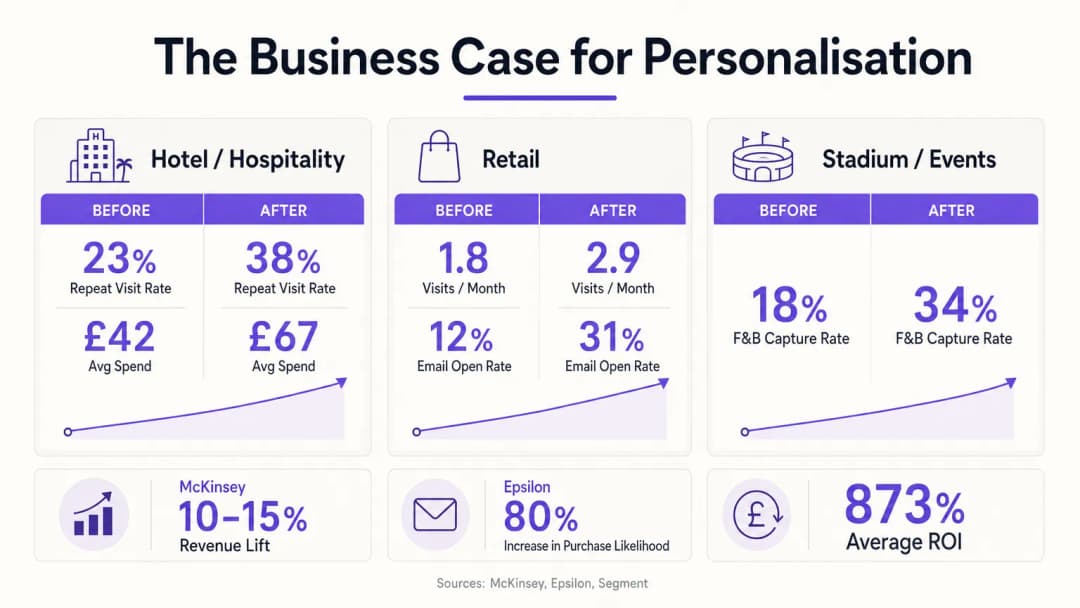
This technical reference guide examines the architectural changes required to implement personalization at scale. By integrating Captive Portal authentication with Customer Relationship Management (CRM) systems and marketing automation, IT and marketing teams can deliver contextual experiences that achieve proven business results. Industry data shows that robust personalization strategies lead to a 10% to 15% increase in revenue, while 80% of consumers report being more likely to purchase from brands that offer tailored experiences.
For IT managers and network architects, moving from basic connectivity to an intelligent analytics overlay requires careful consideration of data schemas, API integrations, and compliance frameworks. This guide provides actionable deployment methodologies, architectural blueprints, and real-world case studies that demonstrate how to build a network that actively contributes to revenue.
Technical Deep-Dive
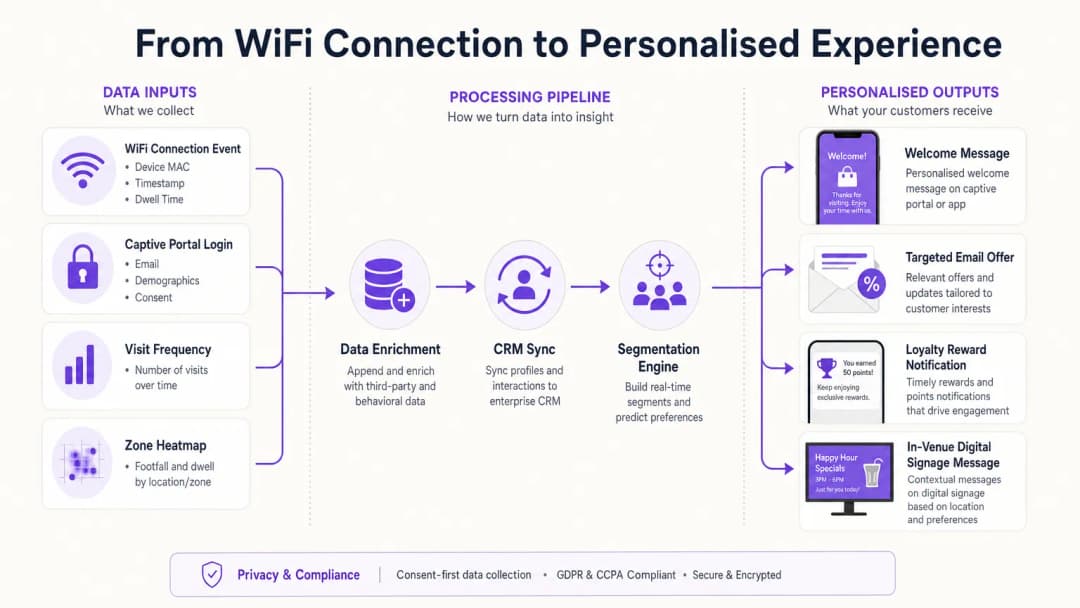
The foundation of scalable personalization relies on moving from isolated network silos to an integrated data ecosystem. When a user authenticates via Guest WiFi, the network captures high-fidelity telemetry - including device MAC addresses, dwell times, zone transitions, and authentication payloads.
Data Ingestion and Schema Mapping
To leverage this telemetry, the analytics overlay must normalize the data into a unified schema. This process involves capturing both deterministic data (e.g. email addresses and demographic details provided during Captive Portal login) and probabilistic data (e.g. behavioral patterns derived from AP triangulation and RSSI values).
The resulting data lake is fed directly into the venue's CRM and marketing automation platforms. Purple's WiFi Analytics platform acts as a central ingestion engine, parsing raw RADIUS accounting packets and HTTP redirect payloads into structured JSON objects suitable for downstream consumption.
Integration Architecture
Successful deployments rely on robust API architectures to synchronize network telemetry with external systems. RESTful APIs facilitate real-time data transfer, enabling triggered workflows, such as sending a welcome email the moment a high-value customer authenticates on the network.
Consider a scenario where a customer enters a Retail environment. The network controller detects device probe requests and associates the MAC address with a known customer profile. The analytics platform then triggers a webhook to the CRM, which evaluates the customer's purchase history and delivers a personalized offer on the Captive Portal or the brand's mobile application.
In Hospitality deployments, this same architecture enables Property Management System (PMS) integration. When a returning guest checks in and connects to the hotel's WiFi, the system cross-references their profile with historical stay data and delivers a personalized welcome message on the Captive Portal, complete with targeted upsells for room upgrades or F&B promotions.
| Data Type | Source | Downstream Use |
|---|---|---|
| Email address | Captive Portal login | CRM profile creation, email campaigns |
| MAC address | Network association | Visit frequency tracking, dwell analysis |
| Zone dwell time | AP triangulation | Contextual triggered offers |
| Visit frequency | RADIUS accounting | Loyalty tier assignment |
| Demographics | Progressive profiling | Audience segmentation |
Implementation Guide
Deploying a personalization-centric network architecture requires a structured approach to ensure data accuracy, system interoperability, and regulatory compliance.
Phase 1: Infrastructure Assessment
Before deploying an analytics overlay, assess the existing WLAN infrastructure. Ensure that wireless controllers and access points support the necessary protocols - RADIUS, SNMP, and Syslog - and can handle the increased processing overhead associated with continuous telemetry reporting. Purple's platform is hardware-agnostic, integrating with existing infrastructure from Cisco, Juniper, Ruckus, and other leading vendors, which significantly reduces the capital expenditure required for deployment.
Phase 2: Captive Portal Configuration
Design the Captive Portal to balance user friction with data acquisition. Implement progressive profiling techniques, requesting minimal information during the initial login and gradually building the customer profile during subsequent visits. Ensure the portal design aligns with corporate brand guidelines and offers seamless authentication methods such as social login or OpenRoaming integrations. All data collection must be based on clear, CCPA/CPRA-compliant consent mechanisms.
Phase 3: System Integration
Establish a bidirectional data flow between the WiFi analytics platform and the venue's CRM, marketing automation, and property management systems. Use robust middleware or direct API integrations to ensure data consistency. For complex environments, consider deploying a Customer Data Platform (CDP) to serve as a central repository for all customer interactions. This is particularly relevant for Transportation hubs and multi-site retail chains where the customer journey spans multiple physical locations.
Phase 4: Campaign Logic and Automation
Once the data pipeline is established, configure marketing automation rules that translate network events into customer actions. Define trigger conditions (e.g. first visit, 5th visit, dwell time exceeding 30 minutes in a specific zone) and map them to relevant campaign actions. Establish A/B testing frameworks to continuously optimize offer relevance and conversion rates.
Got questions about your specific setup?
Our team works with venue operators, IT managers, and network engineers across 80,000 venues. Book a 20-minute call and we will show you how others like you solved it.
Best Practices
To maximize the impact of personalization initiatives, IT and marketing teams should adhere to the following vendor-neutral best practices.
Prioritize data quality. Implement data validation rules at the entry point to prevent corrupt or inaccurate data from entering the CRM. Regularly audit and clean databases to maintain high data fidelity. A single authoritative customer record is far more valuable than ten duplicate, incomplete profiles.
Adopt a privacy-first approach. Ensure all data collection practices comply with regional regulations such as CCPA/CPRA and GDPR. Implement clear, transparent consent mechanisms within the Captive Portal and provide users with accessible tools to manage their data preferences. Non-compliance poses significant financial and reputational risks.
Implement contextual triggers. Leverage real-time location data to deliver highly relevant messaging. In a hospitality setting, trigger a spa promotion when a guest connects to an AP near the wellness center. In retail, trigger a fitting room assistance offer when a customer spends more than 10 minutes in the apparel zone.
Align IT and marketing objectives. Foster cross-functional collaboration between IT and marketing departments. IT must ensure the infrastructure can reliably deliver the required telemetry, while marketing defines the business rules and campaign logic. Misalignment between these teams is the most common cause of failed deployments.
For organizations building a comprehensive customer experience strategy, the guides Como Construir uma Estratégia de Experiência do Cliente and Cómo construir una estrategia de experiencia del cliente provide complementary frameworks.
Troubleshooting and Risk Mitigation
Deploying an intelligent network overlay introduces new complexities and potential failure domains. Proactive risk mitigation is essential to maintain service availability and data integrity.
API rate limiting. High-density venues such as transit hubs or stadiums can generate massive volumes of telemetry data, potentially exceeding the rate limits of downstream APIs. Implement intelligent queuing and batching mechanisms to manage data egress. Filter out low-value events (e.g. transient roaming) and only trigger webhooks for significant state changes.
MAC randomization. Modern mobile operating systems use MAC randomization to protect user privacy, which disrupts probabilistic device tracking between sessions. To maintain tracking accuracy, encourage users to authenticate via the Captive Portal or download the venue's mobile application, which can utilize deterministic identifiers. Certificate-based authentication via Passpoint or OpenRoaming provides the most robust long-term solution.
Network congestion. Continuous telemetry reporting can consume significant bandwidth on constrained backhaul links. Optimize reporting intervals to reduce the load on the core network and leverage edge processing where possible. For venues with high-throughput requirements, consider a dedicated leased line to ensure consistent backhaul performance.
Data consistency failures. Bidirectional API integrations introduce the risk of data discrepancies if one system is temporarily unavailable. Implement idempotent API calls and robust retry logic to ensure no customer events are lost during brief outages.
ROI and Business Impact
The ultimate goal of a personalization strategy is to generate measurable business value. By leveraging network analytics, venue operators can transition from qualitative assumptions to quantitative performance metrics.
Measuring Success
Establish clear key performance indicators (KPIs) to assess the impact of the deployment. The table below outlines the primary metrics and their expected benchmarks based on industry deployments.
| KPI | Baseline (Pre-Deployment) | Target (Post-Deployment) | Measurement Method |
|---|---|---|---|
| Repeat visit rate | 23% | 35%+ | WiFi Analytics / CRM |
| Average transaction value | Baseline | +15% to +25% | POS integration |
| Email campaign open rate | 12% | 28%+ | Marketing automation |
| F&B capture rate (stadiums) | 18% | 30%+ | POS / WiFi correlation |
| Customer lifetime value | Baseline | +20% | CRM analytics |
By continuously analyzing these metrics and refining personalization algorithms, organizations can maximize the ROI of their network infrastructure. Purple's platform reports an average ROI of 873% across its 80,000+ venue deployments, demonstrating the transformative business potential of treating the network as a strategic business asset rather than merely a utility.
Key Definitions
Captive Portal
A web page that a user of a public-access network is obliged to view and interact with before access is granted. It serves as the primary ingestion point for deterministic customer data.
IT teams configure captive portals to enforce acceptable use policies, capture marketing consent, and authenticate users against a backend database. The design of the captive portal directly impacts data quality and network adoption rates.
Progressive Profiling
The technique of gradually gathering customer information across multiple interactions rather than demanding a comprehensive form completion during the first encounter.
Used to minimize authentication friction and improve the user experience while still building robust customer profiles over time. Critical for maintaining high network adoption rates in consumer-facing venues.
MAC Randomization
A privacy feature implemented by modern mobile operating systems (iOS 14+, Android 10+) that generates a temporary, random Media Access Control (MAC) address when scanning for or connecting to wireless networks.
This feature complicates probabilistic device tracking across sessions, making deterministic authentication via a captive portal or Passpoint/OpenRoaming essential for accurate long-term analytics.
Telemetry
The automated communications process by which measurements and other data are collected at remote or inaccessible points and transmitted to receiving equipment for monitoring and analysis.
In WiFi analytics, telemetry includes data points such as signal strength (RSSI), association states, roaming events, and dwell times generated by the access points and wireless controllers.
Webhook
A method of augmenting or altering the behavior of a web application with custom HTTP callbacks, triggered by specific events in a source system and sent to a destination URL in real-time.
Webhooks are heavily utilized to push real-time event data - such as a customer logging into the WiFi - from the analytics platform to external CRM or marketing automation systems.
Customer Data Platform (CDP)
A type of packaged software that creates a persistent, unified customer database accessible to other systems, by pulling data from multiple sources, cleaning it, and combining it into a single customer profile.
Advanced enterprise deployments utilize CDPs to aggregate WiFi telemetry with POS data, loyalty program metrics, and e-commerce interactions into a single, actionable customer view.
Dwell Time
The duration of time a device remains associated with the network or within a specific physical zone, as measured by the WiFi analytics platform.
A critical metric for assessing venue performance and customer engagement. Increased dwell time is a strong indicator of engagement and often correlates directly with higher revenue per visit.
Omnichannel Attribution
The process of tracking and valuing all customer touchpoints across various channels - physical store, website, mobile app - that contribute to a desired outcome such as a purchase.
WiFi analytics provides the crucial physical-world data stream required to build accurate omnichannel attribution models, bridging the gap between online and offline customer behavior.
RADIUS (Remote Authentication Dial-In User Service)
A client/server networking protocol that provides centralized Authentication, Authorization, and Accounting (AAA) management for users who connect and use a network service.
RADIUS accounting packets are the primary source of raw telemetry data in enterprise WiFi deployments, capturing session start/stop events, data usage, and device identifiers.
Worked Examples
A 200-room boutique hotel chain wants to increase F&B revenue by targeting guests who frequently use the lobby lounge but rarely dine in the main restaurant. How should the IT team architect the network to support this objective?
The IT team should configure the access points in the lobby lounge and main restaurant into distinct zones within the WiFi analytics platform. They must implement an API integration between the analytics platform and the hotel's Property Management System (PMS) and marketing automation tool. When a guest authenticates via the captive portal, the system cross-references their profile. If the analytics engine detects high dwell time in the lobby zone but no recent POS transactions in the restaurant zone, it triggers a webhook to the marketing platform, which immediately dispatches a personalized, time-sensitive dining discount via email or SMS. The campaign logic should include a 30-minute expiration window to create urgency and ensure the offer is redeemed during the current visit rather than deferred.
A large retail chain is experiencing a high volume of "window shoppers" who browse the physical store but ultimately purchase online from competitors. How can the network architecture be optimized to capture this lost revenue?
The network architects should deploy a progressive profiling strategy on the captive portal, offering a high-value incentive (e.g., a 15% discount code) in exchange for authentication. The analytics platform must be integrated with the retailer's e-commerce platform and CRM. By analyzing the customer's in-store dwell time in specific departments and cross-referencing it with their online browsing history, the CRM can generate highly targeted, personalized follow-up campaigns. Furthermore, if the customer adds an item to their online cart while connected to the in-store WiFi but fails to checkout, the system can trigger an immediate "abandoned cart" notification with a tailored incentive to complete the purchase at the physical POS.
Practice Questions
Q1. Your organization is deploying a new WiFi analytics overlay across 50 retail locations. The marketing director wants to capture 15 different data points (including physical address, cell phone number, and detailed preferences) during the initial captive portal login to immediately populate the CRM. As the IT architect, what is your recommendation?
Hint: Consider the impact of user friction on network adoption rates and the concept of progressive profiling.
View model answer
Advise against requesting 15 data points during the initial login. This level of friction will severely depress network adoption rates, resulting in a smaller overall data pool and undermining the entire personalization strategy. Instead, implement a progressive profiling strategy. Capture only the essential deterministic data - email address and marketing consent - during the first visit. On subsequent visits, the captive portal can dynamically request one or two additional data points. This approach balances the marketing team's need for rich data with the IT requirement for a seamless user experience, and will ultimately yield a larger, higher-quality dataset.
Q2. A stadium client is experiencing significant latency when attempting to trigger real-time, in-seat F&B offers based on WiFi connection events. The analytics platform is currently configured to send individual API calls to the CRM for every single association and roaming event generated by the 80,000 capacity crowd. How do you resolve this architectural bottleneck?
Hint: Evaluate the difference between raw telemetry and actionable business events, and consider data egress strategies.
View model answer
The current architecture is overwhelming the CRM API with raw, low-value telemetry. Implement edge filtering and batching within the WiFi analytics platform. First, filter out transient roaming events and only trigger webhooks for significant state changes - specifically initial authentication or prolonged dwell time in a specific concession zone. Second, for non-time-sensitive data, transition from real-time API calls to asynchronous batch processing, transmitting aggregated data payloads at scheduled intervals. This reduces the API load by an estimated 90% while ensuring the marketing platform still receives the necessary contextual triggers for real-time offer delivery.
Q3. Following a recent iOS update that aggressively utilizes MAC randomization, the marketing team reports a sharp decline in their ability to track repeat visitors across your venue's network. What technical strategy should you deploy to restore tracking fidelity?
Hint: Contrast probabilistic tracking methods with deterministic authentication.
View model answer
Shift reliance from probabilistic tracking (using MAC addresses) to deterministic authentication. Configure the network to require captive portal re-authentication more frequently by reducing the session timeout duration. Strongly incentivize users to authenticate using persistent credentials, such as a social login or a loyalty program ID. If the venue has a mobile app, integrate an SDK that utilizes a stable, app-specific identifier. For the most robust long-term solution, implement certificate-based authentication via Passpoint or OpenRoaming, which bypasses MAC randomization entirely by using a persistent, device-bound credential.
Continue reading in this series
How to leverage SMS in marketing to increase return visits
This technical reference guide outlines how enterprise venues can integrate WiFi analytics with SMS marketing engines to drive repeat visits. It details the architecture required to capture real-time presence data, trigger automated SMS campaigns based on physical behavior, and measure the direct impact on return rates. By aligning network infrastructure with marketing automation, IT and operations teams can establish a high-yield channel for customer retention.
How to Build a Customer Experience Strategy
This technical reference guide provides a practical framework for IT leaders, network architects, and venue operations directors on how to build a data-driven customer experience strategy. It covers the full architecture from guest WiFi authentication and captive portal design through to spatial analytics, CRM integration, and measurable ROI — with concrete implementation scenarios drawn from hospitality, retail, and public-sector environments. Purple's guest WiFi and analytics platform is positioned throughout as the enabling infrastructure layer.
How to Collect Customer Data In-Store: A Retailer's Guide
This technical reference guide equips IT managers, network architects, and venue operations directors with a practical framework for building first-party customer datasets in physical retail locations. It covers the deployment architecture, compliance obligations, and integration strategies for Guest WiFi, POS systems, loyalty programmes, and survey kiosks. The guide maps each collection method to measurable business outcomes, with concrete implementation scenarios from retail, hospitality, and events environments.
Got questions about your specific setup?
Our team works with venue operators, IT managers, and network engineers across 80,000 venues. Book a 20-minute call and we will show you how others like you solved it.