
How to leverage marketing by SMS to increase return visits
This technical guide details how venue operators can integrate Guest WiFi infrastructure with SMS marketing automation to drive return visits. It covers the data capture architecture, compliance requirements, segmentation strategies, and closed-loop attribution models necessary to achieve high ROI from first-party data.
Listen to this guide
View podcast transcript

Executive Summary
Marketing by SMS delivers an unmatched 98% open rate and a return on investment of up to £41 for every £1 spent [1] [2]. However, for venue operators across hospitality, retail, and public sectors, the challenge is not sending the message - it is capturing verified phone numbers and explicit consent at scale. This technical guide details how to integrate your existing Guest WiFi infrastructure with SMS marketing automation to drive return visits. By using captive portal authentication to capture first-party data, you can build a GDPR and TCPA compliant SMS pipeline that targets lapsed visitors, drives direct bookings, and provides closed-loop attribution when guests reconnect to your network.
Technical Deep-Dive: The WiFi-to-SMS Architecture
The foundation of venue-based SMS marketing is the Guest WiFi login event. Rather than relying on staff to manually collect phone numbers or hoping guests fill out a web form, the network itself becomes the data capture engine.
The Captive Portal Data Pipeline
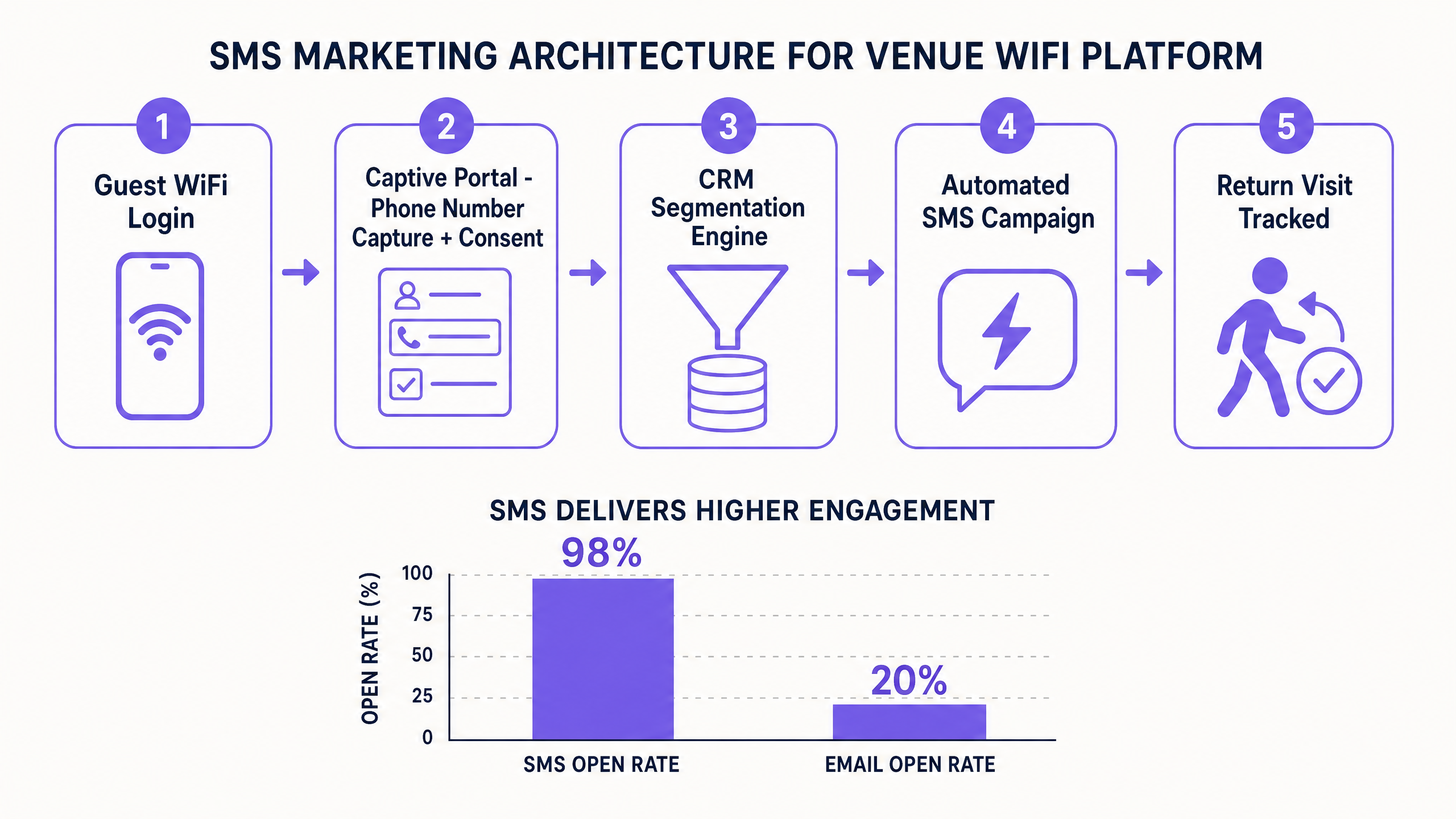
When a visitor connects to the venue SSID, the network controller (whether Cisco Meraki, HPE Aruba, Ruckus, Juniper Mist, or others) redirects their traffic to a cloud-hosted captive portal. This portal serves as the authentication gateway.
- Authentication Request: The access point intercepts the client device and presents the login splash page.
- Data Capture: The guest inputs their details, including their mobile number.
- Consent Logging: The guest actively checks an opt-in box for SMS marketing. This is logged with a timestamp and MAC address to ensure compliance.
- Session Authorisation: The cloud platform authenticates the device via RADIUS and grants internet access.
- Data Synchronisation: The captured profile is pushed to the WiFi Analytics database and synchronised with the venue's CRM via API.
Closed-Loop Attribution
The primary technical advantage of this architecture is attribution. When a guest receives an SMS offer and subsequently returns to the venue, their device automatically probes for the known SSID. When the device authenticates (often seamlessly via MAC caching or Passpoint), the network logs the return visit. The analytics platform matches the return event to the outbound SMS campaign, providing definitive ROI tracking without relying on coupon codes or point-of-sale integration.
Implementation Guide: Building the SMS Re-Engagement Flow
Deploying a successful SMS marketing strategy requires careful segmentation. A blanket broadcast to all previous visitors will result in high opt-out rates and diminished returns.
Step 1: Network Configuration
Ensure your wireless infrastructure is configured to route guest traffic through the captive portal. For multi-tenant environments, refer to Three SSIDs to rule them all: guest, Passpoint, and IoT WiFi for best practice on isolating guest traffic from corporate networks.
Step 2: Captive Portal Design
The login page must be optimised for conversion while maintaining strict compliance.
- Keep it simple: Request only essential fields (Name, Email, Mobile).
- Clear Consent: Provide an explicit, unticked checkbox for SMS marketing. Do not bundle this with the general Terms of Service.
- Brand Consistency: Ensure the portal reflects your venue's identity. See How to make a great first impression with your guest WiFi (and keep your brand consistent) for UI guidelines.
Step 3: Segmentation and Triggers
Configure your CRM or marketing automation platform to segment visitors based on their network connection history:
- The Lapsed Visitor Trigger: Configure a rule to fire when a guest has not connected to the network for 60 days. Send an SMS with a strong incentive to return (e.g., "We've missed you! Show this text for 20% off your next visit").
- The First-Time Visitor Trigger: Send a welcome SMS 24 hours after a guest's first login, encouraging them to leave a review or join a loyalty programme.
- The High-Frequency Visitor Trigger: Identify guests who connect multiple times a week. Send them exclusive perks rather than discounts to build brand advocacy.
Best Practices for Venue Operators
Compliance First
SMS marketing is heavily regulated. In the UK and EU, the General Data Protection Regulation (GDPR) and the Privacy and Electronic Communications Regulations (PECR) mandate explicit, informed consent for electronic marketing [3]. In the US, the Telephone Consumer Protection Act (TCPA) requires prior express written consent [4].
- Never pre-tick consent boxes.
- Always include a clear opt-out mechanism (e.g., "Reply STOP to unsubscribe") in every message.
- Maintain an audit trail. Your captive portal solution must record exactly when and how consent was obtained.
Optimising Send Times and Frequency
Timing is critical for SMS. For Retail venues, sending messages on Thursday or Friday afternoons drives weekend footfall. For Hospitality and food & beverage, sending a message at 11:30 AM can capture the lunchtime crowd.
Limit frequency to avoid fatigue. Research indicates that 53% of SMS opt-outs are caused by over-messaging [5]. A rule of thumb is one targeted SMS per month per segment.
Troubleshooting & Risk Mitigation
Common Failure Modes
| Risk | Cause | Mitigation |
|---|---|---|
| High Opt-Out Rates | Sending generic blasts to the entire database; messaging too frequently. | Implement strict segmentation based on visit recency. Limit frequency to once per 30 days per segment. |
| Low Data Capture Rates | Captive portal is too complex or requires too many fields. | Streamline the login process. Offer alternative authentication methods (e.g., social login) alongside form fills. |
| Attribution Failure | Devices randomise MAC addresses, preventing the network from recognising returning visitors. | Encourage users to download the venue app or use Passpoint/Hotspot 2.0 profiles for persistent identification. |
| Compliance Violations | Importing legacy phone number lists without verified SMS opt-in records. | Only send SMS campaigns to users who have explicitly opted in via the captive portal. Quarantine legacy data. |
ROI & Business Impact
The business case for integrating Guest WiFi with SMS marketing is compelling.
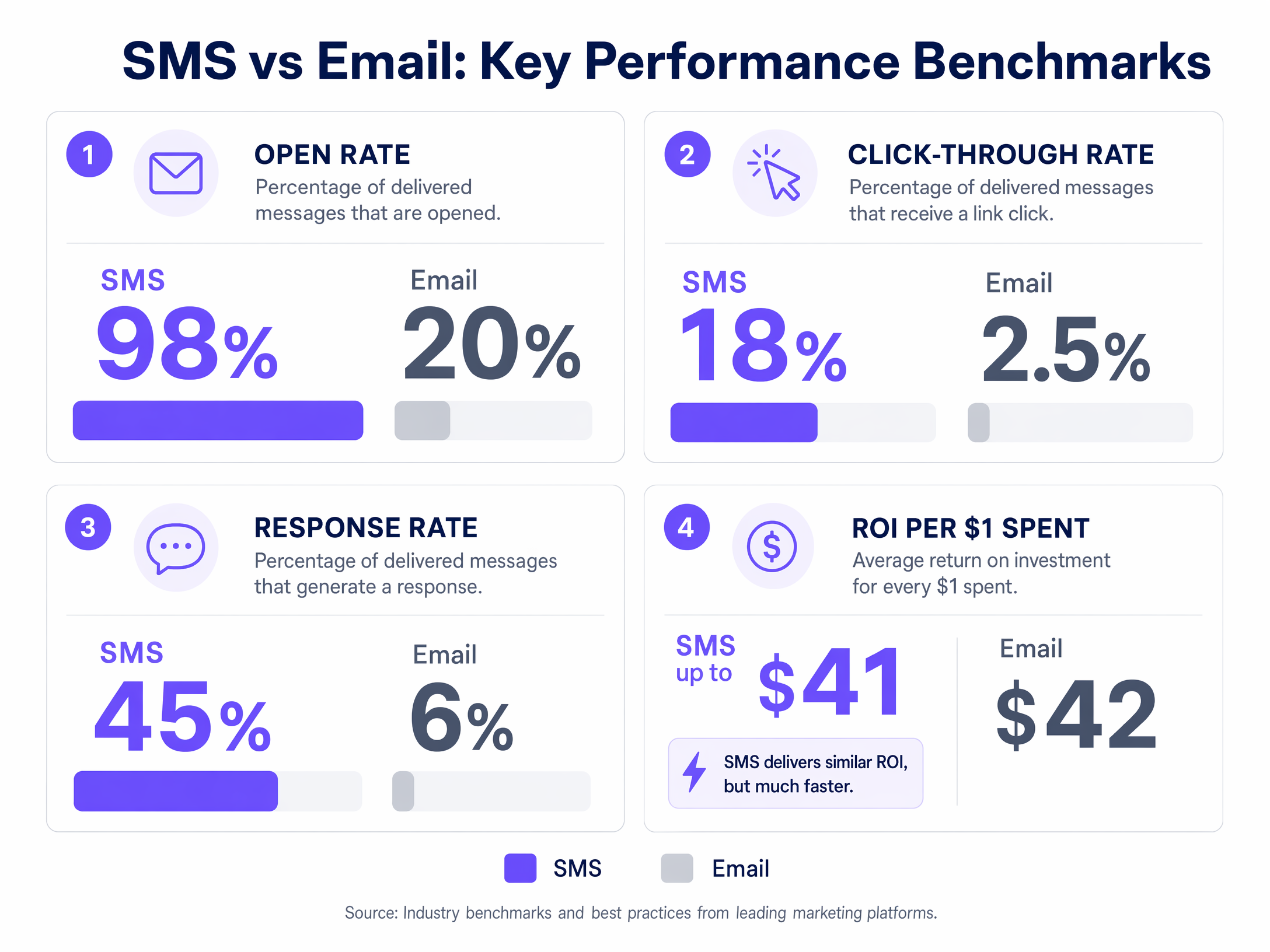
By capturing first-party data at the point of entry, venues eliminate reliance on expensive third-party data brokers. A 300-room hotel implementing automated SMS re-engagement for lapsed guests can see a 22% increase in direct bookings, significantly reducing Online Travel Agency (OTA) commission fees. Similarly, a shopping centre can directly attribute footfall increases to targeted SMS campaigns, providing clear ROI to retail tenants.
For more detailed strategies on implementing these campaigns, refer to How to leverage SMS for marketing to increase return visits .
References
[1] Emarsys. "20+ SMS Marketing Statistics (With Sources) to Know in 2026." https://emarsys.com/learn/blog/sms-marketing-statistics/ [2] Sakari. "SMS Marketing Statistics: Data-Backed Insights for 2025-2026." https://sakari.io/blog/sms-marketing-statistics-data-backed-insights-for-2025-2026/ [3] Information Commissioner's Office (ICO). "Direct marketing and privacy and electronic communications." https://ico.org.uk/for-organisations/direct-marketing-and-privacy-and-electronic-communications/ [4] Bloomreach. "TCPA and CTIA Compliance for SMS Marketing in the US." https://www.bloomreach.com/en/blog/understanding-tcpa-and-ctia-compliance-for-sms-marketing-in-the-us [5] Sakari. "SMS Marketing Statistics: Data-Backed Insights for 2025-2026." https://sakari.io/blog/sms-marketing-statistics-data-backed-insights-for-2025-2026/
Key Definitions
Captive Portal
A web page that a user of a public-access network is obliged to view and interact with before access is granted.
For IT teams, this is the primary mechanism for authenticating guests and capturing first-party data and consent.
First-Party Data
Information a company collects directly from its customers and owns.
In a post-cookie landscape, capturing phone numbers directly via WiFi login is more reliable and compliant than purchasing third-party lists.
Closed-Loop Attribution
The ability to track a marketing campaign directly to a physical visit.
When a guest receives an SMS and their device later authenticates on the venue's WiFi, IT and Marketing can prove the campaign drove a physical return.
MAC Address Caching
Storing a device's Media Access Control address to allow seamless reconnection on subsequent visits without requiring another login.
This improves the guest experience and ensures accurate tracking of return visits, provided the device does not use aggressive MAC randomisation.
PECR
Privacy and Electronic Communications Regulations. UK legislation sitting alongside GDPR that specifically regulates electronic marketing, including SMS.
IT and legal teams must ensure the captive portal design complies with PECR by requiring explicit, granular consent for SMS.
TCPA
Telephone Consumer Protection Act. US legislation regulating telemarketing and SMS messaging.
Requires prior express written consent for promotional texts, dictating how the captive portal opt-in flow must be structured in the US.
SSID
Service Set Identifier. The public name of a wireless network.
Venues should broadcast a dedicated Guest SSID, isolated from corporate traffic, to securely capture visitor data.
OpenRoaming
A federation of WiFi networks allowing devices to connect automatically and securely without captive portals.
While seamless, OpenRoaming bypasses traditional data capture. Purple acts as an identity provider to maintain engagement capabilities even on seamless networks.
Worked Examples
A 200-room hotel needs to reduce OTA commission fees by driving direct bookings from previous guests. They currently offer free WiFi but do not capture marketing consent.
- Configure the network controller to route guest traffic to a cloud captive portal. 2. Design a login splash page requiring Name, Email, and Mobile Number, with a clear, unticked checkbox for SMS marketing opt-in. 3. Integrate the WiFi analytics platform with the hotel's CRM. 4. Build a 'Lapsed Guest' segment for users who have not connected to the WiFi in 90 days. 5. Configure an automated SMS trigger offering a 15% discount code for direct bookings to this segment.
A large retail shopping centre wants to increase weekday footfall. They have 45 tenants and robust WiFi coverage.
- Ensure the captive portal explicitly states that marketing consent applies to the shopping centre management, not individual tenants, to maintain GDPR compliance. 2. Segment the database to identify shoppers who typically visit on weekends but have not visited on a weekday in the last 3 months. 3. Schedule an automated SMS campaign for Wednesday mornings offering a parking discount or a free coffee voucher valid only on Thursdays and Fridays.
Practice Questions
Q1. A stadium operator wants to send an SMS blast to all 40,000 fans who connected to the WiFi during Saturday's match, offering them a discount on merchandise for the next game. They plan to send this on Monday morning. What are the technical and strategic risks with this approach?
Hint: Consider compliance, segmentation, and timing.
View model answer
- Compliance Risk: Not all 40,000 fans will have explicitly ticked the SMS opt-in box. Sending to the entire list violates GDPR/PECR/TCPA. The list must be filtered for explicit consent. 2. Strategic Risk (Timing): Monday morning is a poor time for engagement. A better approach is to schedule the SMS for the afternoon before the next match to drive immediate action. 3. Strategic Risk (Segmentation): A blanket blast ignores behaviour. A better approach is segmenting fans based on dwell time (e.g., fans who spent time near the merchandise stands) or visit frequency.
Q2. Your marketing team reports that an SMS campaign sent to 5,000 lapsed visitors generated 300 clicks on the included link, but the WiFi analytics dashboard only shows 45 return visits attributed to the campaign. How do you investigate this discrepancy?
Hint: Think about how devices behave on wireless networks and how attribution is calculated.
View model answer
- Investigate MAC Randomisation: Modern mobile OSs randomise MAC addresses to protect privacy. If a user connects with a different MAC address on their return visit, the system cannot link it to their original profile. Encourage Passpoint profiles or app downloads to mitigate this. 2. Check Timeframes: The attribution window might be too narrow. Ensure the analytics platform is set to attribute visits within a reasonable window (e.g., 14 days post-SMS). 3. Review Network Coverage: Did the guests return but fail to connect to the WiFi? If they didn't pass an access point or authenticate, the visit wasn't logged.
Q3. You are migrating from a legacy captive portal system to Purple Engage. You have an exported CSV of 10,000 mobile numbers from the old system, but the export does not include the consent timestamps or the specific opt-in language used. Can you import this list into Purple for an SMS campaign?
Hint: Focus on the burden of proof required for regulatory compliance.
View model answer
No. Under regulations like GDPR and TCPA, the burden of proof for consent lies with the venue. Without timestamps and the exact opt-in language, you cannot prove these users explicitly consented to SMS marketing. Importing and messaging this list exposes the organisation to significant compliance fines. The compliant approach is to quarantine the list and rebuild the database organically using the new, compliant captive portal flow.