

Améliorer la visibilité du réseau avec l'intégration NAC et MDM
Ce guide de référence technique détaille l'architecture, l'intégration et l'impact commercial de la combinaison du contrôle d'accès réseau (NAC) avec la gestion des appareils mobiles (MDM). Il fournit des conseils de déploiement exploitables pour les responsables informatiques et les architectes réseau opérant dans des environnements complexes à usages multiples tels que l'hôtellerie, le commerce de détail et les lieux publics.
Listen to this guide
View podcast transcript
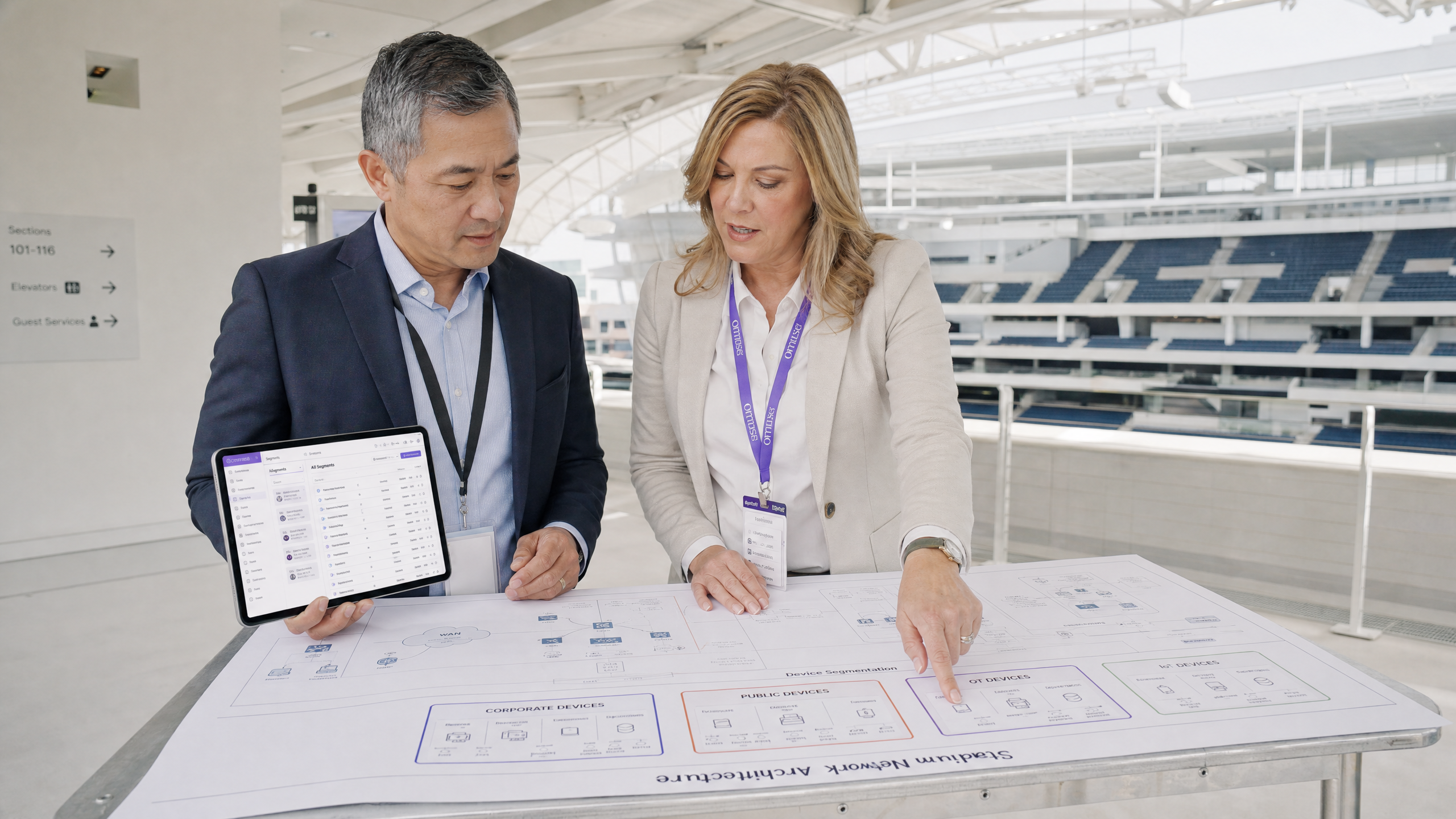
Résumé Exécutif
Pour les équipes informatiques d'entreprise gérant de grands sites physiques — qu'il s'agisse d'un hôtel de 500 chambres, d'un grand stade ou d'une chaîne de vente au détail nationale — le périmètre du réseau s'est dissous. L'infrastructure réseau physique actuelle transporte un mélange volatile de terminaux d'entreprise, de smartphones BYOD, d'appareils invités non gérés, de terminaux de paiement et d'une flotte en expansion rapide de capteurs IoT sans interface. L'exploitation de ces environnements sans une visibilité réseau granulaire et en temps réel constitue un risque significatif en matière de conformité et de sécurité.
Ce guide fournit un plan technique pour améliorer la visibilité du réseau grâce à l'intégration NAC et MDM. En comblant le fossé entre l'identité, la posture des appareils et le contrôle d'accès réseau, les architectes informatiques peuvent passer des attributions VLAN statiques à une segmentation dynamique basée sur la posture. Nous explorerons l'architecture technique requise pour y parvenir, les points d'intégration avec les plateformes d'authentification des invités comme Guest WiFi , et les étapes de mise en œuvre pratiques nécessaires pour sécuriser les environnements multi-usages sans perturber les opérations.
Approfondissement Technique : Architecture et Normes
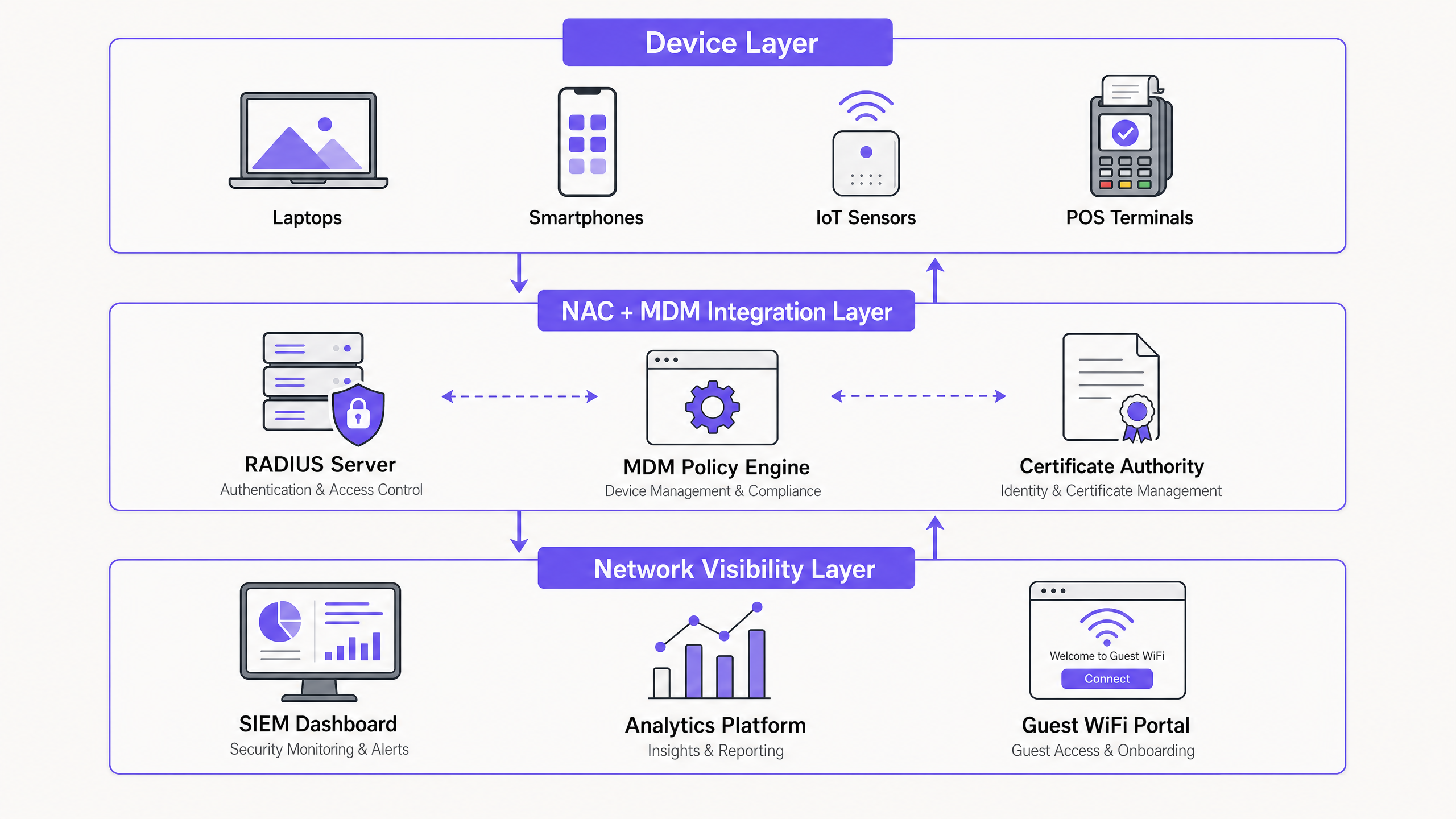
La visibilité du réseau exige fondamentalement de répondre à trois questions en temps réel : Qu'est-ce qui se connecte ? À qui appartient-il ? Est-il conforme ? Répondre à ces questions nécessite une architecture intégrée couvrant la périphérie du réseau, le fournisseur d'identité et la plateforme de gestion des appareils.
La Couche d'Application : Contrôle d'Accès Réseau (NAC)
Au cœur de l'architecture se trouve le système de Contrôle d'Accès Réseau (NAC), agissant comme Point de Décision de Politique (PDP). La norme industrielle pour une implémentation NAC robuste reste IEEE 802.1X, utilisant un serveur RADIUS pour authentifier les demandeurs avant d'accorder l'accès au réseau.
Lorsqu'un terminal d'entreprise tente de s'associer à un point d'accès ou de s'authentifier à un port de commutateur, le cadre 802.1X transporte en toute sécurité les identifiants de l'appareil (généralement via EAP-TLS utilisant des certificats numériques) vers le serveur RADIUS. Le serveur RADIUS évalue ces identifiants par rapport à une matrice de politiques définie pour déterminer le segment réseau approprié, attribuant dynamiquement le VLAN via les attributs RADIUS.
Cependant, le 802.1X seul ne vérifie que l'identité ; il ne vérifie pas la posture de sécurité du terminal. C'est là que l'intégration MDM devient critique.
La Couche de Visibilité : Intégration MDM et Évaluation de la Posture
Les plateformes de gestion des appareils mobiles (MDM) (par exemple, Microsoft Intune, Jamf, Workspace ONE) maintiennent un inventaire continu des appareils gérés, en suivant les versions du système d'exploitation, les niveaux de correctifs, les applications installées et les états de conformité globaux.
L'intégration entre NAC et MDM s'effectue généralement via des API REST. Lorsqu'un appareil s'authentifie via 802.1X, le système NAC intercepte la demande d'authentification et interroge la plateforme MDM en utilisant l'adresse MAC ou l'identité du certificat de l'appareil. La plateforme MDM renvoie la posture de conformité en temps réel de l'appareil.
Si le MDM signale l'appareil comme conforme, le système NAC autorise l'accès au VLAN d'entreprise. Si l'appareil n'est pas conforme (par exemple, il manque des mises à jour critiques du système d'exploitation ou il exécute des logiciels non autorisés), le système NAC attribue dynamiquement l'appareil à un VLAN de remédiation avec routage restreint, permettant à l'appareil d'atteindre uniquement le serveur MDM ou les serveurs de mise à jour pour s'auto-réparer.
Gérer les Non Gérés : Appareils Invités et IoT
Le principal défi dans des environnements comme l' Hôtellerie et le Commerce de Détail est le volume considérable d'appareils non gérés. Ces terminaux ne peuvent pas participer à l'authentification 802.1X ou à l'inscription MDM.
Appareils Invités : Pour les appareils invités non gérés, la visibilité est obtenue via une architecture de Captive Portal. Des plateformes comme WiFi Analytics de Purple interceptent la requête HTTP/HTTPS initiale, redirigeant l'utilisateur vers un portail d'authentification. Cette couche capture l'identité de l'utilisateur, applique les conditions de service et gère le consentement en conformité avec le GDPR. L'invité est ensuite placé sur un VLAN invité isolé, physiquement ou logiquement séparé du trafic d'entreprise.
Terminaux IoT : Les appareils sans interface comme les contrôleurs CVC, l'affichage numérique et les terminaux de point de vente (POS) s'appuient généralement sur le contournement d'authentification MAC (MAB). Étant donné que les adresses MAC sont facilement usurpées, le MAB doit être combiné à un profilage approfondi des appareils. Les systèmes NAC modernes analysent les empreintes DHCP, les agents utilisateurs HTTP et les modèles de comportement du trafic pour classer avec précision les appareils IoT et les attribuer à des VLAN IoT micro-segmentés et fortement restreints.
Guide d'Implémentation
Le déploiement d'une architecture NAC et MDM intégrée nécessite une approche progressive et méthodique pour éviter une perturbation opérationnelle généralisée.
Phase 1 : Découverte et Taxonomie des Appareils
Avant de configurer toute politique d'application, vous devez établir une base de référence complète de l'état actuel de votre réseau. Déployez le système NAC en "Mode Moniteur" (utilisant souvent des ports SPAN ou des données NetFlow) pour observer passivement le trafic et cataloguer chaque terminal connecté.
Développez une taxonomie stricte des appareils. Définissez des catégories distinctes : Géré par l'entreprise, BYOD, Invité, IoT (Sous-catégorisé par fonction) et Contractant. Chaque catégorie doit correspondre à une méthode d'authentification, un ensemble de politiques et un VLAN cible spécifiques.
Phase 2 : Intégration MDM en Lecture Seule
Intégrez le système NAC avec l'API MDM, mais configuconcernant les politiques de journalisation des échecs de conformité sans appliquer de quarantaine. Cette phase en lecture seule est critique. Dans les déploiements d'entreprise, la vérification initiale de la posture révèle fréquemment un pourcentage élevé d'appareils non conformes en raison de cycles de correctifs retardés ou de problèmes de synchronisation de certificats. L'application des vérifications de posture avant de comprendre cette ligne de base entraînera un déni de service auto-infligé. Utilisez cette phase pour corriger la ligne de base via les processus informatiques standard.
Phase 3 : Application de l'accès basé sur la posture
Une fois la ligne de base de conformité stable, faites passer les politiques d'entreprise du mode de surveillance au mode d'application. Commencez par un groupe pilote d'utilisateurs informatiques avant de déployer à l'échelle de l'organisation. Assurez-vous que le VLAN de remédiation est correctement routé pour permettre l'accès à la plateforme MDM et aux serveurs de mise à jour nécessaires, mais strictement protégé par un pare-feu des ressources internes.
Phase 4 : Segmentation des invités et de l'IoT
Implémentez le portail d'authentification des invités et le profilage MAB pour l'IoT. Pour les environnements soumis à la norme PCI DSS, assurez-vous que le VLAN des terminaux de point de vente est complètement isolé des segments invités et d'entreprise. Validez la segmentation à l'aide d'outils de test d'intrusion automatisés pour confirmer que le routage inter-VLAN est explicitement refusé.
Bonnes pratiques
- Prioriser l'authentification basée sur les certificats (EAP-TLS) : S'appuyer sur les noms d'utilisateur et les mots de passe pour le 802.1X (PEAP-MSCHAPv2) est de plus en plus vulnérable à la collecte d'identifiants. Déployez une PKI robuste et utilisez la plateforme MDM pour provisionner automatiquement les certificats machine et utilisateur aux terminaux gérés.
- Mettre en œuvre WPA3-Enterprise : Lors du déploiement de nouvelles infrastructures sans fil, exigez WPA3-Enterprise. Le mode de sécurité 192 bits offre des améliorations cryptographiques qui protègent l'échange d'authentification contre les attaques par dictionnaire hors ligne. Pour plus de contexte sur les normes sans fil modernes, consultez notre guide sur Fréquences Wi Fi : Un guide des fréquences Wi-Fi en 2026 .
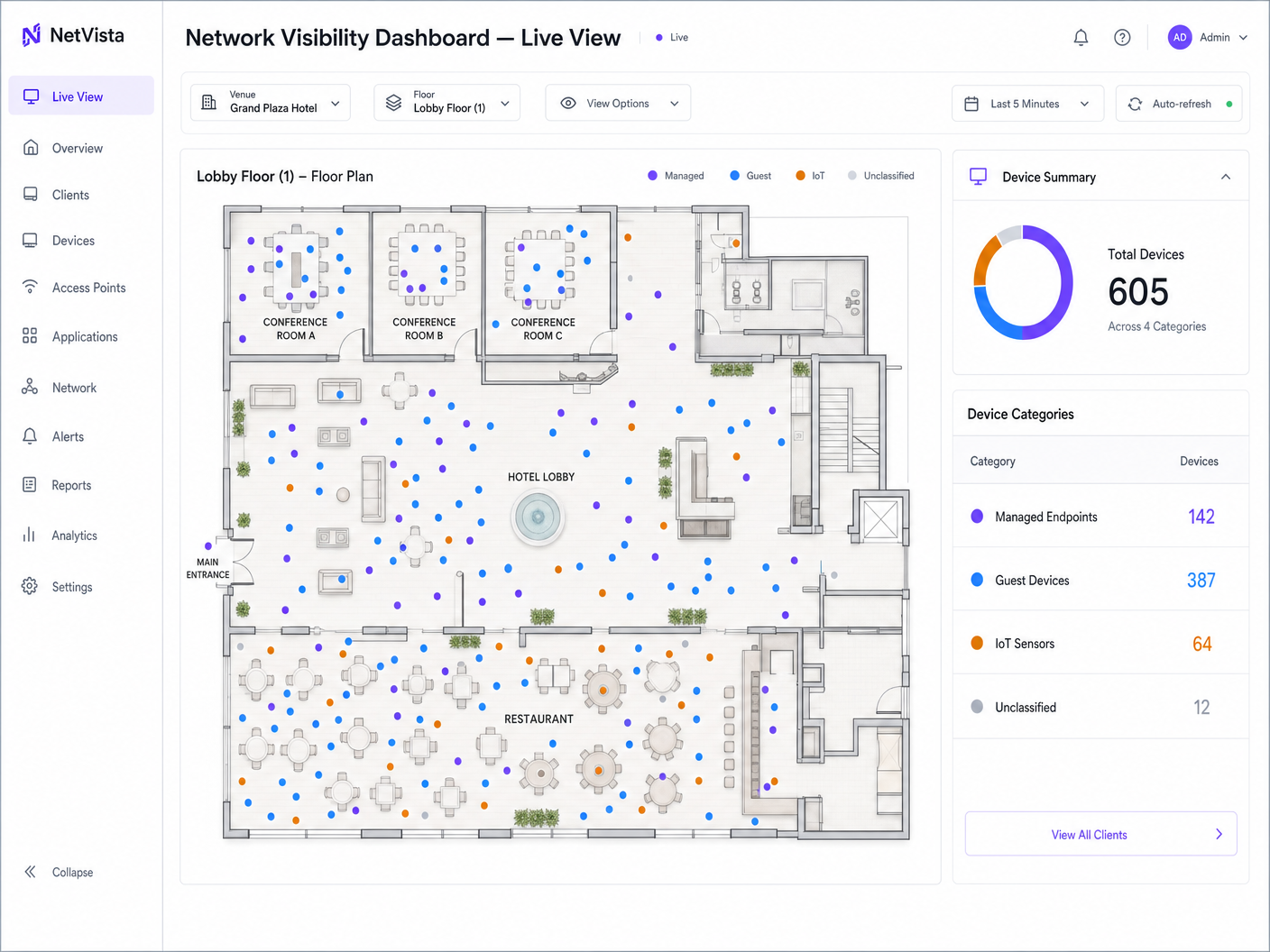
- Unifier la visibilité dans un SIEM : La visibilité du réseau n'est exploitable que si elle est centralisée. Transmettez tous les journaux d'authentification NAC, les événements de conformité MDM et les analyses WiFi des invités à une plateforme centrale de gestion des informations et des événements de sécurité (SIEM). Cela permet une corrélation entre le comportement du réseau, la posture des appareils et l'emplacement physique (en tirant parti des Systèmes de positionnement WiFi intérieur : Comment ils fonctionnent et comment les déployer ).
Dépannage et atténuation des risques
- Mode de défaillance : Limitation du taux d'API : Les environnements à haute densité (comme un stade les jours de match) peuvent générer des milliers d'authentifications simultanées. Si le système NAC interroge l'API MDM pour chaque requête, il peut déclencher des limites de taux, entraînant l'échec des authentifications en mode ouvert ou fermé.
- Atténuation : Implémentez la mise en cache sur le système NAC pour l'état de la posture MDM, en mettant généralement en cache le résultat pendant 15 à 30 minutes, ou utilisez des notifications push basées sur des webhooks du MDM vers le NAC pour les changements d'état en temps réel.
- Mode de défaillance : Expiration du certificat : Un certificat CA racine ou intermédiaire expiré invalidera instantanément toutes les authentifications EAP-TLS, bloquant tous les appareils gérés hors du réseau.
- Atténuation : Mettez en œuvre une surveillance et des alertes agressives pour l'infrastructure PKI. Assurez-vous que les politiques d'inscription automatique dans le MDM fonctionnent et que les appareils se connectent régulièrement.
- Mode de défaillance : Usurpation MAB : Un attaquant clone l'adresse MAC d'une imprimante autorisée pour obtenir l'accès au VLAN interne.
- Atténuation : Ne vous fiez pas uniquement au MAB. Mettez en œuvre un profilage des terminaux qui surveille continuellement le comportement de l'appareil. Si une "imprimante" initie soudainement une connexion SSH ou exécute un scan Nmap, le système NAC doit détecter l'anomalie et mettre immédiatement le port en quarantaine.
ROI et impact commercial
L'analyse de rentabilisation pour l'intégration de NAC et MDM va au-delà de la conformité de sécurité. Le retour sur investissement principal est réalisé grâce à l'atténuation des risques et à l'efficacité opérationnelle.
En automatisant l'intégration des appareils et l'application de la posture, les services d'assistance informatique constatent une réduction significative des tickets liés à l'accès au réseau et à la remédiation de la conformité. Du point de vue de la sécurité, la segmentation dynamique réduit considérablement le rayon d'impact d'un terminal compromis, diminuant le coût potentiel et l'impact opérationnel d'une violation.
De plus, dans les lieux publics tels que les pôles de Transport ou les centres commerciaux, la séparation de l'infrastructure complexe de l'entreprise et de l'IoT de l'expérience client garantit que les services aux invités restent hautement disponibles et performants, soutenant des objectifs commerciaux plus larges en matière d'engagement client et de capture de données.
Key Definitions
Network Access Control (NAC)
A security solution that enforces policy on devices attempting to access a network, acting as the gatekeeper to ensure only authorized and compliant devices connect.
IT teams deploy NAC to prevent unauthorized devices from plugging into switch ports or connecting to corporate SSIDs.
Mobile Device Management (MDM)
Software used by IT departments to monitor, manage, and secure employees' mobile devices, laptops, and tablets across multiple operating systems.
MDM is the source of truth for device compliance, telling the network whether a device is patched and secure.
IEEE 802.1X
An IEEE Standard for port-based Network Access Control, providing an authentication mechanism to devices wishing to attach to a LAN or WLAN.
This is the underlying protocol that allows a laptop to securely present its certificate to the network infrastructure.
MAC Authentication Bypass (MAB)
A fallback authentication method for devices that do not support 802.1X (like printers or IoT sensors), using the device's MAC address as its identity.
Crucial for venue operations where headless IoT devices must connect to the network without user intervention.
Device Profiling
The process of analyzing network traffic, DHCP requests, and behavioral patterns to accurately identify the type and operating system of an unmanaged device.
Used alongside MAB to ensure a device claiming to be a printer actually behaves like a printer, mitigating MAC spoofing attacks.
Dynamic VLAN Assignment
The ability of the network infrastructure to assign a device to a specific Virtual LAN based on its authentication credentials and posture, rather than the physical port it connects to.
Allows a single physical switch or access point to securely service corporate, guest, and IoT devices simultaneously.
Captive Portal
A web page that the user of a public-access network is obliged to view and interact with before access is granted.
The primary mechanism for managing guest WiFi access, capturing marketing data, and enforcing terms of service.
Posture-Based Access Control
An access model where network privileges are dynamically adjusted based on the real-time security state (posture) of the connecting device.
The ultimate goal of NAC and MDM integration, ensuring compromised devices are automatically quarantined.
Worked Examples
A 400-room hotel needs to secure its network infrastructure. The current setup uses a single flat network for staff laptops, smart TVs in guest rooms, point-of-sale (POS) terminals in the restaurant, and guest WiFi. How should the IT architect redesign this using NAC and MDM integration?
- Deploy a NAC appliance and integrate it with the corporate MDM. 2. Create distinct VLANs: Corporate, Guest, IoT (Smart TVs), and PCI (POS). 3. Push EAP-TLS certificates to staff laptops via MDM; configure NAC to assign these to the Corporate VLAN only if the MDM reports them as compliant. 4. Configure MAB with device profiling for the Smart TVs, assigning them to the IoT VLAN with strict ACLs preventing internet access. 5. Isolate POS terminals on the PCI VLAN with hardcoded MAC access lists and micro-segmentation. 6. Deploy Purple Guest WiFi for the public SSID, capturing user consent and assigning them to the isolated Guest VLAN.
A national retail chain is deploying new handheld inventory scanners across 500 stores. The scanners are Android-based and managed by an MDM. Store managers report that scanners frequently drop off the network when moving between the stockroom and the shop floor.
- Review the roaming configuration on the wireless LAN controller (WLC) to ensure 802.11r (Fast Transition) is enabled for the corporate SSID. 2. Check the NAC policy: ensure that the MDM API query isn't introducing latency during the roam. 3. Implement posture caching on the NAC system so that an MDM compliance check is only performed upon initial association, not during every AP transition. 4. Verify that the MDM is pushing the correct WPA3-Enterprise profile to the scanners.
Practice Questions
Q1. Your organization is rolling out a new MDM platform and wants to enforce strict posture checks (e.g., OS patched within 30 days) via the NAC system starting next Monday. What is the primary risk of this approach?
Hint: Consider the difference between theoretical compliance and actual device state in a large enterprise.
View model answer
The primary risk is a widespread denial of service for legitimate users. It is highly likely that a significant portion of the fleet is currently non-compliant due to delayed update cycles or offline devices. The correct approach is to run the integration in 'Monitor Mode' first to establish a baseline, remediate the non-compliant devices through standard IT processes, and only enforce the posture check once the compliance rate is acceptable.
Q2. A stadium IT director wants to use 802.1X for all devices connecting to the network, including digital signage and POS terminals, to maximize security. Why is this architecturally flawed?
Hint: Think about the capabilities of headless devices.
View model answer
This is flawed because most IoT devices, digital signage, and many legacy POS terminals are 'headless' and do not have an 802.1X supplicant; they cannot present credentials or certificates. Attempting to force 802.1X will result in these devices failing to connect. The architect must use MAC Authentication Bypass (MAB) combined with deep device profiling to secure these endpoints on dedicated, restricted VLANs.
Q3. During a PCI DSS audit, the QSA asks you to prove that the guest WiFi network cannot communicate with the POS terminals in the retail stores. How does your NAC architecture demonstrate this?
Hint: Focus on the outcome of the authentication process.
View model answer
The NAC architecture demonstrates this through dynamic VLAN assignment. When a guest connects, they are routed through the captive portal and assigned to an isolated Guest VLAN. When a POS terminal connects, it is profiled via MAB and assigned to a dedicated PCI VLAN. The core network switches and firewalls are configured with Access Control Lists (ACLs) that explicitly deny routing between the Guest VLAN and the PCI VLAN, satisfying the segmentation requirement.