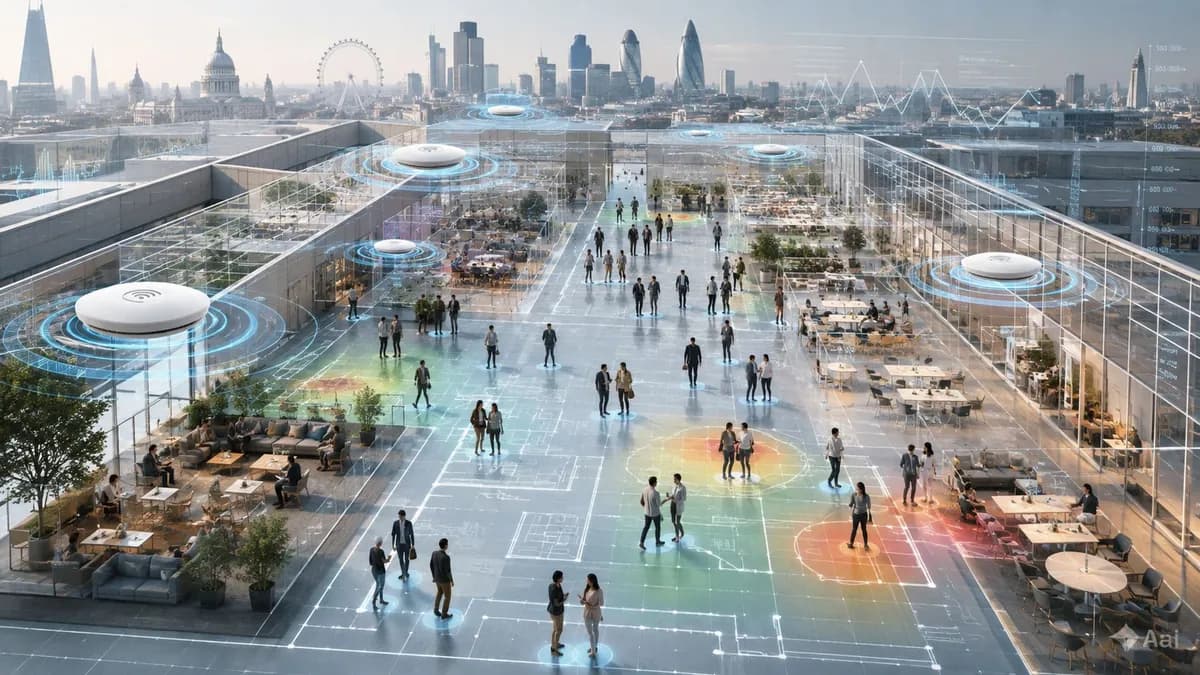
How accurate is your visitor count, and what does it cost?
Compare door staff, WiFi analytics and 3D sensors on daily counting error and annual cost, then test an occupancy limit.
Medium footfall where conversion rate (sales divided by visitors) depends on an accurate door count.
Results
Method: missed visitors = visitors a day x (1 - typical accuracy). Manual cost = entrances x open hours x days open x staff cost, assuming one counter per door whenever the venue is open. Sensor cost is hardware spread over five years plus licence; £600 a door a year is a mid-range assumption, so enter your own quote. Accuracy figures are typical validated ranges; confirm yours with a manual audit at your busiest hour.
Occupancy limit simulator
How a live count drives an entrance sign. Thresholds: 75% warns staff, 90% pauses entry.
| Method | Headcount accuracy | In and out | Groups | Any lighting | Dwell time | Staff |
|---|---|---|---|---|---|---|
| Door staff with tally clickers | About 90%, lower at peaks | Usually in only | Misses at busy times | Not applicable | No | One person per door |
| WiFi probe analytics | About 75% until calibrated | No | Only phones with WiFi on | Yes | Yes | None |
| Overhead 3D stereo or ToF sensors | 98% or better | Yes, in and out | Yes, side by side | Yes (ToF works in the dark) | Only at the line | None |
| 3D sensors plus WiFi analytics | 98% or better (from 3D) | Yes, in and out | Yes, side by side | Yes | Yes, from WiFi | None |
Manually counting people in and out is an inefficient way to collect numbers of visitors, in addition to this, many venues are having to hire additional members of staff to assist with this.
Venues globally, such as supermarkets and high street retailers have opted to implement a one-in-one-out strategy, where a member of staff stands at the entrance to control the flow of visitors in and out of the store.
Since the manual implementation of counting visitors, businesses are seeing a reduction in operational effectiveness; negatively impacting their bottom line.
This is because there are a number of possible human errors that can occur with manually counting people, the member of staff could be distracted, miscounting, or perhaps elsewhere for a short period of time.
In a time where ensuring that a business has no more than the correct number of occupants in a venue at any given time has never been more important, businesses cannot afford to be achieving low accuracy when it comes to counting.
Accurately counting people to increase venue safety
As mentioned above the manual counting of people has the possibility of leading to minor mistakes and miscounts, which during an international health crisis, it's not the sort of mistake any business can afford to be making.
There are numerous ways that businesses can utilise technology to improve the safety of their visitors, staff and venue.
Through connecting cameras with our enterprise-class analytics platform, venues can track visitor numbers with up to 98% accuracy with a 3D compatible camera.
With accurately counting visitors entering and exiting a venue, businesses can also adhere to government guidance through ensuring that it is possible for visitors and staff to maintain a safe social distance.
Businesses can also give their visitors peace of mind when entering their venue as occupancy numbers and data collected are anonymous,
Automating the flow of visitors into a venue
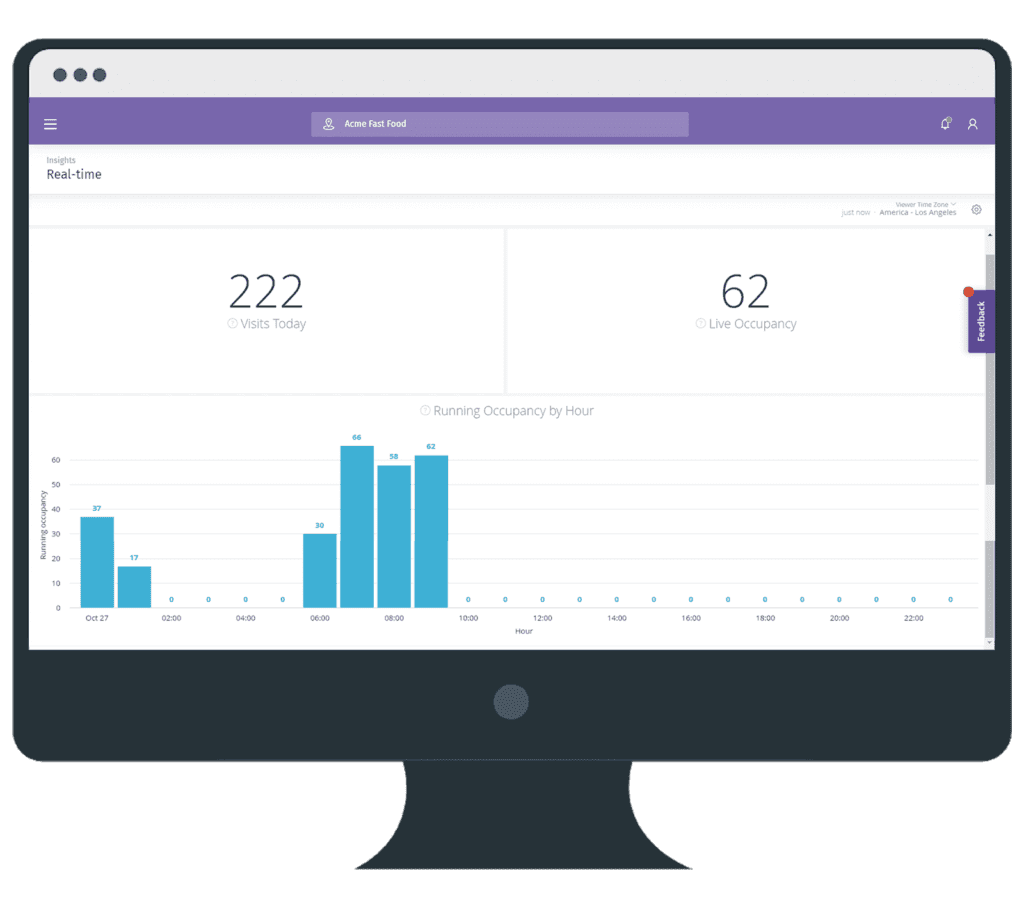
Venues using software such as Purple's automated people counting and analytics can go further than just counting the number of visitors that enter and exit a venue.
Businesses can use a signalling system, displayed on the screen at the entrance of a venue, or a specific zone within your venue, indicating whether it is safe (green) for a visitor to enter, or whether they must wait (red) until the visitor numbers in the venue or zone reduce to a safe level.
This can be done via an API that pulls directly from the Purple portal with real-time data, giving your visitors peace of mind.
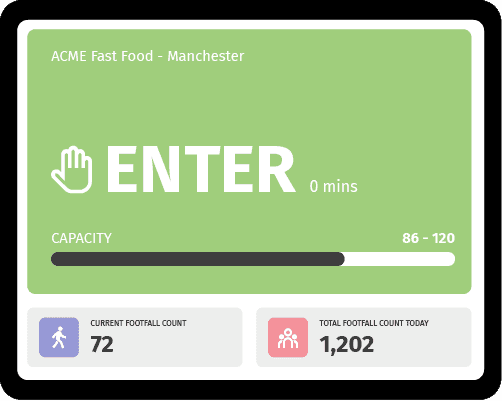
Using this technology to automatically control the flow of visitors in and out of a venue means queue management becomes extremely efficient.
Venues are no longer reliant on a member of staff manually counting visitor numbers and estimating how many people can enter.
In addition to all this, it's possible to use this live data to update your website with occupancy levels and busy periods or use kiosks and displays to highlight the number of visitors in the venue at any given time.
As businesses who have adapted to automation will gladly testify, operational efficiency has improved, so has safety, and as a result of this, visitor and customer numbers are on the increase.
This leaves businesses who are still approaching occupancy and people counting with a manual approach left a little in the dust.
Find out more about our occupancy control and people counting solution