

Wi-Fi 7 for High-Density Venues: Stadiums, Conference Halls, and Terminals
This technical reference guide provides IT leaders and network architects with actionable strategies for deploying Wi-Fi 7 in high-density venues like stadiums and transit terminals. It explores how Multi-Link Operation (MLO), 4K-QAM, and under-seat AP design drastically improve capacity, reduce hardware requirements, and deliver measurable ROI.
🎧 Listen to this Guide
View Transcript
Executive Summary
For IT managers and CTOs operating high-density venues—stadiums, transit terminals, and large conference centres—Wi-Fi 7 (IEEE 802.11be) represents a fundamental architectural shift, not merely a speed upgrade. In environments with 1,000+ concurrent clients per sector, legacy Wi-Fi standards collapse under airtime contention and uplink starvation. Wi-Fi 7 solves the "stadium squeeze" through Multi-Link Operation (MLO), 4096-QAM, and Multi-Resource Unit (MRU) puncturing, allowing networks to pack more data into shorter transmissions and dynamically route traffic across 2.4 GHz, 5 GHz, and 6 GHz bands simultaneously.
This guide provides a vendor-neutral blueprint for designing and deploying Wi-Fi 7 in ultra-high-density environments. By adopting modern under-seat deployment strategies and leveraging the efficiency gains of the new standard, venue operators can increase client-to-AP ratios by up to 50% compared to Wi-Fi 6E, significantly reducing CAPEX while unlocking new revenue streams through Guest WiFi monetization and seamless mobile ticketing.
Technical Deep-Dive
The Physics of High-Density Wi-Fi
In a standard enterprise deployment, an access point might serve 20-30 clients. In a stadium bowl or airport gate lounge, that number can easily spike to 100+ concurrent associations per AP. The primary failure mode in these environments is not downlink bandwidth, but uplink airtime starvation and Co-Channel Interference (CCI).
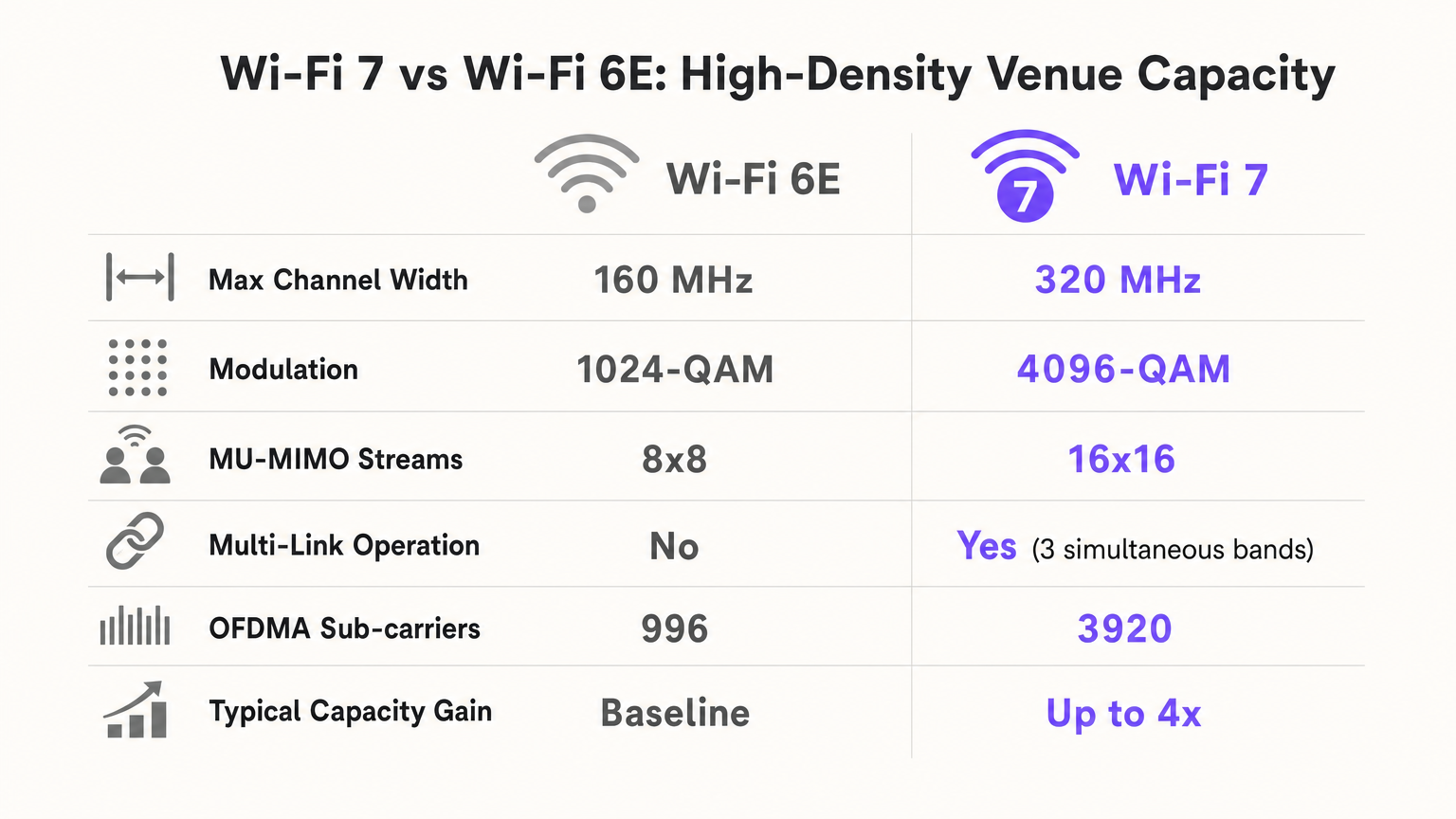
When thousands of fans simultaneously attempt to upload video to social media, the collision domain expands rapidly. Legacy standards forced devices to wait for clear airtime on a single band. Wi-Fi 7 introduces three critical mechanisms to combat this:
- Multi-Link Operation (MLO): MLO enables a Multi-Link Device (MLD) to simultaneously operate across multiple frequency bands (2.4 GHz, 5 GHz, and 6 GHz). In a stadium, this means a client can dynamically shift packets to the cleanest available spectrum with near-zero latency, effectively load-balancing the RF environment at the device level.
- 4096-QAM (4K-QAM): By increasing the modulation density from 1024-QAM (Wi-Fi 6/6E) to 4096-QAM, Wi-Fi 7 packs 20% more data into each symbol transmission. In a dense venue where clients are close to the AP (e.g., under-seat deployments), this allows devices to get on and off the network faster, freeing up critical airtime.
- Multi-Resource Unit (MRU) Puncturing: If a portion of a wide channel (e.g., 160 MHz or 320 MHz) is occupied by a legacy device or radar interference, previous standards required the entire channel to drop to a narrower width. MRU puncturing allows the AP to simply carve out the interfered segment and utilize the remaining clean spectrum, maximizing throughput in noisy environments.
Implementation Guide
Architectural Strategy: Under-Seat vs. Overhead
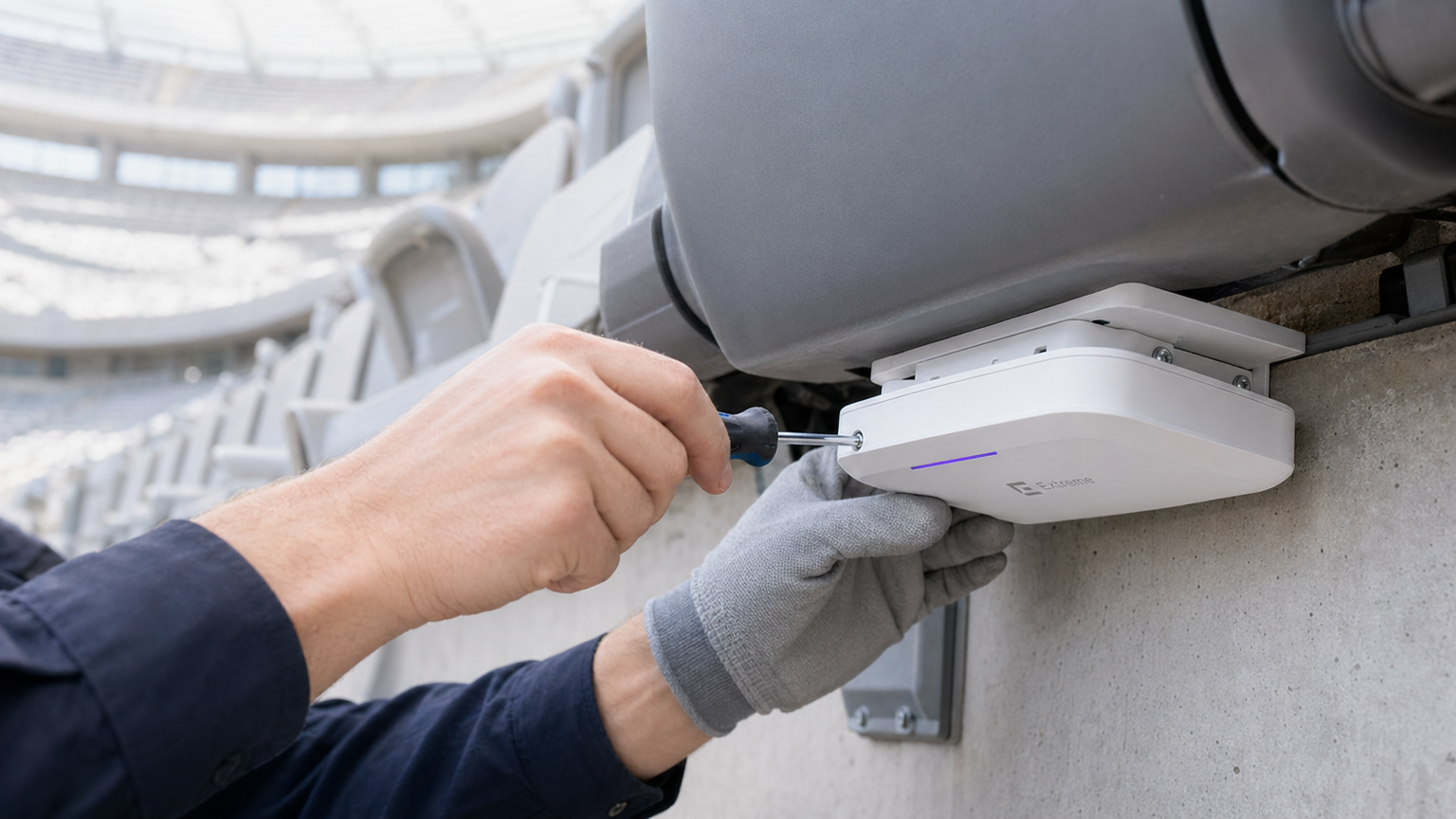
For a 50,000-seat stadium, overhead ceiling deployments are catastrophic. An overhead AP covering 1,000 seats creates a massive CCI zone and an unmanageable uplink collision domain. The modern gold standard is under-seat deployment.
- The "Meat Shield" Effect: Human bodies absorb lateral RF signals (attenuating 5 GHz by 5-15 dB). By placing APs under the seats, you utilize the crowd as a natural RF attenuator, creating small, localized micro-cells (often called "soft bubbles").
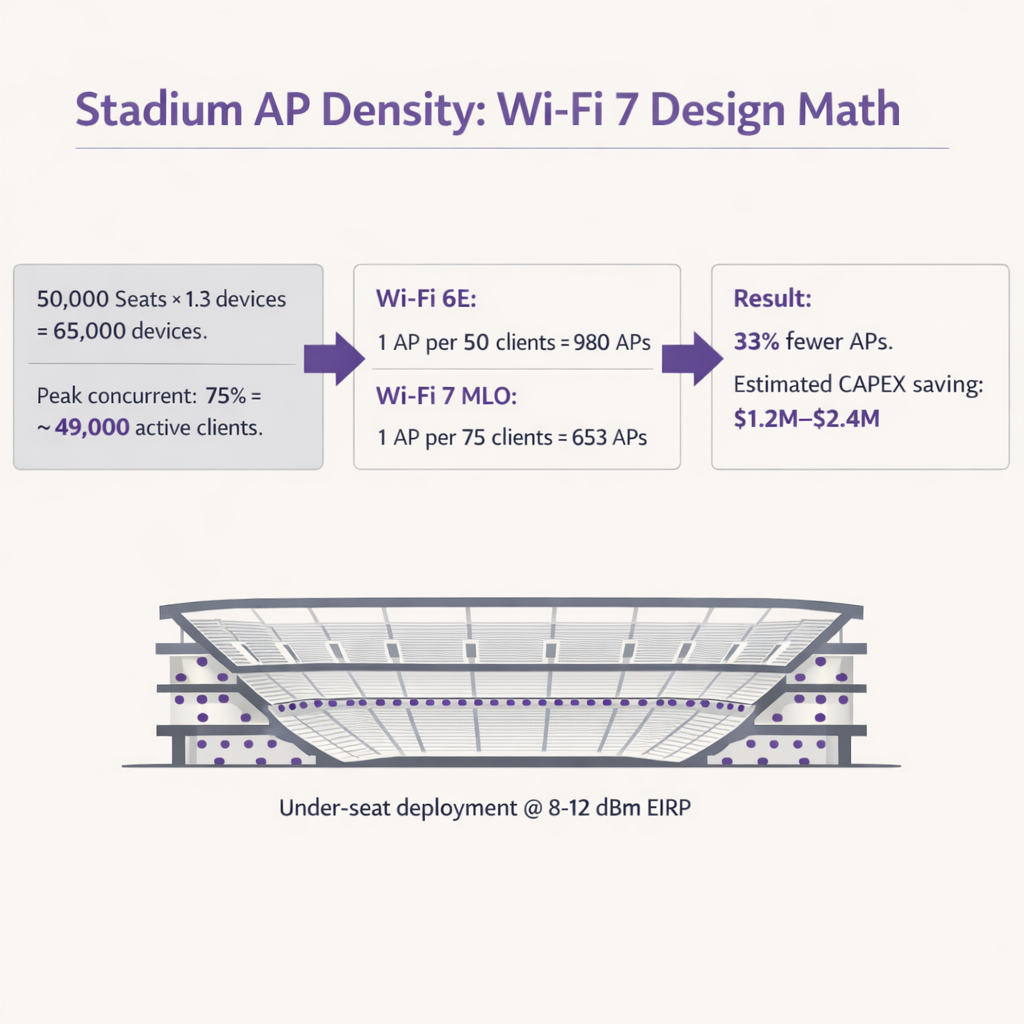
- AP Density Math: With Wi-Fi 6E, architects typically designed for 1 AP per 50 clients. Due to the efficiency of MLO and 4K-QAM, Wi-Fi 7 allows designs of 1 AP per 75-80 clients. In a 50,000-seat venue (assuming 1.3 devices per person and 75% concurrency), this reduces the required AP count from ~980 to ~650, driving massive CAPEX savings on hardware, cabling, and switch ports.
Transit Terminals and Conference Centres
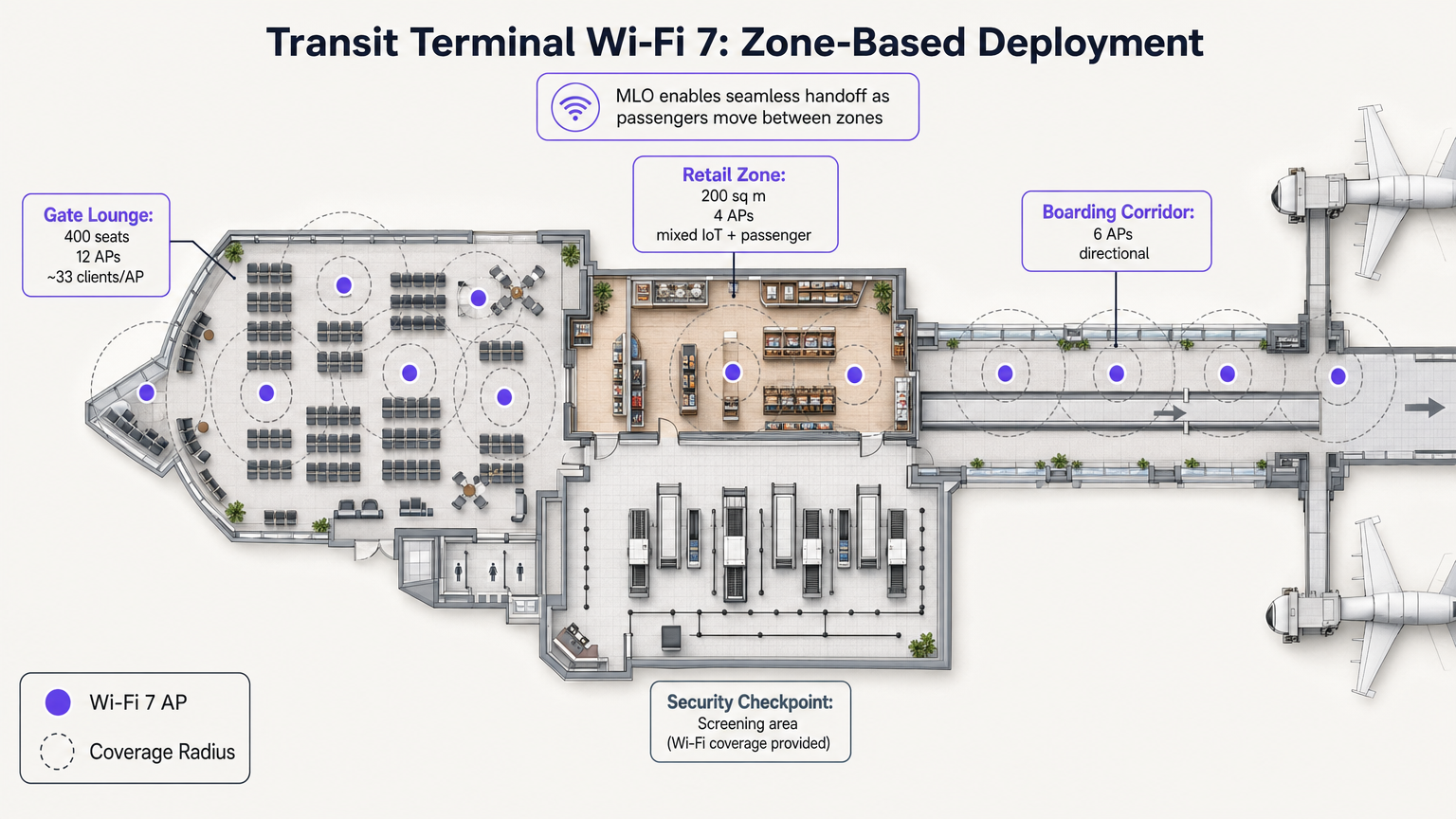
Unlike stadiums, transit terminals feature distinct operational zones with varying density profiles. Wi-Fi 7's MLO is particularly valuable here, enabling seamless handoffs as passengers move from a high-density gate lounge to a retail concourse.
For example, deploying directional APs in boarding corridors and omnidirectional APs in retail zones ensures that WiFi Analytics platforms can accurately track dwell times and footfall without connection drops. This data is critical for optimizing operations in sectors like Transport and Retail .
Best Practices
- Tune Transmit Power for the Uplink: Stadium Wi-Fi is uplink-limited. A Wi-Fi 7 AP can transmit at 30 dBm, but a smartphone can only transmit at ~10 dBm. If the AP power is too high, the client sees a strong signal but the AP cannot hear the client's response. Always set AP EIRP to match the worst-case client uplink (typically 8-12 dBm).
- Aggressive Channel Reuse: In a 5 GHz/6 GHz deployment, use 20 MHz or 40 MHz channels exclusively. Disable 80 MHz and 160/320 MHz in the bowl to maximize the number of non-overlapping channels. Reuse channels every 2-3 seating sections.
- Minimize SSIDs: Every broadcast SSID consumes management frame airtime. In a 600-AP deployment, broadcasting 5 SSIDs can consume 20% of your total airtime before a single user connects. Limit the network to 1-2 SSIDs (e.g., an Open SSID with OWE for guests, and WPA3-Enterprise for staff/media).
- Wired Infrastructure Upgrades: Wi-Fi 7 APs require PoE++ (up to 60W) and multi-gigabit backhaul. Ensure edge switches support 5 Gbps or 10 Gbps ports to prevent wired bottlenecks.
Troubleshooting & Risk Mitigation
| Failure Mode | Symptom | Root Cause | Mitigation Strategy |
|---|---|---|---|
| Sticky Clients | Devices hold onto a distant AP despite being closer to a new one. | Poor roaming configuration; excessive AP transmit power. | Enable 802.11k/v/r. Reduce AP Tx power to 8-12 dBm. Implement BSS coloring. |
| Uplink Starvation | High download speeds, but social media uploads fail or time out. | Hidden node problem; large cell sizes causing collisions. | Shift to under-seat deployment. Ensure AP Tx power matches client capabilities. |
| Airtime Exhaustion | High latency and dropped connections even with few active users. | Too many SSIDs; wide channels (80+ MHz) causing excessive CCI. | Reduce to 1-2 SSIDs. Use 20 MHz channels in ultra-dense zones. |
ROI & Business Impact
Deploying Wi-Fi 7 in a high-density venue is a significant capital expenditure, but the ROI is highly defensible when factoring in hardware reduction and new revenue capabilities.
- CAPEX Reduction: By increasing the client-to-AP ratio from 50:1 to 75:1, venues can reduce hardware and installation costs by up to 33%. For a 50,000-seat stadium, this can represent $1.2M to $2.4M in savings.
- Monetization and Analytics: A robust, high-capacity network is the foundation for capturing first-party data. By utilizing a captive portal, venues can build rich customer profiles, driving loyalty programs and targeted marketing campaigns. This is especially relevant when navigating compliance frameworks like the EU AI Act and Guest WiFi: What Marketers Need to Know .
- Operational Efficiency: Reliable connectivity supports high-volume POS transactions, mobile food ordering, and digital ticketing, directly increasing per-capita spend during events. It also enables advanced location services, as detailed in our Indoor Positioning System: UWB, BLE, & WiFi Guide .
Listen to our deep-dive podcast briefing on Wi-Fi 7 stadium architectures:
Key Terms & Definitions
Multi-Link Operation (MLO)
A Wi-Fi 7 feature allowing devices to transmit and receive data simultaneously across multiple frequency bands (2.4, 5, and 6 GHz).
Crucial for stadiums, it acts as an RF load balancer, instantly shifting traffic away from congested bands to maintain low latency and high throughput.
4096-QAM (4K-QAM)
An advanced modulation scheme that packs 12 bits of data per symbol, a 20% increase over Wi-Fi 6's 1024-QAM.
Allows devices close to the AP (like in under-seat deployments) to transmit data faster, freeing up airtime for other users in the dense sector.
Multi-Resource Unit (MRU) Puncturing
The ability to block out specific segments of a channel affected by interference while continuing to transmit on the clean portions of that same channel.
Prevents a single legacy device or radar event from crippling the bandwidth of an entire 160 MHz or 320 MHz channel.
Co-Channel Interference (CCI)
Interference caused when multiple access points on the same channel can hear each other, forcing them to share airtime and wait their turn to transmit.
The primary cause of poor performance in poorly designed overhead stadium deployments. Mitigated by under-seat design and low transmit power.
Equivalent Isotropically Radiated Power (EIRP)
The total effective transmit power of an access point, combining the radio's output power with the antenna's gain.
Must be carefully tuned down (typically 8-12 dBm) in high-density venues to prevent APs from overpowering client device uplinks.
Uplink Starvation
A condition where clients can receive data from the AP but cannot successfully transmit data back due to collisions or weak signal strength.
The reason why fans can often load a webpage but fail to upload a photo or video during a game.
BSS Coloring
A spatial reuse technique that adds a 'color' tag to transmissions, allowing APs on the same channel to ignore traffic from neighboring cells if the signal is below a certain threshold.
Helps mitigate the impact of CCI in dense environments by allowing simultaneous transmissions when physically separated.
Opportunistic Wireless Encryption (OWE)
A standard that provides individualized encryption for open Wi-Fi networks without requiring a shared password.
Essential for modern Guest WiFi portals, providing security against passive eavesdropping while maintaining a frictionless onboarding experience.
Case Studies
A 2,500-capacity conference hall is upgrading to Wi-Fi 7. The current Wi-Fi 5 network uses 40 overhead APs transmitting at 20 dBm on 80 MHz channels. Users report excellent signal strength but cannot load basic web pages during keynote sessions. How should the architect redesign the RF plan?
- Reduce Channel Width: Drop from 80 MHz to 20 MHz or 40 MHz channels to increase the number of non-overlapping channels and reduce Co-Channel Interference (CCI).
- Lower Transmit Power: Reduce AP EIRP from 20 dBm to 10-12 dBm to match client uplink capabilities and shrink cell sizes.
- Leverage 6 GHz: Enable the 6 GHz band to offload Wi-Fi 6E/7 capable devices, freeing up 5 GHz airtime for legacy clients.
- Enable MLO: Configure Multi-Link Operation to allow capable devices to dynamically load-balance across available bands.
A luxury hotel brand (e.g., Ritz Carlton or W Hotels) is deploying Wi-Fi 7 in their high-density ballroom and adjacent pre-function areas. They need to ensure seamless roaming for VIP guests while supporting hundreds of IoT devices (digital signage, environmental sensors). What is the recommended SSID and band strategy?
- SSID Consolidation: Limit to two SSIDs: 'Guest_WiFi' (Open with OWE) and 'IoT_Secure' (WPA3-SAE/PSK).
- Band Steering: Configure the 'Guest_WiFi' SSID to prioritize 5 GHz and 6 GHz bands, utilizing MLO for Wi-Fi 7 clients to ensure high-bandwidth performance for video streaming and presentations.
- IoT Isolation: Restrict the 'IoT_Secure' SSID exclusively to the 2.4 GHz band. Most IoT devices only support 2.4 GHz, and isolating them prevents slow-talking devices from consuming valuable airtime on the high-performance bands.
- Roaming Optimization: Enable 802.11k/v/r on the Guest SSID to facilitate fast BSS transition as guests move from the ballroom to the pre-function area.
Scenario Analysis
Q1. You are finalizing the RF design for a 20,000-seat indoor arena using Wi-Fi 7 APs. The client insists on using 160 MHz channels in the 6 GHz band to 'maximize speed for the fans.' Do you agree with this approach?
💡 Hint:Consider the relationship between channel width, the number of available non-overlapping channels, and Co-Channel Interference (CCI) in a dense environment.
Show Recommended Approach
No. In a high-density arena, the primary goal is capacity and airtime availability, not peak single-client throughput. Using 160 MHz channels drastically reduces the number of non-overlapping channels available. With 200+ APs in the bowl, this will cause massive Co-Channel Interference (CCI) as APs overlap and wait for airtime. The correct approach is to strictly use 20 MHz or 40 MHz channels, allowing for aggressive channel reuse and minimizing CCI.
Q2. During a live test event at a newly deployed Wi-Fi 7 stadium, the dashboard shows that 5 GHz channel utilization is at 85%, while the 6 GHz band is only at 15%. What Wi-Fi 7 feature should be verified or adjusted to resolve this imbalance?
💡 Hint:Which Wi-Fi 7 feature allows capable devices to dynamically utilize multiple bands simultaneously?
Show Recommended Approach
You should verify that Multi-Link Operation (MLO) is properly enabled and supported by the client devices. MLO allows Wi-Fi 7 clients to aggregate or dynamically switch between the 5 GHz and 6 GHz bands. If configured correctly, MLO will automatically load-balance the traffic, moving capable devices to the clean 6 GHz spectrum and freeing up the congested 5 GHz band for legacy clients.
Q3. A venue operator wants to deploy overhead Wi-Fi 7 APs attached to the stadium catwalk, 80 feet above the seating bowl, to save on the cabling costs associated with under-seat deployment. What is the primary technical risk of this design?
💡 Hint:Think about cell size, the 'Meat Shield' effect, and the difference between AP transmit power and client smartphone transmit power.
Show Recommended Approach
The primary risk is a massive uplink collision domain and severe Co-Channel Interference (CCI). An AP mounted 80 feet high will have a huge coverage footprint, potentially 'hearing' thousands of clients simultaneously. Furthermore, while the high-powered AP can reach the clients (downlink), the low-powered smartphones (uplink) will struggle to transmit back 80 feet through the RF noise. This results in uplink starvation. Under-seat deployment is required to create small, isolated micro-cells that utilize human bodies to attenuate lateral signal bleed.




