Remote work data security & risk posture calculator
Score your remote workforce across access, WiFi, sign-in and devices, and get a remediation plan ordered by impact.
Below the baseline most insurers and auditors expect for remote access to company data.
- 1Replace network-level VPN access with zero trust network access (ZTNA) and per-application policies. (+18 points)
- 2Ask staff to switch home routers to WPA3 (or WPA2 with a long password) and use 802.1X with EAP-TLS in offices and hubs. (+15 points)
- 3Enrol every device in MDM with EDR, and block sign-in from devices without disk encryption (BitLocker or FileVault) or current patches. (+14 points)
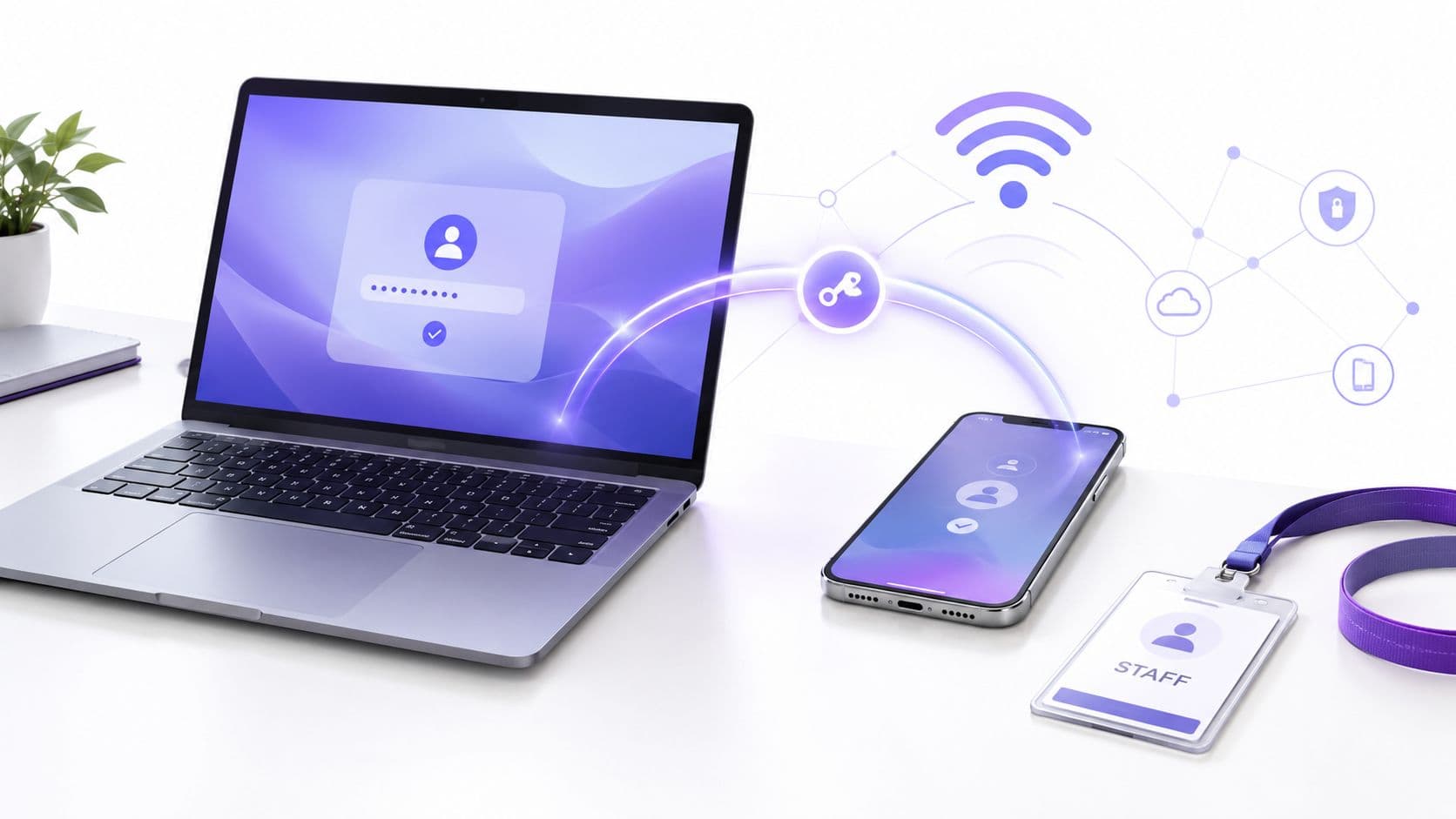
- 4Move from SMS codes and push approvals to FIDO2 passkeys or certificate-based sign-in. (+9 points)
- 5Automate leaver offboarding in Entra ID or Okta so network and SaaS access is revoked at once.
- 6Run regular phishing simulations and keep an incident contact route that works outside the VPN.
Purple connects to Microsoft Entra ID, Okta and Google Workspace for 802.1X certificate provisioning, BYOD onboarding and per-user network access, with cloud RADIUS instead of on-premises servers.
The shift to hybrid and remote working has permanently dissolved the traditional corporate network perimeter. When employees operate from home offices, co-working spaces, and public venues, critical company data traverses networks outside the direct control of IT and security teams. This distributed model introduces complex vulnerabilities: unencrypted home networks, rogue public hotspots, unmanaged mobile devices, and sophisticated credential-harvesting attacks.
According to cybersecurity benchmarks from the UK National Cyber Security Centre (NCSC) and NIST SP 800-63B, securing a remote workforce requires moving beyond static perimeter defenses towards a zero-trust model. In a zero-trust architecture, no user, device, or network is implicitly trusted, whether inside the office or operating across public internet connections.
Here are six enterprise safeguards to protect corporate data in remote and hybrid work environments.
1. Transition from legacy perimeter VPNs to Zero Trust Network Access (ZTNA)
For decades, enterprise remote connectivity relied on full-tunnel Virtual Private Networks (VPNs). While VPNs encrypt data in transit between the client device and the corporate gateway, they present a dangerous architectural flaw - once authenticated, the remote client is granted broad broadcast access across the entire internal subnet.
If an attacker compromises a single remote laptop or steals VPN credentials, they can move laterally across internal databases, file shares, and administrative dashboards. Zero Trust Network Access (ZTNA) eliminates this risk by replacing flat network perimeters with micro-segmented, application-specific connections:
- Least-privilege application access: Remote staff only connect directly to authorized applications (such as CRM or ERP platforms) without gaining visibility into the underlying network topology.
- Continuous context-aware evaluation: ZTNA gateways continuously assess user identity, device compliance, geographic location, and threat telemetry before and during active sessions.
- Cloaked infrastructure: Internal services remain hidden behind outbound-only reverse tunnels, preventing port scanning and internet-wide discovery by external adversaries.
2. Mandate phishing-resistant multi-factor authentication (FIDO2 & PKI certificates)
Compromised credentials remain the leading initial access vector in remote enterprise breaches. Relying solely on static passwords creates unacceptable risk. However, not all multi-factor authentication (MFA) mechanisms provide equal protection.
Legacy MFA methods - specifically SMS text codes and automated voice calls - are explicitly deprecated by NIST SP 800-63B guidelines due to known vulnerabilities, including SIM swapping, SS7 telecommunication interception, and adversary-in-the-middle (AiTM) proxy phishing. Modern organizations must enforce phishing-resistant authentication across all remote access points:
- FIDO2 / WebAuthn passkeys: Cryptographically binds authentication credentials to the legitimate domain origin, rendering credential-harvesting phishing sites completely ineffective.
- 802.1X EAP-TLS client certificates: Issues managed digital device certificates via public key infrastructure (PKI) to guarantee that only pre-approved corporate endpoints can initiate network handshakes.
- Identity provider synchronization: Connects authentication flows directly to enterprise identity directories, such as Microsoft Entra ID, Okta, or Google Workspace.
3. Secure wireless connections with WPA3-Enterprise and Cloud RADIUS
Remote employees routinely connect to residential broadband routers, public airport networks, and hospitality hotspots. Standard home and coffee shop networks present severe security gaps, including default router passwords, outdated WPA2-PSK passphrases shared among hundreds of guests, and exposure to Evil Twin access point spoofing.
To eliminate eavesdropping and man-in-the-middle attacks on wireless traffic, IT leaders should implement enterprise WiFi security and Cloud RADIUS protocols:
- WPA3-Enterprise encryption: Utilizes 192-bit cryptographic suites and Galois/Counter Mode Protocol (GCMP-256) to ensure unique, session-specific encryption keys for each connected client.
- Cloud RADIUS over TLS (RadSec): Secures authentication traffic over encrypted TLS tunnels (RFC 6614), allowing remote branch offices and hybrid staff to authenticate against central directory services without maintaining vulnerable on-premises RADIUS servers.
- Automated network profile provisioning: Delivers pre-configured wireless security profiles to employee devices via Mobile Device Management (MDM), removing manual password entry and preventing connection to rogue SSIDs.
4. Enforce centralized endpoint posture checking and full-disk encryption
A secure network tunnel offers little protection if the endpoint connecting to it is infected with keyloggers or ransomware. In remote work models, organizations must maintain strict visibility and control over all physical endpoints accessing company assets.
Enterprise IT teams should implement unified endpoint management (UEM) and Endpoint Detection and Response (EDR) platforms:
- Mandatory full-disk encryption: Enforce BitLocker on Windows and FileVault on macOS to ensure that lost or stolen laptops cannot be physically extracted for data.
- Continuous posture validation: Automatically verify that remote devices run the latest operating system security patches, active firewalls, and certified EDR agents before granting access to corporate applications.
- Remote wipe and isolation capabilities: Allow security administrators to instantly lock, isolate, or remotely wipe corporate containers on lost, stolen, or compromised devices.
5. Deploy Data Loss Prevention (DLP) and Cloud Access Security Brokers (CASB)
Remote work increases the risk of data leakage through unapproved personal cloud services, unmanaged USB drives, and unauthorized file sharing (Shadow IT). Protecting sensitive intellectual property and customer personally identifiable information (PII) requires proactive data protection policies.
Cloud Access Security Brokers (CASB) and Data Loss Prevention (DLP) solutions provide necessary visibility:
- Granular upload/download restrictions: Prevent remote workers from downloading sensitive database exports to local personal drives or uploading company documents to personal cloud storage.
- Contextual clipboard and screenshot controls: Restrict clipboard copying, screen captures, and printing for highly regulated financial and medical data within virtual desktop environments.
- Automated data classification: Automatically scan and classify files in transit for compliance with CCPA/CPRA, HIPAA, and ISO/IEC 27001 data protection standards.
6. Automate user lifecycle provisioning and instant access revocation
One of the most overlooked security risks in remote workforces is the delay in revoking access credentials upon employee departure or role transition. Industry studies show that over 20% of former employees retain access to at least one corporate application after leaving an organization.
Organizations must establish automated identity lifecycle pipelines to eliminate orphaned accounts and stale permissions:
- SCIM directory automation: Implement System for Cross-domain Identity Management (SCIM) to synchronize HR management systems directly with identity providers and SaaS platforms in real time.
- Instant single-click de-provisioning: When an employee departs, deactivating their central identity immediately revokes all active SSO sessions, invalidates 802.1X certificates, terminates VPN/ZTNA tunnels, and triggers an automated device wipe.
- Routine access reviews: Schedule quarterly permission audits to ensure staff hold only the minimum necessary privileges required for their current role.
Legacy remote security vs Zero-Trust enterprise architecture
Building a resilient distributed security posture
Securing remote work is not a one-off IT checklist - it is a continuous, identity-centric security posture. By combining Zero Trust Network Access, phishing-resistant authentication, centralized endpoint management, and WPA3-Enterprise wireless encryption, organizations protect sensitive assets while empowering distributed teams to work productively from any location.
Explore Purple's Enterprise WiFi Security Guide to learn how cloud identity management and automated 802.1X network access keep hybrid organizations secure.