
Gerenciamento de WiFi para Hóspedes de Hotel: Integrando PMS, Portais e Padrões de Marca
Este guia técnico detalha como arquitetar redes WiFi corporativas para hotéis, concentrando-se em segmentação de VLAN, integração de PMS para gerenciamento automatizado de sessões e otimização de Captive Portal para captura de dados em conformidade com a GDPR.
Video overview
Ouça este guia
Ver transcrição do podcast
Parte da nossa série principal: Guia de Guest WiFi →
Resumo Executivo
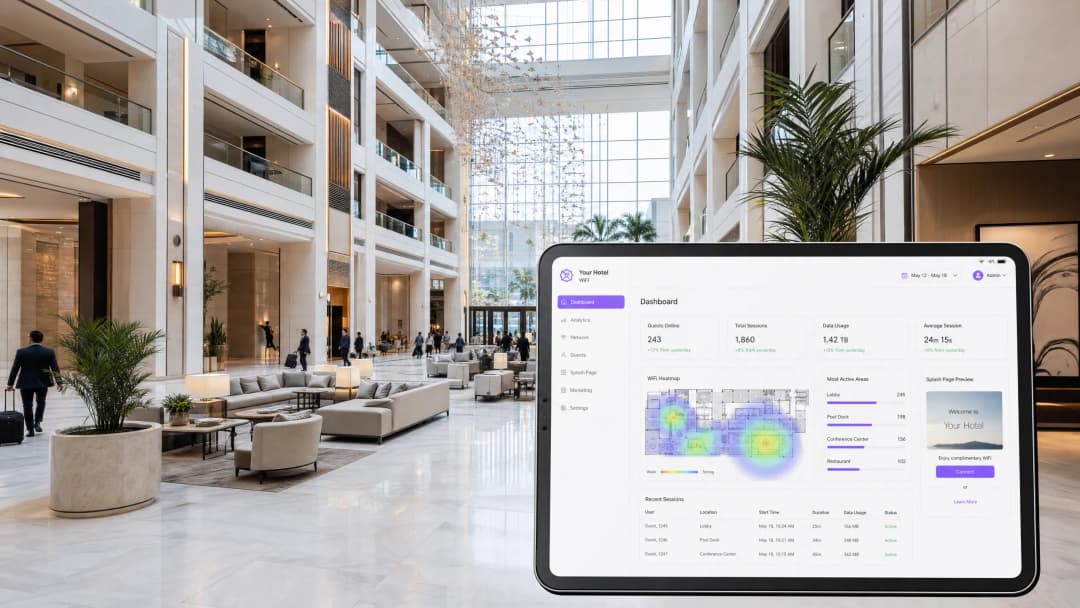
O WiFi para hóspedes de hotéis não é mais apenas um serviço utilitário; é um sistema operacional crítico e um canal primário para captura de dados primários (first-party data). Este guia de referência técnica detalha como projetar, implantar e gerenciar WiFi de classe empresarial em ambientes de hospitalidade. Ele aborda segmentação de rede, integração com Sistema de Gestão de Propriedade (PMS), otimização de Captive Portal e a aplicação de padrões de marca em toda a rede de hotéis. Para diretores de TI, arquitetos de rede e diretores de operações, o objetivo é claro: fornecer uma conexão rápida e segura que se integre perfeitamente com sua infraestrutura de Guest WiFi enquanto captura dados em conformidade para alimentar sua plataforma de WiFi Analytics.
Quer você gerencie um hotel boutique ou um portfólio global de 500 propriedades, os requisitos técnicos são os mesmos: isolar o tráfego, automatizar o gerenciamento de sessões via PMS e aplicar políticas de segurança consistentes. A Purple fornece a camada de nuvem agnóstica de hardware que torna isso possível em implantações Cisco Meraki, HPE Aruba, Ruckus, Juniper Mist, Ubiquiti UniFi, Cambium, Extreme e Fortinet.
Detalhamento Técnico
Segmentação de Rede e Arquitetura de VLAN
Uma rede plana em um ambiente hoteleiro representa uma vulnerabilidade de segurança grave e uma falha de conformidade. Uma rede hoteleira deve atender a diferentes populações: hóspedes, funcionários, sistemas de gerenciamento predial e dispositivos IoT. A base de um WiFi de hotel seguro é a segmentação lógica usando Redes Locais Virtuais (VLANs), conforme definido pelo padrão IEEE 802.1Q.
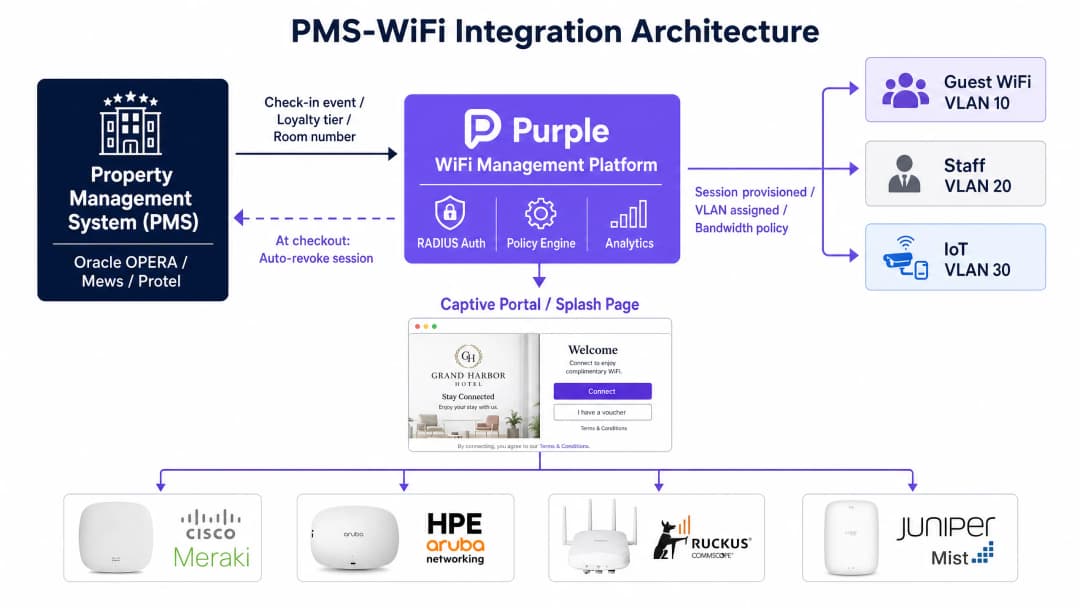
Você deve atribuir uma VLAN dedicada para cada classe de tráfego. Uma implantação padrão requer pelo menos quatro VLANs: Guest WiFi, Funcionários, Sistemas IoT/Prediais e uma rede com escopo PCI para terminais de pagamento. Seu firewall deve aplicar uma política de negação por padrão (default-deny) entre esses segmentos. O tráfego de hóspedes deve ser roteado diretamente para a internet, totalmente isolado do sistema de gestão de propriedade, terminais de ponto de venda (POS) e comunicações da equipe.
Para a borda sem fio, cada Identificador de Conjunto de Serviços (SSID) é mapeado para uma VLAN específica. No SSID de hóspedes, você deve ativar o isolamento de clientes. O isolamento de clientes impede que os dispositivos no mesmo SSID se comuniquem diretamente entre si, mitigando o risco de um dispositivo comprometido sondar outros hóspedes.
Integração de PMS e Gerenciamento Automatizado de Sessões
A integração entre sua plataforma de gerenciamento de WiFi e seu Sistema de Gestão de Propriedade (PMS) - como Oracle OPERA, Mews ou Protel - é o elemento central de uma rede de hospitalidade moderna. O PMS detém a verdade absoluta sobre a identidade do hóspede, atribuição de quarto, status de check-in e nível de fidelidade.
Quando um hóspede faz o check-in, o PMS envia uma chamada de API ou webhook para a plataforma WiFi. A plataforma pré-provisiona a sessão do hóspede, aplicando a política de largura de banda correta com base em seu nível de fidelidade. Quando o hóspede se conecta, a autenticação é contínua. Fundamentalmente, quando o hóspede faz o check-out, o PMS sinaliza à plataforma WiFi para revogar o acesso imediatamente. Isso elimina o risco de segurança de credenciais ativas e evita que antigos hóspedes consumam largura de banda.
Captive Portals e Captura de Dados de First-Party
O Captive Portal é o portal de entrada onde o investimento em infraestrutura se converte em valor comercial. Ele não é apenas um mecanismo de controle de acesso; é o seu principal motor para captura de dados de first-party.
Os hóspedes se autenticam via e-mail, login social ou verificação por SMS. Isso captura uma identidade verificada, que é então vinculada ao endereço MAC do dispositivo, registro de data/hora da visita e tempo de permanência. Esses dados alimentam diretamente o seu CRM, permitindo e-mails direcionados pré-estadia, pesquisas pós-estadia e ofertas baseadas em localização.
A conformidade não é negociável. Um Captive Portal em conformidade com a GDPR deve apresentar um aviso de privacidade claro e capturar consentimento explícito e desmembrado para comunicações de marketing. O consentimento para acessar o WiFi não deve ser condicionado ao consentimento para receber marketing. A Purple gerencia isso nativamente, mantendo trilhas de auditoria detalhadas para cada perfil de usuário.
Tem dúvidas sobre a sua configuração específica?
A nossa equipa trabalha com operadores de espaços, gestores de TI e engenheiros de rede em 80.000 locais. Agende uma chamada de 20 minutos e mostraremos como outros profissionais na sua situação o resolveram.
Guia de Implementação
Fase 1: Levantamento de Campo e Planejamento de Capacidade
Antes de configurar qualquer hardware, realize um levantamento de campo (site survey) de RF detalhado usando ferramentas de modelagem preditiva. Para ambientes hoteleiros, o foco é a cobertura dentro do quarto. Implante um ponto de acesso (AP) por quarto, ou no mínimo um AP para cada dois quartos. Evite o posicionamento em corredores, o que cria áreas de sombra na cobertura e degrada o desempenho. Dimensione seu link de internet para o pico de uso simultâneo. Planeje de 5 a 10 Mbps por quarto; uma propriedade de 200 quartos exige um link dedicado contratado de 800 Mbps a 1.6 Gbps.
Fase 2: Arquitetura e Design de Políticas
Mapeie cada tipo de dispositivo para uma VLAN dedicada. Documente suas regras de roteamento inter-VLAN e políticas de firewall de bloqueio padrão (default-deny). Determine seus padrões de autenticação: WPA3-Enterprise com IEEE 802.1X para redes de funcionários, e WPA3-Personal ou uma rede aberta com aplicação de HTTPS e isolamento de clientes para hóspedes.
Fase 3: Integração de PMS e Portal
Configure a conexão de API entre seu PMS e a plataforma de WiFi. Desenhe o captive portal para alinhar-se aos padrões da marca. Teste a jornada completa do hóspede em dispositivos iOS, Android e Windows. Verifique se a revogação de sessão é acionada corretamente após o checkout no PMS.
Melhores Práticas
- Force o Isolamento de Clientes: Sempre habilite o isolamento de clientes em SSIDs voltados para hóspedes para evitar a movimentação lateral entre dispositivos.
- Automatize o Acesso Baseado em Funções: Use autenticação IEEE 802.1X e RADIUS para redes de funcionários. Integre com o Microsoft Entra ID, Okta ou Google Workspace para atribuir VLANs e políticas de QoS de forma dinâmica com base nas funções dos usuários.
- Centralize os Padrões da Marca: Use uma plataforma gerenciada na nuvem com um mecanismo de política hierárquico. Defina SSIDs, protocolos de segurança e a identidade visual do captive portal no nível da matriz, permitindo a herança regional ou por propriedade sem quebrar os padrões da marca.
- Separe o Tráfego de IoT: Isole TVs inteligentes, termostatos e assistentes de voz em uma VLAN de IoT dedicada com filtragem rigorosa de saída.

Resolução de Problemas e Mitigação de Riscos
- Velocidades Lentas: A causa mais comum de WiFi lento em hotéis é um link de WAN subdimensionado, não a interferência de RF. Monitore a utilização do seu circuito de internet. Se o link estiver saturado, atualizar os pontos de acesso não melhorará a experiência do hóspede.
- Falha de Segmentação: Portas de tronco de switch configuradas incorretamente podem colapsar múltiplas VLANs em um único domínio de broadcast, quebrando silenciosamente a sua segmentação. Audite as configurações dos switches regularmente.
- Fricção na Autenticação: Um Captive Portal que exige a inserção excessiva de dados fará com que os hóspedes abandonem o processo de conexão. Mantenha o formulário conciso.
ROI e Impacto nos Negócios
Uma rede WiFi hoteleira arquitetada corretamente entrega retornos mensuráveis. Ela reduz os chamados de suporte de TI relacionados a problemas de conectividade, impulsionando a eficiência operacional. Melhora as pontuações de satisfação dos hóspedes, que se correlacionam diretamente com o RevPAR. Mais importante ainda, gera um banco de dados em conformidade de first-party com hóspedes verificados, reduzindo a dependência de agências de viagens online (OTAs) e impulsionando campanhas de marketing de reserva direta.
Definições principais
VLAN (Virtual Local Area Network)
Uma sub-rede lógica que agrupa uma coleção de dispositivos de diferentes LANs físicas. Essencial para isolar o tráfego de hóspedes dos sistemas operacionais.
Utilizada para separar o WiFi de hóspedes, dispositivos de funcionários, hardware de IoT e terminais de pagamento em domínios de broadcast isolados para segurança e conformidade com PCI.
PMS (Property Management System)
A plataforma de software central utilizada por hotéis para gerenciar reservas, check-ins, faturamento e status dos quartos.
A integração do PMS com a plataforma de WiFi permite o provisionamento automatizado de sessões, alocação de largura de banda por categoria de fidelidade e revogação imediata de acesso no checkout.
Captive Portal
Uma página web que os usuários devem visualizar e interagir antes que o acesso seja concedido a uma rede WiFi pública.
Utilizado no setor de hospitalidade para autenticar hóspedes, apresentar termos de serviço e capturar dados de marketing primários (first-party).
Isolamento de Cliente
Um recurso de segurança de rede sem fio que impede que os dispositivos conectados se comuniquem diretamente entre si.
Obrigatório em SSIDs de hóspedes para impedir que um dispositivo comprometido faça varreduras ou ataque outros hóspedes na mesma rede.
IEEE 802.1X
Um padrão IEEE para Controle de Acesso à Rede baseado em porta, fornecendo um mecanismo de autenticação para dispositivos que desejam se conectar a uma LAN ou WLAN.
O padrão ouro para autenticação de rede de funcionários, permitindo a atribuição dinâmica de VLAN com base na função do usuário definida em um provedor de identidade como o Microsoft Entra ID.
RADIUS (Remote Authentication Dial-In User Service)
Um protocolo de rede que fornece gerenciamento centralizado de Autenticação, Autorização e Contabilização para usuários que se conectam e utilizam um serviço de rede.
Utilizado em conjunto com o 802.1X para verificar as credenciais dos funcionários e aplicar políticas de rede específicas.
SSID (Service Set Identifier)
O nome público de uma rede sem fio.
Os hotéis normalmente transmitem múltiplos SSIDs (por exemplo, 'Guest WiFi', 'Rede de Funcionários'), cada um mapeado para uma VLAN específica.
WPA3-Enterprise
O nível mais alto de segurança WiFi, exigindo que cada usuário se autentique com credenciais exclusivas em vez de uma senha compartilhada.
Necessário para redes operacionais e de funcionários para garantir a responsabilidade individual e permitir a aplicação de políticas dinâmicas.
Exemplos práticos
Um hotel boutique de 150 quartos que utiliza Oracle OPERA precisa de uma implantação de WiFi segura que diferencie a largura de banda para membros do programa de fidelidade e revogue automaticamente o acesso no checkout.
Implante um ponto de acesso WiFi 6 por quarto. Configure quatro VLANs: Guest (VLAN 10), Staff (VLAN 20), IoT (VLAN 30) e POS (VLAN 40). Integre a plataforma Purple com o Oracle OPERA via API. Quando um hóspede faz o check-in, o OPERA envia a categoria de fidelidade para o Purple. O Purple provisiona a sessão, aplicando uma política de 50 Mbps para hóspedes padrão e uma política de 100 Mbps para membros premium. No checkout, o OPERA dispara uma chamada de API que revoga imediatamente a sessão do endereço MAC no Purple.
Uma marca global de hotéis com 400 propriedades precisa garantir uma identidade visual consistente no Captive Portal e conformidade com a GDPR em todos os locais, apesar de utilizar diferentes ISPs locais e fornecedores de hardware (Cisco Meraki, HPE Aruba e Ruckus).
Implemente uma plataforma de sobreposição em nuvem como o Purple acima da camada de hardware heterogênea. Defina um modelo de política global na sede da marca que dite o nome do SSID, o design do Captive Portal e as caixas de seleção específicas de consentimento da GDPR. Aplique este modelo hierarquicamente a todas as 400 propriedades. As equipes locais de TI podem gerenciar seus APs e switches específicos, mas não podem alterar o fluxo do Captive Portal ou os requisitos de captura de dados.
Questões práticas
Q1. Um hotel está atualizando sua rede para suportar check-in móvel e chaves digitais nos quartos. A equipe de TI planeja colocar as fechaduras eletrônicas na mesma VLAN que o WiFi de convidados para simplificar o roteamento. Qual é o principal risco dessa abordagem?
Dica: Considere o princípio da segmentação lógica e do movimento lateral.
Ver resposta modelo
Colocar dispositivos IoT, como fechaduras eletrônicas, na VLAN de convidados expõe a infraestrutura crítica do edifício a dispositivos não confiáveis. O smartphone de um convidado comprometido poderia tentar investigar ou atacar as fechaduras. A abordagem correta é colocar as fechaduras em uma VLAN de IoT dedicada (por exemplo, VLAN 30) com filtragem estrita de entrada/saída, totalmente isolada da VLAN de convidados.
Q2. Um gerente regional relata que o WiFi em uma propriedade de 300 quartos está "muito lento", apesar das atualizações recentes para pontos de acesso WiFi 6 nos corredores. Quais são as duas causas arquitetônicas mais prováveis para esse desempenho insatisfatório?
Dica: Considere tanto a capacidade da WAN quanto os princípios de propagação de RF.
Ver resposta modelo
Primeiro, o uplink de internet provavelmente está subdimensionado. Uma propriedade de 300 quartos requer um link dedicado de pelo menos 1.5 Gbps para lidar com picos de streaming simultâneos. Segundo, o posicionamento dos APs nos corredores é um design falho; o sinal de RF se degrada significativamente ao passar por portas corta-fogo pesadas e pelo encanamento dos banheiros. Os APs devem ser realocados para os quartos de hóspedes.
Q3. A equipe de marketing deseja atribuir automaticamente os hóspedes recorrentes a uma faixa de largura de banda maior para recompensar a fidelidade. Como a arquitetura de rede deve ser projetada para suportar esse requisito?
Dica: Qual sistema contém a fonte da verdade para a identidade do hóspede e como ele se comunica com a rede?
Ver resposta modelo
A arquitetura requer uma integração de API entre o Property Management System (PMS) e a plataforma de gerenciamento de WiFi. Quando o hóspede se conecta, a plataforma WiFi consulta o PMS usando o endereço MAC do dispositivo ou o e-mail autenticado. O PMS retorna o status de fidelidade do hóspede, e a plataforma WiFi aplica dinamicamente uma política de QoS para alocar maior largura de banda.
Continue a ler esta série
Staff WiFi vs. Guest WiFi: Melhores Práticas para Segmentação de Rede Corporativa
Um guia técnico abrangente para líderes de TI sobre segmentação de redes WiFi de funcionários e visitantes. Ele abrange arquitetura de VLAN, autenticação 802.1X, políticas de firewall e o impacto comercial do design de rede seguro.
Como Configurar WiFi de Visitantes: Um Guia de Configuração Corporativa Segura
Este guia definitivo oferece aos líderes de TI e arquitetos de rede um modelo claro para implantar WiFi de visitantes corporativo seguro. Ele aborda arquitetura essencial, migração para WPA3, segmentação de VLAN e integração de Captive Portal para proteger sistemas internos enquanto coleta dados primários em conformidade.
Como Corrigir WiFi Lento Sem Fazer Upgrade do Seu Plano de Internet
Um guia de referência técnica abrangente para gerentes de TI e arquitetos de rede sobre como otimizar o desempenho do WiFi corporativo sem aumentar a largura de banda do provedor de internet. Abrange ajuste de RF, gerenciamento de densidade de clientes, implementação de QoS e como utilizar WiFi analytics para diagnosticar e resolver gargalos.
Tem dúvidas sobre a sua configuração específica?
A nossa equipa trabalha com operadores de espaços, gestores de TI e engenheiros de rede em 80.000 locais. Agende uma chamada de 20 minutos e mostraremos como outros profissionais na sua situação o resolveram.