
Mesh Network对比Access Points:大型场馆如何抉择?
本技术指南提供了大型场馆中Mesh Network与传统有线Access Points之间的权威对比,涵盖架构、性能权衡和部署策略。它为IT经理、网络架构师和CTO提供了可操作的框架,以便为酒店、零售、活动和公共部门环境设计高性能、符合合规要求的WiFi基础设施。该指南还将这些架构决策与Purple的硬件无关型客用WiFi和分析平台相结合,展示了合适的基础设施选择如何推动可衡量的业务成果。
Video overview
收听本指南
查看播客转录
核心系列的一部分:客用WiFi指南 →
Venue WiFi Architecture Advisor: Mesh vs Wired AP Calculator
Compare wireless mesh backhaul degradation against wired PoE access points. Model throughput loss per hop, latency penalties, roaming handover success, structured cabling investment, and 3-year total cost of ownership.
Multi-floor hospitality venue requiring guest captive portal onboarding, PMS billing integration, and consistent in-room streaming.
A shared radio carries client traffic and backhaul at once, so each hop is half-duplex. This is the largest single determinant of mesh throughput.
25 nodes puts the furthest ones 4 wireless hops from the gateway, where roaming succeeds 68% of the time and the edge keeps 179 Mbps of the 1000 Mbps uplink. A mesh this deep cannot hold a consistent SLA across the estate; cable the APs and let the controller coordinate 802.11k/v/r.
Side-by-Side Technical Comparison for 45,000 sq ft Venue
| Metric / Feature | Wired Enterprise APs (PoE) | Wireless Mesh Network |
|---|---|---|
| Backhaul Type | Dedicated Cat6/Cat6A Gigabit (1G/2.5G/10G) Full Duplex | Shared RF Airtime / Wireless 5GHz or 6GHz Hops |
| Edge Throughput | 1000 Mbps (100% capacity) | 1000 Mbps on the wired root node, falling to 179 Mbps at the edge (4 hops on a dedicated tri-band backhaul, -82%) |
| Network Latency | 14ms (Deterministic switched LAN) | 74ms (+15ms per wireless relay hop) |
| Max Concurrency / AP | 150+ devices (MU-MIMO, OFDMA scheduled) | ~25 devices (Airtime starvation risk) |
| Roaming Protocol | 802.11k/v/r Seamless Fast Transition (<50ms) | Client-driven roaming / Sticky clients common |
| Network Segmentation | 802.1Q Multi-VLAN (Staff, Guest, IoT, POS) | Limited single guest SSID isolation |
| Power Delivery | PoE/PoE+ from central UPS-backed switch | Individual AC wall outlets required per node |
Planning a Venue WiFi Network Upgrade?
Purple pairs with leading enterprise AP vendors to deliver automated guest splash pages, CRM profile capture, and location analytics.
决策摘要
对于管理大型场所 - 体育场馆、Retail 连锁、Hospitality 综合体、Transport 枢纽和会议中心 - 的IT经理和CTO而言,选择正确的无线架构是一项高风险的资本决策。部署**网状网络(Mesh Network)还是传统的有线接入点(APs)**之间的争论,从根本上影响着资本支出(CapEx)、运营可靠性以及最终用户体验。
传统AP通过专用以太网回传提供确定性的性能和无与伦比的吞吐量,而网状网络则在布线成本过高或物理上无法实现的环境中,提供了快速部署能力和灵活性。本指南将剖析这两种架构的技术现状,提供实用的框架,帮助您使硬件策略与场所的具体密度、延迟和合规性要求相匹配。至关重要的是,正确的网络基础设施选择还决定了您如何有效地利用 Guest WiFi 和 WiFi Analytics 等平台来捕获用户数据并实现可衡量的业务成果。
技术深度剖析
传统接入点(AP)架构
在传统部署中,每个接入点都通过有线方式连接回边缘或核心交换机,通常使用端接至8P8C (RJ-45)连接器的Cat6或Cat6a电缆。这种有线回传可确保AP 100%的射频(RF)容量都专门用于为客户端设备提供服务。
**吞吐量与延迟:**由于回传流量完全由物理导线处理,传统AP可提供确定性的、多千兆位的吞吐量。现代WiFi 6 (IEEE 802.11ax) AP在多个空间流中支持高达9.6 Gbps的聚合吞吐量,而WiFi 7 (IEEE 802.11be)通过多链路操作(MLO)进一步提升了这一性能。这种架构对于亚10毫秒(sub-10ms)延迟至关高要求的密集型环境至关重要 - 销售点(POS)系统、实时分析仪表盘和VoWLAN部署都依赖于它。
**供电与基础设施:**这种方法需要强大的以太网供电(PoE)基础设施。具有完整射频链的现代WiFi 6和WiFi 7 AP通常需要PoE+ (IEEE 802.3at, 30W)或PoE++ (IEEE 802.3bt, 高达90W)才能满负荷工作,因此在进行任何硬件升级之前,必须进行周密的交换机端口和电力预算规划。
**安全态势:**有线回传从根本上减少了物理攻击面。结合IEEE 802.1X基于端口的认证和WPA3-Enterprise加密,该架构为满足PCI-DSS和GDPR合规性提供了最强大的基准。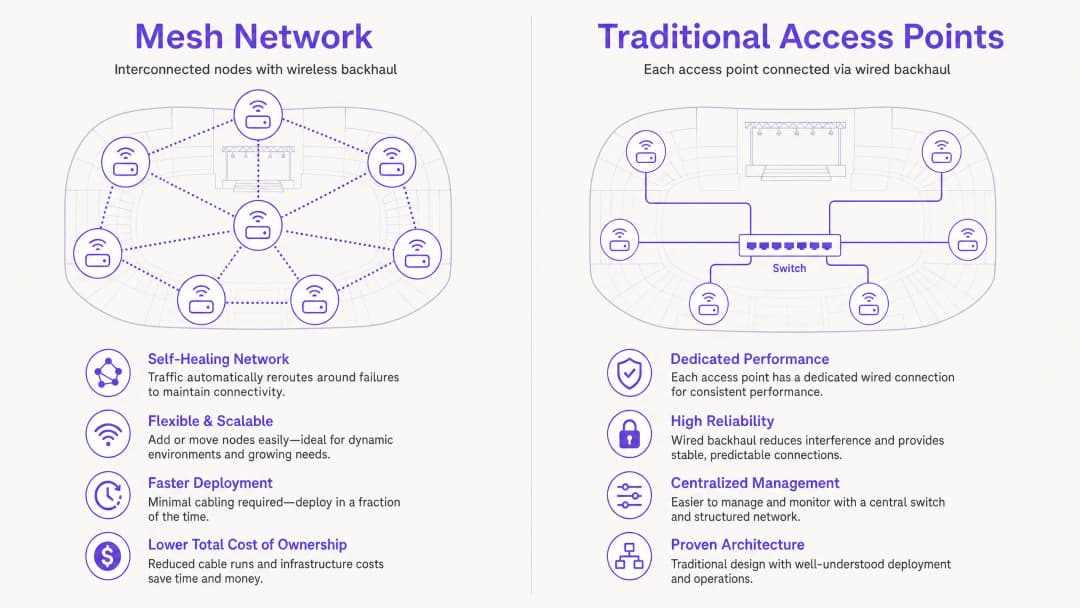
Mesh网络架构
Mesh网络用无线链路取代了有线回传。典型的企业级部署包括一个连接到有线局域网的根节点,该节点向分布在整个场所的卫星节点无线传输数据。
**半双工惩罚:**WiFi本质上是半双工的。在标准的双频Mesh系统中,射频必须在服务客户端设备和向链中的下一个节点转发流量之间交替进行。每一次无线跳跃实际上都会使可用吞吐量减半,并增加 1 - 5 毫秒的额外延迟。在拥有数千名并发用户的高密度环境中,这种延迟会迅速堆积,并在业务运行中产生显著影响。
**三频缓解:**企业级Mesh系统通过利用专用的第三个射频(通常在 5GHz 或 6GHz 频段运行)专门用于回传流量来缓解这一问题。这可以防止回传与面向客户端的射频争夺空口时间。虽然这比消费级Mesh显著提高了性能,但它仍然消耗宝贵的射频频谱,并且无法与高密度环境中有线连接的原始、确定性容量相媲美。
**自愈拓扑:**Mesh的一个关键弹性优势是其自愈能力。如果卫星节点失去其主要回传链路,它可以自动通过相邻节点重新路由流量。这在可能发生物理中断的动态或临时场所配置中特别有用。
性能横向对比
| 属性 | 传统有线AP | 企业级Mesh网络 |
|---|---|---|
| 回传类型 | 有线 (Cat6/Cat6a) | 无线(专用射频) |
| 每个AP的吞吐量 | 高达 9.6 Gbps | 每跳减少约 50% |
| 延迟 | 5毫秒以下(确定性) | 5 - 20毫秒(可变) |
| 部署速度 | 慢(需要布线) | 快(仅需电源) |
| 资本支出 (CapEx) | 高(布线 + 交换机) | 较低(极少布线) |
| 运营成本 (OpEx) | 低(高可靠性) | 中等(射频调优) |
| 高密度适用性 | 极佳 | 有限 |
| 灵活性 / 可扩展性 | 低(固定线缆走向) | 高(节点位置可调) |
| PCI-DSS / GDPR合规性 | 简单直接 | 通过配置可实现 |
对您的具体配置有疑问吗?
我们的团队与 80,000 多个场所的运营方、IT 经理和网络工程师保持合作。预约 20 分钟的通话,我们将为您展示同行是如何解决类似问题的。
实施指南
步骤 1:射频预测性规划与密度绘制
在选择硬件之前,请使用 Ekahau Pro 或 iBwave 等工具进行预测性射频现场勘测。将您的场所划分为不同的区域:
- **高密度区域:**会议厅、体育场看台、酒店大堂、零售收银区。这些区域需要有线AP。
- **中等密度区域:**酒店走廊、零售卖场、办公翼楼。优选有线AP;Mesh可行。
- 难以布线/临时区域: 户外露台、历史建筑翼楼、临时活动空间。Mesh 网络是实用的选择。
步骤 2:架构选择与混合设计
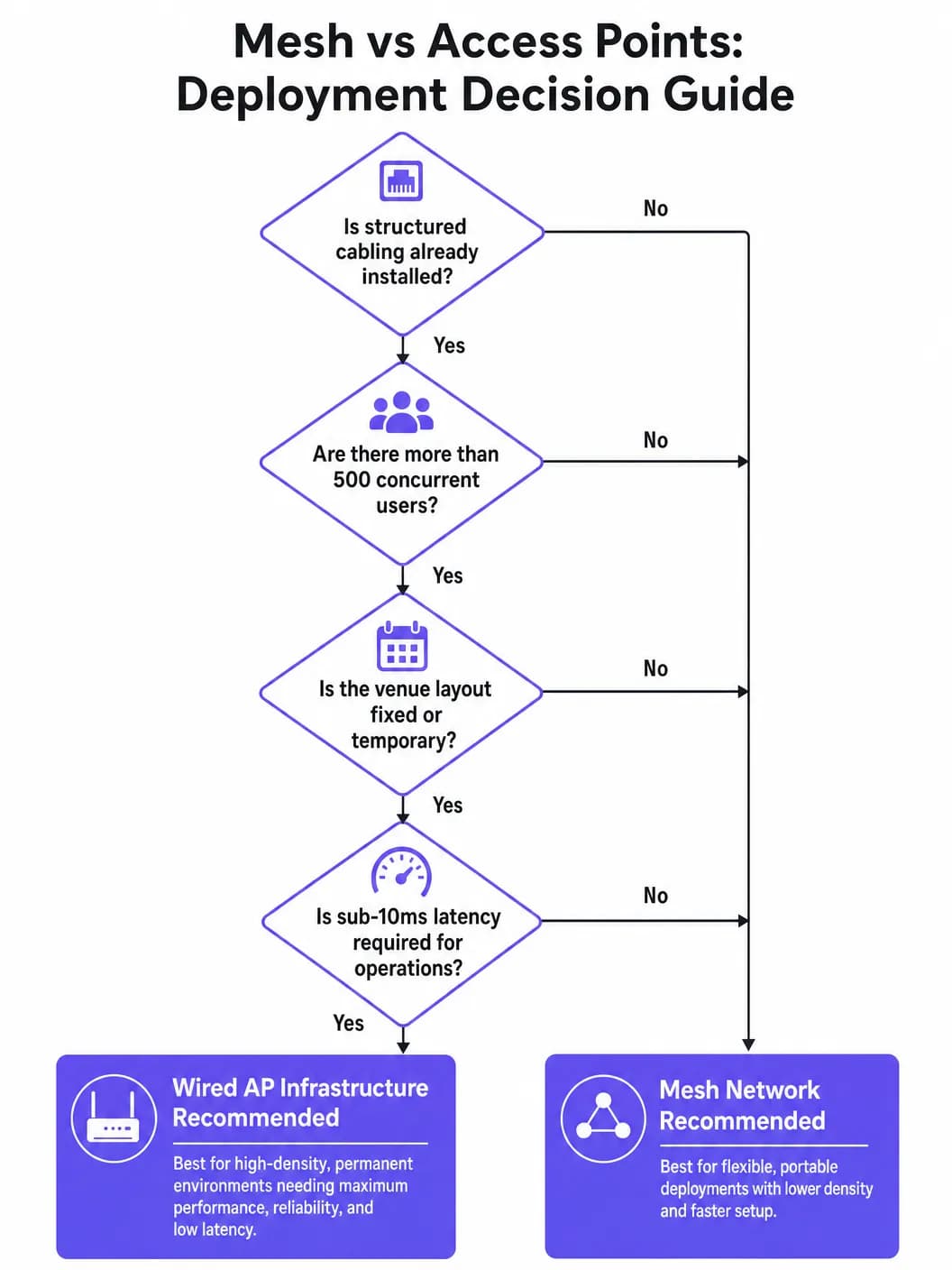
对于大多数大型场所而言,混合架构是最佳方案:在高密度核心区域使用有线 AP,并利用 Mesh 节点将覆盖范围延伸至周边或受限区域。这种方法在资金效率与性能之间取得了完美平衡。
步骤 3:回传基础设施容量规划
对于有线部署,请确保您的边缘交换机提供充足的 PoE 预算。一个提供 90W 单端口预算、配备 2.5GbE 或 10GbE 上行链路至核心交换机的 48 端口 PoE++ 交换机,是现代 Wi-Fi 6/7 部署的推荐基准。对于 Mesh 网络,请确保根节点通过万兆/多千兆上行链路连接,以处理来自所有卫星节点的聚合流量。
步骤 4:安全与合规配置
无论采用何种架构,都请配置以下内容:
- 在所有企业和运营 SSID 上启用 WPA3-Enterprise。
- 使用 RADIUS 服务器(例如 FreeRADIUS、Cisco ISE 或云端托管的同等产品)进行 IEEE 802.1X 设备认证。
- 实施 VLAN 隔离,将访客流量与 POS 和后勤系统隔离开来。这是满足 PCI-DSS 合规要求的强制性控制措施。
- 部署 无线入侵防御系统 (WIPS) 以检测并遏制流氓 AP。
步骤 5:平台集成
硬件层是基础,而商业价值则在软件层得以释放。请确保您选择的 AP 厂商固件支持您的访客 WiFi 和分析平台所需的 API 集成。Purple 平台兼容各种硬件,支持包括 Cisco Meraki、Aruba、Ruckus 和 Ubiquiti 在内的各大主流厂商。这使您无论选择何种底层硬件,都能够收集访客数据、运行 Captive Portal 流程并提供 WiFi 仪表盘分析。要深入了解管理架构对此有何影响,请参阅《比较基于控制器与云管理的接入点》。
最佳实践
将 Mesh 跳数限制在三跳以内。 在设计 Mesh 网络时,切勿允许从卫星节点返回根节点的无线跳数超过三跳。超过三跳后,延迟将变得让企业级应用无法接受,且吞吐量会退化到严重影响用户体验的程度。
在进行任何硬件升级前进行 PoE 预算审计。 在不升级边缘交换机的情况下直接升级到 Wi-Fi 6 或 Wi-Fi 7 AP 是一个常见且代价高昂的错误。新 AP 通常需要 PoE++ (802.3bt),而现有交换机可能仅支持 PoE+ (802.3at),这会导致 AP 在负载下不断重启。 在所有 SSID 上标准化 WPA3。 WPA3 的对等实体同时身份验证 (SAE) 握手消出了 WPA2 中存在的 KRACK 和字典攻击漏洞。对于根据 GDPR 处理支付数据或敏感个人数据的场所,这是不可逾越的安全基线。
将网状回传链路视为关键基础设施。 在网状网络部署中,节点之间的无线链路与电缆一样重要。需持续监控回传链路质量(RSSI、SNR 和 MCS 速率)。降级 decline 的回传链路会暗中限制连接到下游的每个客户端的性能。
利用硬件中立性进行供应商谈判。 通过将软件管理层(Purple 的平台)与硬件层分离,您可以在设备更新周期中保留切换硬件供应商的能力。这种竞争优势通常能在 5 年的 TCO 周期内降低 15% - 25% 的硬件成本。
故障排除与风险缓解
常见故障模式
隐藏节点问题。 在网状网络中,如果两个卫星节点无法“听到”彼此,但同时向同一个根节点传输数据,就会发生数据包冲突,从而破坏吞吐量。这在具有复杂射频环境的场所中尤为常见。缓解措施: 仔细进行射频微调、调整发射功率水平,并使用 RTS/CTS(请求发送/清除发送)机制。
PoE 预算耗尽。 如上所述,在旧版 PoE 基础设施上部署新的高功率 AP 会导致在负载下间歇性重启。缓解措施: 在部署前进行全面的 PoE 预算审核。计算所有连接设备在最坏情况下的总功耗,并对照交换机的总 PoE 预算进行评估。
流氓 AP 干扰。 在同一空域中广播的未管理消费级设备(尤其是在参展商或租户携带自己设备的场所)将严重降低网状回传和客户端访问的性能。缓解措施: 实施持续的 WIPS 扫描,并执行禁止未经授权无线设备的明确策略。
网状节点部署在盲区。 一个常见的部署错误是将网状卫星节点放置在它旨在解决的覆盖盲区中。如果节点无法接收到强大的回传信号,它就无法提供良好的客户端覆盖。缓解措施: 将卫星节点放置在根节点和盲区之间、且回传信号较强的位置,并依靠卫星节点的面向客户端射频来覆盖盲区。
ROI 与业务影响
在评估无线基础设施的 ROI 时,不要只看硬件的初始资本支出 (CapEx)。
| 成本类别 | 传统有线 AP | 网状网络 |
|---|---|---|
| 硬件资本支出 (CapEx) | 中等 | 较低 |
| 布线资本支出 (CapEx) | 高(每个信息点 $150 - $300) | 极低 |
| 安装人工 | 高 | 低 |
| 持续射频微调运营支出 (OpEx) | 低 | 中等 |
| 硬件生命周期 | 5 - 7 年 | 3 - 5 年 |
| 停机风险 | 低 | 中等 |
对于拥有 500 间客房并部署了 300 个 AP 的酒店而言,传统部署的仅线缆成本就可能达到 60,000 - 90,000 英镑。而在同一场所采用网状网络部署,则可将此项成本降至 10,000 英镑以下,这意味着极大的 CapEx 节省 - 前提是性能折中方案对于该使用场景是可接受的。
归根结底,基础设施是数据的载体。一个强大且设计良好的网络 - 无论是有限、网状网络还是混合网络 - 都能使场所捕获极具价值的访客分析数据、推动个性化营销并提高运营效率。像 Purple 的 Guest WiFi 这样的平台能够将网络从成本中心转变为创造收入的资产。有关利用这些数据的实用策略,请参阅 如何提高宾客满意度:终极指南。向无缝、免密码认证的演进进一步提升了这一价值,正如 WiFi 助手如何在 2026 年实现免密码访问 中所探讨的那样。
对于公共部门场所和智慧城市部署而言,网络基础设施在数字包容性计划中也发挥着基石作用,这是 Purple 正在积极推动的战略重点,正如 Purple 任命 Iain Fox 为公共部门增长副总裁以推动数字包容性与智慧城市创新 中所体现的那样。
音频简报
在这份 10 分钟的技术简报中,听听我们的高级解决方案架构师讨论架构上的细微差别:
关键定义
无线回传
使用无线通信将数据从接入点传输回核心网络,而不是使用物理以太网电缆。
网状网络(mesh network)的决定性特征。节省布线成本并实现灵活部署,但会消耗射频频谱并带来延迟。
三频无线电 (Tri-Band Radio)
配备三个独立无线电(通常是一个 2.4GHz 和两个 5GHz 或 6GHz 无线电)的接入点,允许将其中一个无线电专门用于无线回传流量。
对于企业级 mesh 网络至关重要。如果没有专用的回传无线电,由于 AP 必须在服务客户端和转发流量之间共享其无线电,面向客户端的吞吐量将严重下降。
确定性性能 (Deterministic Performance)
无论环境发生微小变化还是负载波动,延迟和吞吐量都可预测且保持一致的网络行为。
有线接入点的一个关键优势,对于 Voice over WLAN (VoWLAN)、实时 POS 系统以及任何对延迟敏感的操作技术等应用至关重要。
根节点 (Root Node)
网状网络(mesh network)中与局域网有物理有线连接,并充当所有下游无线卫星节点网关的接入点。
合理部署和规划根节点的大小对于防止瓶颈至关重要。根节点上行链路的容量决定了所有下游 mesh 流量的上限。
以太网供电 (PoE)
一种 IEEE 标准 (802.3af/at/bt),允许以太网电缆同时向连接的设备(如接入点)传输数据和电能。
有线 AP 部署的主要规划考量。IT 团队必须确保其交换机具有足够的 PoE 预算(30W 的 PoE+ 或高达 90W 的 PoE++)以支持现代 WiFi 6/7 硬件。
IEEE 802.1X
基于端口的网络访问控制的 IEEE 标准,为尝试通过 RADIUS 服务器连接到局域网或无线局域网的设备提供身份验证机制。
对于企业安全和合规性至关重要。确保只有经过授权的设备和用户才能访问公司网络段,这是 PCI-DSS 和 ISO 27001 合规性的基本要求。
VLAN 隔离 (VLAN Segmentation)
将单个物理网络划分为多个逻辑网络 (VLAN) 的做法,以隔离不同用户群或系统之间的流量。
PCI-DSS 合规性的强制要求。访客 WiFi 流量必须与支付终端和后台系统完全隔离。未能正确进行隔离是 PCI 审计失败最常见的原因之一。
多链路操作 (MLO)
WiFi 7 (IEEE 802.11be) 的一项关键功能,允许设备同时在多个频段(例如 2.4GHz、5GHz 和 6GHz)上发送和接收数据。
显着提高支持的客户端设备的吞吐量并降低延迟。随着 WiFi 7 基础设施变得更加普及,这对于高密度场馆规划尤为重要。
无线入侵防御系统 (WIPS)
一种安全系统,用于监控无线电频谱是否存在未经授权的接入点,并采取自动对策来遏制它们。
对于参展商、租户或访客可能携带自己的无线设备的场馆至关重要。流氓 AP 是射频干扰和安全风险的重要来源。
应用实例
一家拥有400间客房的历史建筑酒店需要提供全面覆盖的WiFi。大堂和会议中心设有吊顶,但客房翼楼采用实体混凝土墙,历史遗迹保护规定禁止钻孔铺设新电缆。该酒店还需要收集客人的数据以用于其CRM和会员计划。
部署混合架构。在大堂和会议中心安装传统的有线WiFi 6 Access Points(例如Aruba AP-635或Cisco Catalyst 9136),因为高密度环境需要最大吞吐量,且吊顶便于进行Cat6a布线。在客房翼楼,部署三频段企业级Mesh Network,将根节点安装在现有传统以太网插口所在的走廊,并将无线卫星节点放置在走廊壁龛中,无需钻孔即可传播信号。在有线和Mesh AP上配置带有802.1X认证的单一SSID,并使用由Purple的客用WiFi平台管理的Captive Portal。将VLAN 10用于客用流量,VLAN 20用于管理。确保Mesh节点支持Purple API集成以捕获分析数据。
一个大型户外音乐节预计在为期3天的周末里,在占地15公顷的绿地场地上接待20,000名观众。该场地没有现成的基础设施。POS商家要求交易处理延迟低于50毫秒。活动组织者还希望提供带有品牌宣传Splash Page的客用WiFi,以用于赞助商推广。
使用5GHz或60GHz定向天线,从制作区到节日场地周围的灯塔部署点对多点 (PtMP) 无线回传。在每个灯塔处,安装一个根Mesh节点,通过较短的Cat6线缆连接到PtMP天线。每个区域部署1 - 2个卫星Mesh节点以覆盖该区域。将POS流量隔离到专用的隐藏SSID (VLAN 30) 上,并对其设置优于客用流量的严格QoS优先级 (DSCP EF标记)。部署一个单独的品牌客用SSID (VLAN 40),利用Purple Captive Portal进行赞助商推广和客用数据捕获。确保所有Mesh节点均通过每个灯塔处的紧凑型网管交换机进行PoE供电,并由场地的临时配电系统供电。
练习题
Q1. 您的团队正在一个新建的 500,000 平方英尺的零售配送中心部署 WiFi。该设施拥有 40 英尺高的天花板和重型金属货架。主要应用场景是安装在叉车上的条形码扫描仪,这些扫描仪需要无缝漫游,并且与库存管理服务器的延迟必须低于 20 毫秒。预算不受限制。您会推荐 mesh 网络还是传统的有线 AP?
提示:考虑重型金属货架对射频传播的影响、条形码扫描仪的延迟要求,以及移动设备在 mesh 网络与有线网络上的漫游行为。
查看标准答案
明确推荐使用传统的有线AP。重型金属货架会造成严重的多路径干扰和信号衰减,这将严重降低mesh网络的无线回传链路性能。此外,条形码扫描枪对亚20毫秒(sub-20ms)延迟的严格要求需要有线回传的确定性性能。使用安装在通道高处的定向天线,将信号向下导向货架之间。在所有AP上实施802.11r(快速BSS过渡)和802.11k/v(邻居报告和BSS过渡管理),以确保车载扫描枪在叉车移动时实现无缝漫游。
Q2. 一家精品酒店正在进行扩建,将相邻的一栋19世纪联排别墅改建为15间豪华套房。业主拒绝在走廊或房间内允许任何新的导线管或可见布线。您在地下室有一个来自主楼的现有以太网接口。您如何为所有15间套房提供高速宾客WiFi?
提示:您需要在不从地下室铺设新线缆的情况下提供跨楼层的覆盖。请考虑从地下室到高楼层的回传路径。
查看标准答案
部署企业级三频mesh网络。将根节点连接到地下室的单个以太网接口。在每个楼层战略性地布置卫星节点,使其位置尽可能与根节点垂直对齐,以通过地板建立强壮的无线回传。三频系统可确保专用的6GHz回传射频不会干扰5GHz客户端接入射频,从而为豪华套房提供充足的带宽。与Purple的宾客WiFi平台集成,以提供品牌化的Captive Portal体验,并为酒店的CRM收集宾客数据。
Q3. 您正在升级一个可容纳60,000人的体育场的WiFi,以支持成千上万球迷的同时连接。以前的部署混合使用了有线AP和mesh节点,但球迷一致反映在半场休息期间网络速度慢到无法使用。全盘推倒重建的预算已获批准。核心架构策略是什么?导致半场性能崩溃的可能原因是什么?
提示:高密度是主要的限制因素。当成千上万的客户端同时尝试上传内容时,mesh回传容量会发生什么变化?
查看标准答案
半场性能崩溃几乎肯定是因为并发客户端流量的突然激增 - 数千名球迷同时向社交媒体上传照片和视频 - 导致mesh节点的无线回传链路饱和。无线回传已经消耗了射频频谱,此时更是过载。替代方案的核心策略必须是100%传统有线AP架构,采用WiFi 6或WiFi 7接入点,并在座椅下方或悬空挑檐位置部署高密度定向天线。每个AP必须有专用的多吉比特有线连接回传到核心。在容纳60,000人的体育场部署中,mesh节点没有立足之地。
常见问题
What is the core architectural difference between a mesh network and wired access points?
In a wired access point (AP) architecture, every AP connects directly to an Ethernet switch via Cat6/Cat6A cabling, providing dedicated full-duplex Gigabit (1G/2.5G/10G) backhaul with Power over Ethernet (PoE). In a wireless mesh network, only the root node connects to physical Ethernet; satellite mesh nodes relay client data across intermediate wireless hops over radio frequencies. This wireless backhaul shares airtime with client transmissions unless isolated on a dedicated 6GHz or secondary 5GHz backhaul radio.
How much throughput is lost across wireless mesh backhaul hops?
On single or dual-band mesh systems sharing a radio between client access and backhaul, throughput halves (50% reduction) with every wireless hop due to half-duplex radio contention. Even modern tri-band or WiFi 7 mesh systems with dedicated wireless backhaul experience a 20% to 35% throughput penalty per hop from channel contention, packet retransmissions, and RF interference. In venues larger than 10,000 sq ft requiring multi-hop relays, edge nodes often deliver less than 25% of baseline ISP speeds.
Why do wireless mesh networks struggle with high device density in commercial venues?
Commercial venues concentrate hundreds or thousands of active mobile devices. Mesh nodes saturate available radio airtime rapidly because each data frame must be transmitted twice across the same RF environment - once from client to mesh node, and once from node to upstream uplink. Furthermore, consumer and prosumer mesh systems lack enterprise radio resource management (RRM), dynamic channel assignment, and OFDMA spatial reuse, resulting in co-channel interference and bufferbloat under heavy concurrency.
How does client roaming compare between enterprise access points and mesh systems?
Enterprise AP architectures use centralized controllers or cloud platforms supporting 802.11k (radio resource measurement), 802.11v (BSS transition management), and 802.11r (fast BSS transition). These standards coordinate seamless sub-50ms handoffs with pre-authentication, eliminating VoIP jitter and video call drops. In contrast, wireless mesh systems rely primarily on client-initiated roaming or aggressive 802.11v deauthentication, which frequently causes 'sticky client' syndrome and disconnects as guests walk between coverage zones.
When is wireless mesh suitable versus dedicated wired access points?
Wireless mesh is appropriate for temporary pop-up retail, historical buildings where running structured cabling is structurally prohibited or cost-prohibitive, and low-density branch offices with under 25 concurrent users. Dedicated wired access points are mandatory for hotels, shopping centers, stadiums, corporate campuses, healthcare facilities, and multi-tenant MDUs where continuous uptime, multi-VLAN segmentation, SLA bandwidth guarantees, and enterprise security compliance (WPA3-Enterprise, 802.1X) are required.
What are the cabling and total cost of ownership (TCO) tradeoffs between mesh and wired APs?
While wireless mesh avoids initial structured cabling costs (typically $150 to $300 per Ethernet drop), its long-term total cost of ownership (TCO) in large venues is frequently higher due to troubleshooting labor, client churn from dead zones, hardware lifecycle churn, and lack of enterprise monitoring. Dedicated wired AP deployments require higher upfront CapEx for PoE switches and cabling, but deliver 5 to 7 year operational lifespans, zero backhaul airtime degradation, and centralized operational control.
继续阅读本系列
什么是 WLC(无线局域网控制器)?您现在还需要它吗?
本综合指南探讨了无线局域网控制器(WLCs)的演变,并为确定 2026 年的正确架构提供了一个技术框架。它涵盖了传统硬件、云管理和无控制器模式,详细介绍了它们对合规性、可扩展性和访客体验的影响。
Cisco Meraki 对比 Aruba:访客 WiFi 的技术评估
针对企业级访客 WiFi 部署,对 Cisco Meraki 与 HPE Aruba 进行权威的技术对比。本指南为 IT 经理和架构师在架构、身份验证、网络分段以及硬件无关的分析集成方面提供具有实用价值的见解。
对比基于控制器与云管理的接入点
本技术参考指南对比了适用于企业环境的基于控制器和云管理的接入点架构。它为 IT 领导者提供了一个厂商中立的框架,用于评估部署模式、总体拥有成本以及与 Purple 等访客智能平台的集成能力。
对您的具体配置有疑问吗?
我们的团队与 80,000 多个场所的运营方、IT 经理和网络工程师保持合作。预约 20 分钟的通话,我们将为您展示同行是如何解决类似问题的。