跳至主要内容

深入了解 Cisco SUDI:网络准入控制中基于硬件的设备身份

本指南详细介绍了 Cisco SUDI 的技术架构,阐述了硬件锚定身份如何保障网络准入控制的安全。它为 IT 决策者提供了可操作的实施步骤,以便在企业场所中部署 802.1X EAP-TLS 身份验证并实现零接触配置(Zero Touch Provisioning)的自动化。

📖 6 分钟阅读📝 1,346 🔧 2 应用实例3 练习题📚 8 关键定义

收听本指南

查看播客转录
Understanding Cisco SUDI: Hardware-Based Device Identity in Network Access Control A Purple Technical Briefing - Full Podcast Script (approx. 10 minutes) --- SEGMENT 1: INTRODUCTION AND CONTEXT (approx. 1 minute) Hello and welcome to a Purple technical briefing. I'm going to spend the next ten minutes walking you through Cisco SUDI - Secure Unique Device Identifier - what it actually is, how it fits into your network access control architecture, and what you need to do about it if you're running Cisco infrastructure at scale. This is aimed at network architects, IT managers, and CTOs at venues - hotels, retail estates, stadiums, conference centres - anywhere you're running enterprise WiFi and need to be confident that the hardware on your network is exactly what it claims to be. Let's start with the problem SUDI solves. In any large venue network, you have dozens or hundreds of access points, switches, and controllers. The question your security posture depends on is: how do you know each of those devices is a genuine, unmodified Cisco product - and not a counterfeit, a compromised unit, or a device that's been tampered with in transit? That's the gap SUDI closes. --- SEGMENT 2: TECHNICAL DEEP-DIVE (approx. 5 minutes) SUDI stands for Secure Unique Device Identifier. It's an X.509 version 3 certificate - the same certificate format used in HTTPS and TLS - but rather than being issued to a person or a server, it's issued to a specific piece of hardware during manufacturing. It contains the device's product identifier and serial number, and it's rooted in Cisco's own public key infrastructure. Here's what makes SUDI different from a software certificate you'd install yourself. The SUDI certificate, along with its associated key pair, lives inside a tamper-resistant chip called the Trust Anchor module, or TAm. The private key is generated inside that chip and never leaves it. You cannot export it. You cannot clone it. If someone physically tampers with the chip, the key is destroyed. That's the hardware root of trust. SUDI is Cisco's implementation of the IEEE 802.1AR standard - the industry standard for Secure Device Identifiers, or DevIDs. Under 802.1AR, the manufacturer-installed credential is called an Initial Device Identifier, or IDevID. Cisco's SUDI is exactly that - an IDevID that Cisco installs at the factory. You can supplement it with a Locally Significant Device Identifier, or LDevID, which your own PKI issues for local authorisation policies. Now, how does this plug into network access control? The most common integration point is IEEE 802.1X - the port-based network access control standard. When a Cisco access point or switch comes online, it can present its SUDI certificate to a RADIUS server - typically Cisco ISE, Identity Services Engine - using EAP-TLS, which is Extensible Authentication Protocol with Transport Layer Security. The RADIUS server validates the certificate against Cisco's public certificate authority, confirms the device is genuine, and then applies the appropriate network policy. This is significantly stronger than MAC address bypass, which is the fallback most networks use for infrastructure devices. MAC addresses can be spoofed in under a minute. A hardware-bound certificate in a tamper-resistant chip cannot be spoofed without physically destroying the device. In a venue context, this matters for three reasons. First, it eliminates the risk of rogue access points joining your network. A counterfeit or unauthorised device simply cannot present a valid SUDI. Second, it enables automated, Zero Touch Provisioning - a new device ships to your venue, powers on, presents its SUDI, and your management system verifies it against your inventory before pushing configuration. No manual intervention. Third, it gives you a cryptographically verifiable audit trail. Every device that authenticated to your network did so with a certificate that proves it's a specific, named Cisco product. Let me talk about the Trust Anchor module in a bit more detail, because it's the foundation everything else sits on. The TAm is a proprietary Cisco chip that provides three things: non-volatile secure storage for the SUDI and keys, cryptographic services including random number generation, and hardware fingerprinting. That last one is worth noting - Cisco fingerprints the critical hardware components of a device at manufacturing and stores that fingerprint in the TAm. When the device boots, it checks the observed hardware fingerprint against the stored one. If they don't match, the device won't boot. That detects hardware tampering in transit - a real concern for large venue deployments where hardware may pass through multiple hands before installation. One operational issue you need to be aware of: SUDI certificates issued before May 2019 expire either ten years from manufacture date or on the 14th of May 2029, whichever comes first. Cisco has addressed this with a new generation of certificates called SUDI-2099, valid until December 2099. If you're running Catalyst 9000 series hardware manufactured before 2019, you need to check your SUDI expiry dates now. The command is show crypto pki certificate on IOS-XE. Look for the CISCO_IDEVID_SUDI trustpoint and check the end date. If you're on Catalyst 9200, upgrade to IOS-XE 17.12.2 or later to ensure you're using the correct 2099 certificate. --- SEGMENT 3: IMPLEMENTATION RECOMMENDATIONS AND PITFALLS (approx. 2 minutes) Let me give you the practical implementation picture. If you're deploying SUDI-based authentication in a venue environment, here's the sequence that works. Start with your RADIUS infrastructure. Cisco ISE is the natural choice if you're already in the Cisco ecosystem, but any RADIUS server that supports EAP-TLS and can validate against an external CA will work. You need to import Cisco's root CA and the ACT2 SUDI CA certificates into your RADIUS trust store. These are publicly available from Cisco's PKI portal. Next, configure your 802.1X policy to require certificate-based authentication for infrastructure devices. Separate this from your end-user authentication policy - staff and guest authentication flows are different and should be on different policy sets in ISE. For new deployments, enable Zero Touch Provisioning. Your network management system - Cisco DNA Centre or Catalyst Centre - can use SUDI to verify device identity before pushing configuration. This eliminates the manual staging process and reduces provisioning time from hours to minutes per device. Now, the pitfalls. The most common one I see is mixing SUDI authentication with MAC address bypass on the same port. If you fall back to MAB when SUDI fails, you've undermined the security model. Define a clear policy: SUDI-capable devices must authenticate via SUDI, full stop. Non-SUDI devices go to a quarantine VLAN pending manual review. The second pitfall is certificate expiry. Set up monitoring for SUDI expiry dates across your estate now. Don't wait for a service outage to discover that your access points can no longer authenticate. Purple's platform integrates with Cisco Meraki and other hardware vendors to surface device health signals - including authentication status - in a single dashboard, which makes this kind of proactive monitoring practical at scale. The third pitfall is scope creep. SUDI authenticates the hardware device. It does not authenticate the user connecting through that device. You still need a separate identity layer for guests, staff, and residents. That's where a platform like Purple sits - we handle the human identity layer, the consent capture, the VLAN assignment for guest traffic, and the analytics, while SUDI handles the infrastructure layer underneath. --- SEGMENT 4: RAPID-FIRE Q AND A (approx. 1 minute) Let me run through three questions I get asked regularly. Does SUDI replace my existing PKI? No. SUDI is a manufacturer-installed IDevID. It proves the device is genuine Cisco hardware. Your enterprise PKI issues LDevIDs and user certificates for everything else. They work in parallel. Can I use SUDI on non-Cisco hardware? No. SUDI is Cisco-specific. HPE Aruba has an equivalent called IAP provisioning certificates. Ruckus and Juniper Mist have their own device identity mechanisms. The underlying standard - IEEE 802.1AR - is vendor-neutral, but each manufacturer implements it differently. What happens when a SUDI certificate expires? Services that rely on SUDI for authentication - HTTPS, SSH with certificate auth, Zero Touch Provisioning - will fail. The device itself continues to operate, but it can no longer prove its identity cryptographically. That's why the SUDI-2099 migration matters. --- SEGMENT 5: SUMMARY AND NEXT STEPS (approx. 1 minute) To wrap up: Cisco SUDI gives you hardware-rooted device identity that cannot be spoofed, cloned, or exported. It's the foundation of a trustworthy infrastructure layer. Combined with IEEE 802.1X and a well-configured RADIUS policy, it eliminates rogue device risk and enables automated provisioning at scale. Your three immediate actions: one, audit your Cisco estate for SUDI expiry dates using show crypto pki certificate. Two, import Cisco's root CA into your RADIUS trust store and configure EAP-TLS policies for infrastructure devices. Three, separate your infrastructure authentication policy from your end-user authentication policy - they serve different purposes and should be managed independently. If you want to go deeper on how Purple integrates with Cisco Meraki and other hardware vendors to deliver identity-based network segmentation for guests, staff, and residents, visit purple.ai or read the related guides linked below this episode. Thanks for listening. I'll see you in the next briefing. --- END OF SCRIPT

header_image.png

执行摘要

硬件身份验证保障了企业网络的物理基础安全。Cisco 安全唯一设备标识符 (SUDI) 为基础设施设备提供了一种不可篡改、可通过密码学验证的身份,该身份在制造过程中直接嵌入到防篡改芯片中。对于管理酒店、零售和公共部门大规模部署的 IT 决策者而言,SUDI 消除了恶意硬件的风险,并实现了自动化的零接触配置 (Zero Touch Provisioning)。

本指南详细介绍了 Cisco SUDI 的技术架构、其与 IEEE 802.1X 网络准入控制 (NAC) 的集成,以及大规模部署和维护基于硬件的身份所需的操作步骤。您将学习如何从脆弱的 MAC 地址绕过 (MAB) 过渡到强大的 EAP-TLS 身份验证,管理 SUDI-2099 证书生命周期,并将基础设施安全与 Purple 等用户身份管理平台进行对接。

技术深度解析

硬件身份架构

Cisco 安全唯一设备标识符 (SUDI) 是一种 X.509v3 证书,可为网络设备提供永久身份。与 IT 团队生成和部署的软件证书不同,Cisco 在制造过程中将 SUDI 证书及其关联的密钥对注入到设备中。

该证书安全地存储在信任锚模块 (TAm) 中,这是一种专有的防篡改芯片。TAm 在内部生成私钥,确保其永远无法被导出或克隆。这种硬件信任根保证了如果设备使用其 SUDI 成功通过身份验证,则该设备为正品 Cisco 产品。

SUDI 实现了安全设备标识符的 IEEE 802.1AR 标准。根据该标准,制造商提供的证书被称为初始设备标识符 (IDevID)。企业可以使用由其自身企业公钥基础设施 (PKI) 颁发的本地有效设备标识符 (LDevID) 来补充 IDevID。

sudi_architecture_overview.png

与网络准入控制的集成

在企业环境中,SUDI 主要通过基于端口的 IEEE 802.1X 身份验证与网络准入控制 (NAC) 系统集成。当 Cisco 接入点或交换机连接到网络时,它充当请求方 (supplicant) 并向 RADIUS 服务器(例如 Cisco 身份服务引擎 (ISE))出示其 SUDI 证书。

身份验证过程使用带有传输层安全性的可扩展身份验证协议 (EAP-TLS)。RADIUS 服务器根据 Cisco 公钥基础设施验证 SUDI 证书。验证通过后,RADIUS 服务器将对设备进行授权,并根据网络准入策略将其分配到正确的 VLAN。

这种方法取代了 MAC 地址绕过 (MAB),这是一种依赖于极易被欺骗的 MAC 地址的传统方法。MAB 无法提供设备身份的密码学保证,使网络容易受到恶意接入点的攻击。

硬件指纹与篡改检测

信任锚模块提供的不仅仅是安全存储。它还能在运输或部署过程中主动保护设备免受物理篡改。

在制造过程中,Cisco 会记录关键硬件组件(如 CPU 和 ASIC)的密码学指纹。该指纹永久存储在 TAm 中。当设备启动时,UEFI 固件会计算检测到的硬件的新指纹,并将其与 TAm 中的主指纹进行对比。如果指纹不匹配,设备将停止启动过程。该机制确保了部署在酒店或零售店中的硬件在出厂与安装现场之间未被篡改。

实施指南

部署基于 SUDI 的身份验证需要交换机基础设施、RADIUS 服务器和网络 management 平台之间的协同配合。请按照以下步骤实施硬件身份。

步骤 1:配置 RADIUS 信任

您的 RADIUS 服务器必须信任颁发 SUDI 的 Cisco 证书颁发机构 (CA)。

  1. 从 Cisco PKI 门户下载 Cisco Root CA 和 ACT2 SUDI CA 证书。
  2. 将这些证书导入到您的 RADIUS 服务器(例如 Cisco ISE)的受信任证书存储库中。
  3. 配置 RADIUS 服务器以使用这些证书进行 EAP-TLS 身份验证。

步骤 2:定义 802.1X 策略

为基础设施设备创建特定的身份验证策略,与用户身份验证策略分开。

  1. 在 Cisco ISE 中创建一个与 SUDI 证书属性相匹配的策略集(例如,将使用者备用名称与预期的设备 PID 进行匹配)。
  2. 将成功通过身份验证的设备分配到基础设施管理 VLAN。
  3. 为未通过 SUDI 身份验证的设备配置隔离 VLAN。请勿为基础设施端口配置回退到 MAB 的设置。

步骤 3:启用零接触配置

使用 SUDI 自动进行设备上线。

  1. 将您的网络管理系统(如 Cisco Catalyst Center)配置为充当 ZTP 服务器。
  2. 当新设备连接时,它会出示其 SUDI 证书。
  3. 管理系统验证证书,对照库存数据库确认设备序列号,并推送初始配置。

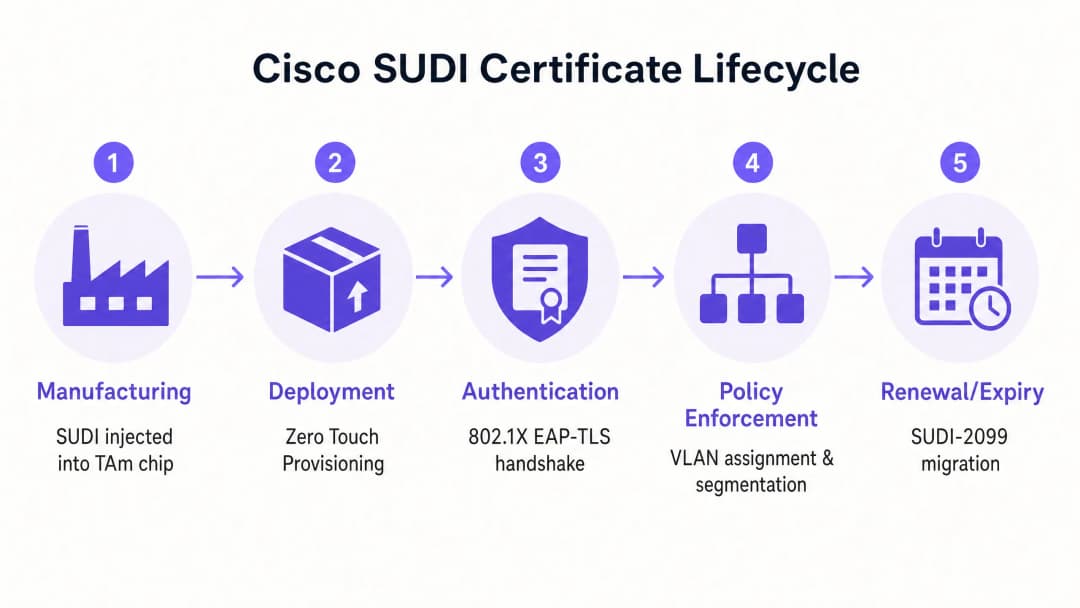
sudi_lifecycle_diagram.png

步骤 4:管理 SUDI-2099 迁移

2019 年 5 月之前颁发的 SUDI 证书将在自颁发之日起的 10 年后到期,或者 生产日期或 2029 年 5 月 14 日,以较早者为准。当 SUDI 过期时,依赖它的功能(包括 HTTPS、SSH 和零接触配置 (Zero Touch Provisioning))将会失效。

思科已推出 SUDI-2099 证书,其有效期至 2099 年 12 月。为确保业务连续性:

  1. 使用 IOS-XE 设备上的 show crypto pki certificate 命令审计您的库存。检查 CISCO_IDEVID_SUDI 信任点的 end date(结束日期)。
  2. 将受影响的硬件升级到推荐的软件版本。例如,Catalyst 9200 交换机需要 IOS-XE 17.12.2 或更高版本才能正确处理 2099 年的过期日期。

最佳实践

为了最大化硬件身份的安全效益,请遵循以下与厂商无关的原则。

  1. 强制执行严格的 EAP-TLS:要求所有基础设施设备都使用 EAP-TLS。不允许使用 PEAP 等较弱的 EAP 方法进行设备身份验证。
  2. 将基础设施身份与用户身份隔离:SUDI 验证的是硬件,而不是用户。使用专用平台来管理人员身份。例如,使用 Purple 来处理访客身份验证、同意获取和第一方数据收集,同时依靠 SUDI 来保护底层的 Cisco Meraki 或 HPE Aruba 硬件。
  3. 自动进行证书监控:部署监控工具以跟踪整个资产中的证书过期日期。主动监控可防止突发的身份验证失败。
  4. 实施微隔离:使用通过 SUDI 验证的身份将设备分配到严格控制的 VLAN。接入点应该只具有到其控制器和管理系统的网络可达性,别无其他。

故障排除与风险缓解

在部署基于 SUDI 的身份验证时,请针对这些常见的故障模式做好准备。

故障模式 根本原因 缓解策略
EAP-TLS 身份验证失败 RADIUS 服务器缺少正确的 Cisco 根证书或中间 CA 证书。 验证完整的 Cisco 信任链是否已安装在 RADIUS 服务器的受信任存储中。
设备拒绝启动 启动时计算的硬件指纹与 TAm 中的主指纹不匹配。 将该设备视为已受损。通过 RMA 流程将硬件退回给厂商。
管理访问失败 SUDI 证书已过期,导致 HTTPS 和 SSH 证书身份验证中断。 将设备固件升级到支持 SUDI-2099 的版本,或使用您的企业 PKI 部署 LDevID。
恶意设备获取访问权限 交换机端口配置为在 802.1X 失败时回退到 MAC 地址旁路 (MAB)。 从基础设施端口中移除 MAB 回退配置。强制执行严格的 802.1X 策略。

投资回报率 (ROI) 与业务影响

实施基于硬件的设备身份可在三个方面带来可衡量的业务价值。

1. 降低配置成本 由 SUDI 保护的零接触配置 (Zero Touch Provisioning) 消除了手动预配置。工程师无需在将接入点运送到零售店之前花费 45 分钟进行预配置,设备可以直接从分销商处发货。它在连接时进行安全身份验证并自动下载其配置。对于一个拥有 500 个站点的零售部署,这可以节省大约 375 个工程小时。

2. 消除恶意设备风险 通过弃用 MAC 地址旁路并采用加密硬件身份,您可以消除攻击者将恶意设备连接到基础设施端口的风险。这直接支持符合 PCI DSS 和 ISO 27001 对网络访问控制的要求。

3. 清晰的身份边界 部署 SUDI 可以建立清晰的架构边界。硬件层通过加密方式进行自身身份验证,使您能够将资源集中在用户身份层。当您集成像 Purple 这样的平台来管理 访客 WiFiWiFi 分析 时,您是在可验证、安全的基础设施基础之上进行的。

关键定义

SUDI (Secure Unique Device Identifier)

An X.509v3 certificate and associated private key embedded into a Cisco device during manufacturing to provide an immutable hardware identity.

Used by IT teams to cryptographically verify that a device connecting to the network is a genuine Cisco product.

TAm (Trust Anchor module)

A proprietary, tamper-resistant hardware chip that securely stores the SUDI certificate, generates cryptographic keys, and manages hardware fingerprinting.

Provides the hardware root of trust. If the TAm is compromised, the device will fail to boot or authenticate.

IDevID (Initial Device Identifier)

The manufacturer-installed secure device identifier defined by the IEEE 802.1AR standard. Cisco SUDI is an implementation of an IDevID.

Provides the foundational identity for a device before it is integrated into an organisation's own PKI environment.

LDevID (Locally Significant Device Identifier)

A device certificate issued by an organisation's own enterprise Public Key Infrastructure, supplementing the manufacturer's IDevID.

Used when IT teams require devices to authenticate using certificates issued by their internal corporate CA rather than the vendor's CA.

IEEE 802.1X

The IEEE standard for port-based network access control, providing an authentication mechanism to devices wishing to attach to a LAN or WLAN.

The primary protocol used to enforce network security, ensuring only authorised devices and users can send traffic through a switch port.

EAP-TLS (Extensible Authentication Protocol-Transport Layer Security)

A highly secure authentication protocol that requires both the client and the authentication server to prove their identities using digital certificates.

The specific method used within 802.1X to validate the SUDI certificate between the network device and the RADIUS server.

Zero Touch Provisioning (ZTP)

An automated process that allows network devices to be provisioned and configured automatically without manual intervention.

SUDI secures ZTP by ensuring the management system only pushes configurations to verified, genuine hardware.

MAC Address Bypass (MAB)

A legacy authentication method where a switch uses the connecting device's MAC address as its identity credential.

An insecure fallback method that should be eliminated and replaced by SUDI-based 802.1X authentication.

应用实例

A 400-room hotel is upgrading its network infrastructure and needs to deploy 250 new Cisco Catalyst access points. The IT team wants to avoid manually configuring each device before installation while ensuring no rogue devices can join the management VLAN.

  1. The IT team configures Cisco ISE with the Cisco Root CA to trust SUDI certificates.
  2. They create an 802.1X policy in ISE that assigns devices presenting a valid SUDI to a restricted provisioning VLAN.
  3. The access points are shipped directly to the hotel and plugged into the PoE switches.
  4. Each AP boots, presents its SUDI via EAP-TLS, and is authenticated by ISE.
  5. The management system (Catalyst Center) verifies the serial number, provisions the AP, and ISE shifts the port to the production management VLAN.
考官评语: This approach uses Zero Touch Provisioning secured by hardware identity. It eliminates manual staging costs and prevents rogue devices from exploiting open provisioning ports. The use of Change of Authorization (CoA) to move the device from a provisioning VLAN to a production VLAN demonstrates strong network segmentation.

A national retail chain with 1,200 stores discovers that their legacy switches use MAC Address Bypass (MAB) to authenticate access points. They need to migrate to a secure standard without causing store outages.

  1. The network team audits the switch inventory to confirm all devices support 802.1X and SUDI.
  2. They deploy the Cisco CA certificates to their RADIUS infrastructure.
  3. They configure the switch ports in 'monitor mode' (open authentication), allowing devices to attempt 802.1X EAP-TLS using SUDI while falling back to MAB if they fail, but logging the results.
  4. After verifying in the RADIUS logs that all legitimate APs are successfully authenticating via SUDI, they switch the ports to 'closed mode', enforcing strict 802.1X and disabling MAB.
考官评语: The phased migration using monitor mode is the correct operational approach for a large retail estate. It allows the team to validate the PKI trust chain and certificate validity without risking network isolation for the access points. Removing MAB entirely is the necessary final step to secure the environment.

练习题

Q1. You are deploying 50 new Cisco Catalyst switches in a stadium environment. The security policy mandates strict 802.1X authentication for all infrastructure devices. During testing, the switches fail to authenticate to your Cisco ISE server. What is the most likely cause?

提示:Consider the chain of trust required for EAP-TLS authentication.

查看标准答案

The Cisco ISE server is missing the Cisco Root CA or the ACT2 SUDI CA certificates in its trusted certificate store. Without these, ISE cannot validate the SUDI certificate presented by the switches. You must download the certificates from the Cisco PKI portal and import them into ISE.

Q2. A network engineer proposes configuring switch ports to attempt 802.1X authentication first, but fall back to MAC Address Bypass (MAB) if the device does not have a valid certificate. Why should you reject this proposal for infrastructure ports?

提示:Evaluate the security strength of the fallback mechanism.

查看标准答案

Falling back to MAB undermines the entire security model. An attacker can simply connect a rogue device, wait for the 802.1X timeout, and spoof the MAC address of a legitimate access point to gain access to the infrastructure VLAN. Infrastructure ports should enforce strict 802.1X with SUDI, and non-compliant devices should be placed in a restricted quarantine VLAN.

Q3. You are auditing a network of Catalyst 9200 switches deployed in 2018. You run the 'show crypto pki certificate' command and notice the CISCO_IDEVID_SUDI trustpoint expires in May 2029. What action must you take to prevent future outages?

提示:Review the SUDI-2099 migration requirements for legacy hardware.

查看标准答案

You must upgrade the IOS-XE software on the Catalyst 9200 switches to version 17.12.2 or later. This upgrade ensures the hardware properly supports the SUDI-2099 certificate extension, extending the valid identity of the device until December 2099 and preventing authentication failures for services like HTTPS and ZTP.