

Configuração de WiFi para Escritório: Como Construir uma Rede Sem Fio Confiável
Este guia abrangente detalha a arquitetura técnica e a implantação estratégica de WiFi de nível empresarial para escritórios. Ele aborda o design baseado em capacidade, o posicionamento de pontos de acesso, a segmentação segura de usuários e como aproveitar a infraestrutura de rede para inteligência de negócios.
🎧 Ouça este Guia
Ver Transcrição

Resumo Executivo
Para as empresas modernas, a rede sem fio não é mais apenas um meio de acesso; é uma infraestrutura de missão crítica. Seja para dar suporte a uma sede corporativa, a um ambiente de varejo de alta densidade ou a um complexo de hospitalidade em expansão, os arquitetos de rede enfrentam o mesmo desafio fundamental: fornecer conectividade contínua, segura e de alta capacidade.
Este guia descreve os requisitos técnicos para projetar e implantar uma rede WiFi de escritório confiável. Indo além da cobertura básica, abordamos o design centrado na capacidade, a necessidade de um backhaul com fio robusto e a importância crítica da segmentação de rede. Exploraremos como a transição de controladores legados no local para arquiteturas gerenciadas em nuvem aumenta a escalabilidade e como a integração de plataformas como o Guest WiFi da Purple transforma um centro de custo em uma fonte de inteligência de negócios acionável e gerenciamento seguro de usuários.
Análise Técnica Detalhada
Design de Capacidade vs. Cobertura
Historicamente, as redes sem fio foram projetadas para cobertura — posicionando Pontos de Acesso (APs) para garantir que um sinal chegasse a todos os cantos do edifício. Hoje, a principal restrição é a capacidade. Um escritório padrão de plano aberto pode ter usuários carregando três a quatro dispositivos conectados (laptops, smartphones, smartwatches).
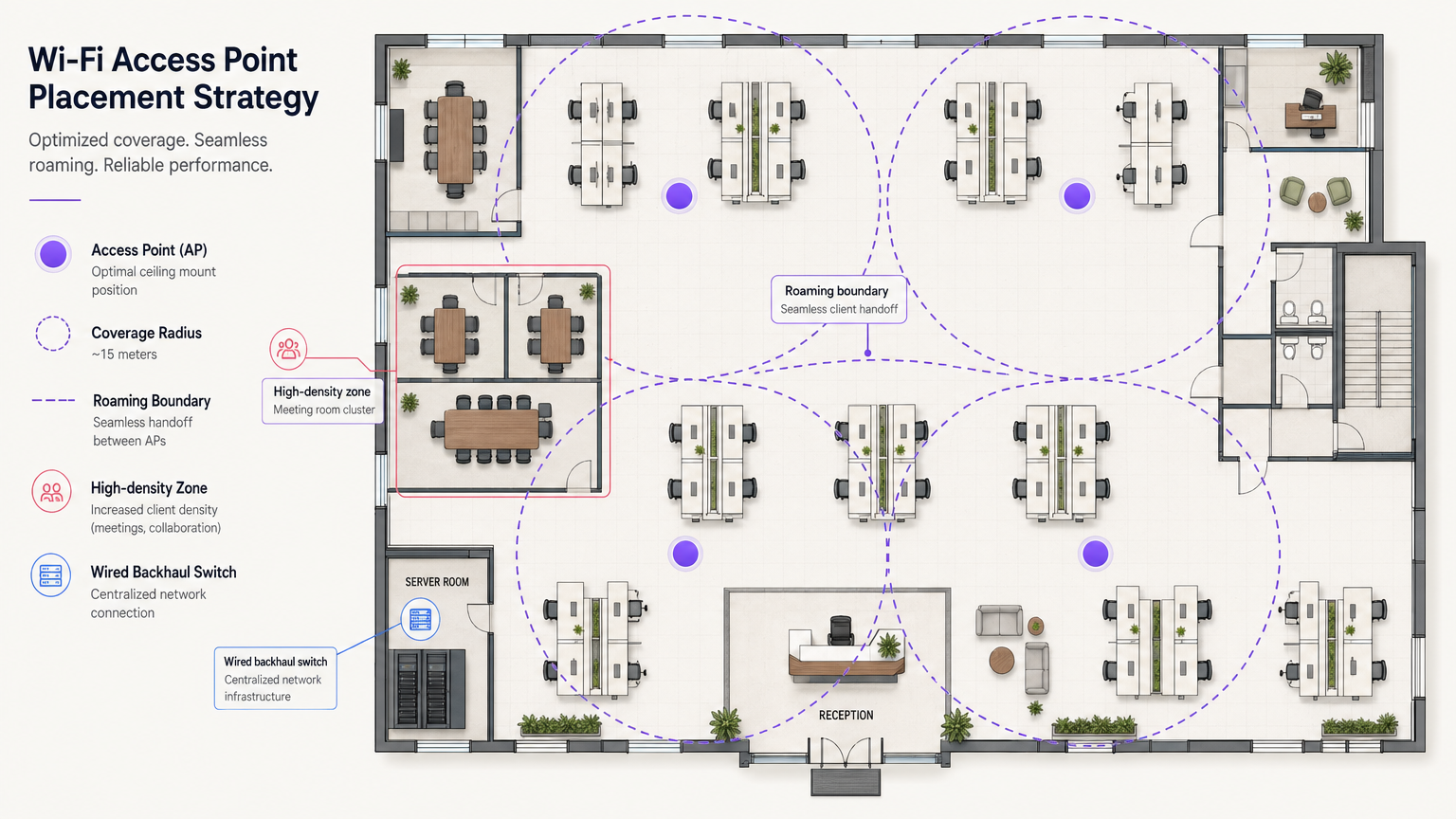
O design de rede moderno exige planejamento para a densidade de dispositivos. Isso envolve a implantação de APs Wi-Fi 6 (802.11ax) ou Wi-Fi 6E para utilizar as bandas de 5GHz e 6GHz de forma eficaz. Para gerenciar a interferência de co-canal em áreas de alta densidade, os engenheiros devem ajustar cuidadosamente a potência de transmissão para baixo e desabilitar taxas de dados mais baixas, forçando os clientes a se conectarem a APs mais próximos em vez de se agarrarem a APs distantes.
Arquitetura: Gerenciamento em Nuvem vs. No Local
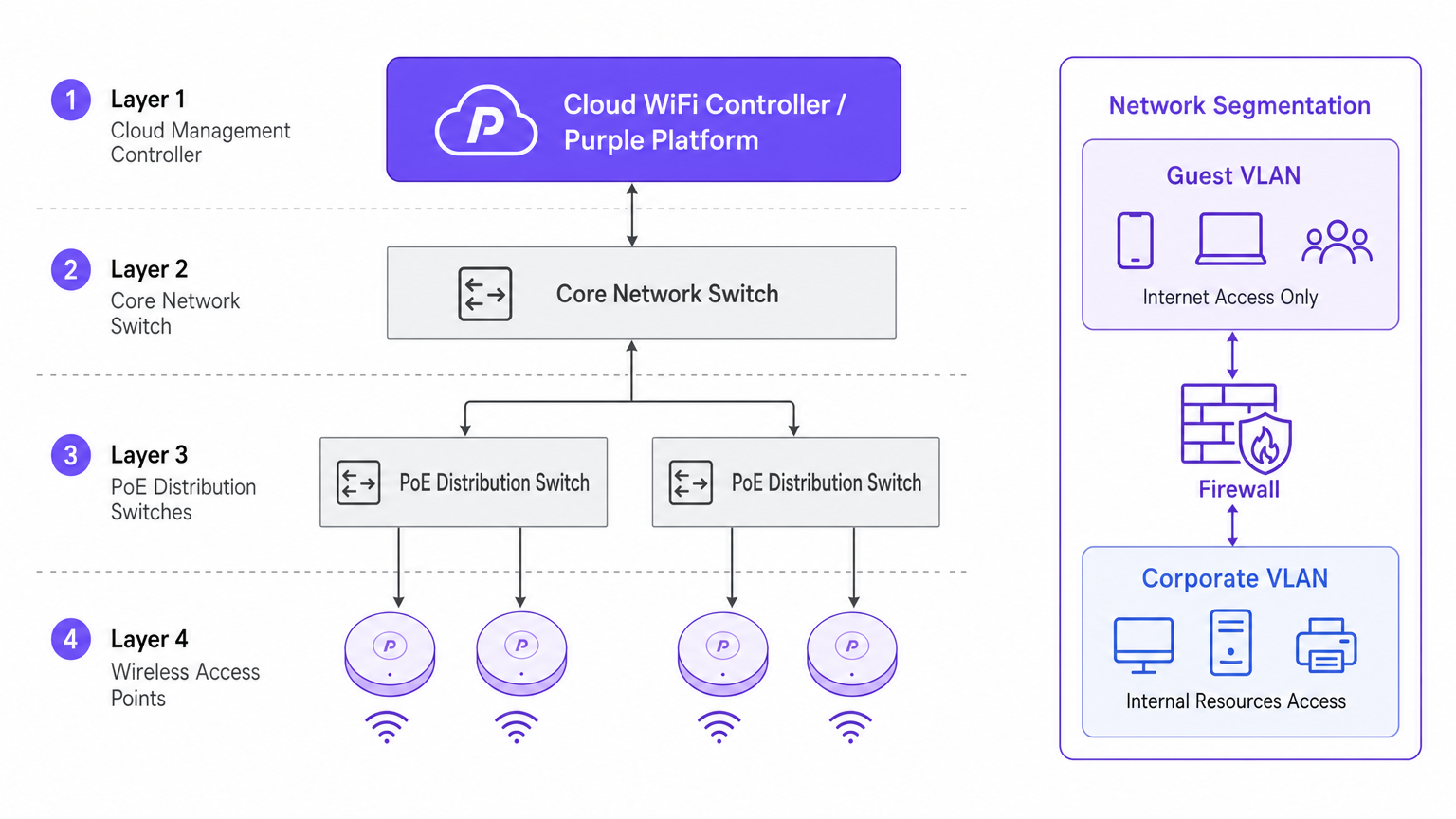
A mudança arquitetônica em direção a controladores gerenciados em nuvem é impulsionada pela escalabilidade e visibilidade. Ao contrário dos Controladores de LAN Sem Fio (WLCs) físicos tradicionais que tunelam todo o tráfego para um ponto central, as arquiteturas em nuvem distribuem o plano de dados para a borda enquanto centralizam o plano de controle. Isso garante que, se o link WAN para o controlador em nuvem cair, os APs locais continuem a comutar o tráfego local — um recurso de redundância vital para implantações empresariais.
Segurança e Segmentação
A segmentação rigorosa da rede é inegociável. Os ativos corporativos devem residir em uma VLAN segura, autenticados via 802.1X contra um servidor RADIUS ou provedor de identidade.
Por outro lado, o tráfego de convidados e BYOD deve ser isolado. É aqui que uma solução de Captive Portal se torna crítica. Ao direcionar dispositivos não gerenciados para uma VLAN de Convidado separada que roteia diretamente para a internet, você mitiga os riscos de movimento lateral. Em ambientes como saúde , garantir a segmentação segura é vital para a conformidade; mais detalhes podem ser encontrados em nosso guia sobre WiFi em Hospitais: Um Guia para Redes Clínicas Seguras .
Guia de Implementação
1. Pesquisa de Campo Ativa
Não confie apenas na modelagem preditiva. Embora as ferramentas de software sejam excelentes para o orçamento inicial, elas não podem contabilizar anomalias estruturais não documentadas (por exemplo, dutos de HVAC ou paredes revestidas de chumbo). Uma pesquisa de campo de RF ativa mede a propagação real do sinal, interferência e atenuação, garantindo o posicionamento preciso do AP.
2. Posicionamento do Ponto de Acesso
Evite o antipadrão de "implantação em corredor". Colocar APs em corredores força os sinais a penetrar paredes em ângulos oblíquos para alcançar usuários dentro dos escritórios, causando degradação significativa do sinal. Os APs devem ser colocados nas salas onde os usuários realmente trabalham. Além disso, escalone o posicionamento dos APs entre os andares para minimizar a interferência vertical de co-canal.
3. Atualização do Backhaul com Fio
A implantação de APs Wi-Fi 6E de alto desempenho é inútil se a infraestrutura com fio subjacente for um gargalo. Garanta que os switches de borda suportem Multi-Gigabit Ethernet (2.5Gbps ou 5Gbps) e tenham orçamentos de Power over Ethernet (PoE++ / 802.3bt) suficientes para alimentar pontos de acesso modernos e densos em rádio.
Melhores Práticas
- Otimização de Roaming de Cliente: Dispositivos, não APs, decidem quando fazer roaming. Mitigue "clientes pegajosos" ajustando as taxas básicas mínimas e implementando padrões como 802.11k/v/r para ajudar os clientes a tomar decisões inteligentes de roaming.
- Estratégia de Rede IoT: Não desative a banda de 2.4GHz completamente. Dispositivos IoT legados e sem interface ainda a exigem. Crie um SSID dedicado para IoT em 2.4GHz e utilize Identity PSK (iPSK) para segmentar esses dispositivos de forma segura sem a complexidade do 802.1X.
- Aproveite o OpenRoaming: Para acesso de convidado seguro e sem atritos, considere implementar o OpenRoaming. A Purple fornece serviços de provedor de identidade sob a licença Connect, permitindo um onboarding contínuo para os usuários.
Solução de Problemas e Mitigação de Riscos
O Problema do Cliente "Pegajoso"
Sintoma: Um usuário caminha do lobby para uma sala de reunião, mas sua conexão cai ou fica extremamente lenta, apesar de estar diretamente sob um novo AP. Causa Raiz: O dispositivo cliente está se mantendo conectado ao sinal fraco do AP do lobby. Mitigação: Reduza a potência de transmissão do AP para diminuir o tamanho das células e desative as taxas de dados baixas legadas (por exemplo, 1, 2, 5.5, 11 Mbps). Isso força o cliente a abandonar a conexão fraca e se associar ao AP mais próximo e mais forte.
Interferência de Co-Canal (CCI)
Sintoma: Alta utilização do canal e baixo throughput apesar da forte intensidade do sinal. Causa Raiz: Muitos APs no mesmo canal "ouvindo" uns aos outros, forçando-os a esperar por tempo de antena livre (CSMA/CA). Mitigação: Implemente atribuição dinâmica de canais, utilize o espectro mais amplo disponível em 5GHz e 6GHz, e posicione fisicamente os APs de forma adequada.
ROI e Impacto nos Negócios
Investir em infraestrutura WiFi de nível empresarial gera retornos mensuráveis que vão além da conectividade básica. Ao integrar WiFi Analytics , a rede se torna um sensor. Em um centro de transporte ou espaço de varejo, esta infraestrutura fornece dados acionáveis sobre fluxo de pessoas, tempo de permanência e comportamento do usuário.
Além disso, uma rede confiável reduz os tickets de suporte de TI relacionados a problemas de conectividade, diminuindo as despesas operacionais (OpEx). Ao implantar recursos avançados como serviços de localização, você pode consultar nosso Guia de Sistema de Posicionamento Interno: UWB, BLE e WiFi para entender como monetizar o espaço físico.
Termos-Chave e Definições
802.1X
An IEEE standard for port-based network access control (PNAC). It provides an authentication mechanism to devices wishing to attach to a LAN or WLAN.
Used to secure corporate networks by ensuring only authenticated devices and users can access internal resources.
Co-Channel Interference (CCI)
Occurs when two or more access points operate on the same frequency channel and can 'hear' each other, causing them to share airtime and reduce overall throughput.
A critical issue in high-density deployments that must be mitigated through careful channel planning and transmit power tuning.
VLAN (Virtual Local Area Network)
A logical grouping of devices on the same physical network infrastructure, isolating traffic at Layer 2.
Essential for security, ensuring guest traffic cannot interact with corporate servers or payment systems.
Captive Portal
A web page that the user of a public-access network is obliged to view and interact with before access is granted.
Used by platforms like Purple to capture user data, enforce terms of service, and provide secure onboarding for guests.
Wired Backhaul
The physical wired network (switches, cabling) that connects wireless access points back to the core network and the internet.
A common bottleneck; high-speed Wi-Fi 6/6E APs require multi-gigabit wired backhaul to perform optimally.
PoE (Power over Ethernet)
A technology that allows network cables to carry electrical power to devices like access points and IP cameras.
Crucial for AP deployment; modern APs often require higher power standards (PoE+ or PoE++) to operate all radios.
Band Steering
A technique used by wireless networks to encourage dual-band capable clients to connect to the less congested 5GHz or 6GHz bands rather than 2.4GHz.
Improves overall network performance by clearing congestion on the legacy 2.4GHz spectrum.
OpenRoaming
A federation of networks allowing users to automatically and securely connect to participating Wi-Fi networks without manual authentication.
Provides a frictionless cellular-like experience for users while maintaining enterprise-grade security.
Estudos de Caso
A 200-room corporate hotel needs to upgrade its wireless network to support conference attendees and internal operations. The current network suffers from severe congestion during keynote speeches in the main hall.
- Redesign for Density: Shift from a coverage model to a high-density capacity model in the main hall. Deploy directional patch antennas rather than omnidirectional APs to create smaller, focused coverage cells.
- Spectrum Management: Disable 2.4GHz in the main hall entirely to force all client devices onto the cleaner 5GHz and 6GHz bands.
- Network Segmentation: Implement strict VLANs. Corporate operational devices use 802.1X. Guest traffic is routed through Purple's captive portal on an isolated VLAN, ensuring PCI DSS compliance for the hotel's payment terminals.
A public-sector organization is moving to a new multi-floor open-plan office and needs to support a BYOD policy alongside corporate-issued laptops.
- Authentication Strategy: Implement 802.1X with certificate-based authentication (EAP-TLS) for corporate laptops, ensuring they connect automatically to the secure internal VLAN.
- BYOD Onboarding: Utilize a captive portal for BYOD devices, requiring users to authenticate with their corporate credentials (e.g., via SAML integration with Azure AD) before being placed on a restricted internet-only VLAN.
- Infrastructure: Deploy Wi-Fi 6 APs in a staggered formation across floors to prevent vertical interference, backed by multi-gigabit PoE+ switches.
Análise de Cenário
Q1. You are deploying APs in a long, narrow corporate corridor flanked by private offices. Where should the APs be mounted to ensure optimal performance for the users inside the offices?
💡 Dica:Consider the angle at which RF signals must penetrate the walls if APs are placed in the corridor.
Mostrar Abordagem Recomendada
APs should be placed inside the offices themselves, not in the corridor. Placing them in the hallway forces the signal to penetrate walls at oblique angles, causing significant attenuation. Designing for capacity requires placing the APs where the users actually are.
Q2. A client complains that their laptop maintains a poor connection to an AP on the first floor even after they have moved to the boardroom on the second floor, which has its own AP. How do you resolve this?
💡 Dica:The client device is making the roaming decision based on the signal it receives.
Mostrar Abordagem Recomendada
This is a 'sticky client' issue. You must tune the RF environment to encourage roaming. This involves reducing the transmit power of the APs to shrink cell sizes and disabling legacy minimum basic rates (e.g., 1, 2, 5.5 Mbps). This forces the client to drop the weak connection sooner and associate with the closer, stronger AP in the boardroom.
Q3. Your organization needs to deploy hundreds of headless IoT devices (e.g., smart thermostats, sensors) that do not support 802.1X authentication. How do you secure them on the wireless network?
💡 Dica:Consider how to uniquely identify devices without certificates while keeping them off the corporate VLAN.
Mostrar Abordagem Recomendada
Create a dedicated SSID for IoT devices, typically on the 2.4GHz band. Implement Identity PSK (iPSK) or Multiple Pre-Shared Keys (MPSK) to assign a unique password to each device or device group. Tie these credentials to a specific, isolated IoT VLAN that has no access to the corporate network, restricting lateral movement.




