

WiFi Marketing: O Guia Completo
O WiFi marketing transforma as redes de convidados de um puro centro de custos num motor de receita mensurável através da captura estruturada de dados e automação de campanhas. Este guia fornece aos líderes de TI e operadores de espaços a arquitetura técnica e o enquadramento estratégico necessários para implementar soluções de WiFi marketing seguras, conformes e altamente lucrativas.
🎧 Ouça este Guia
Ver Transcrição
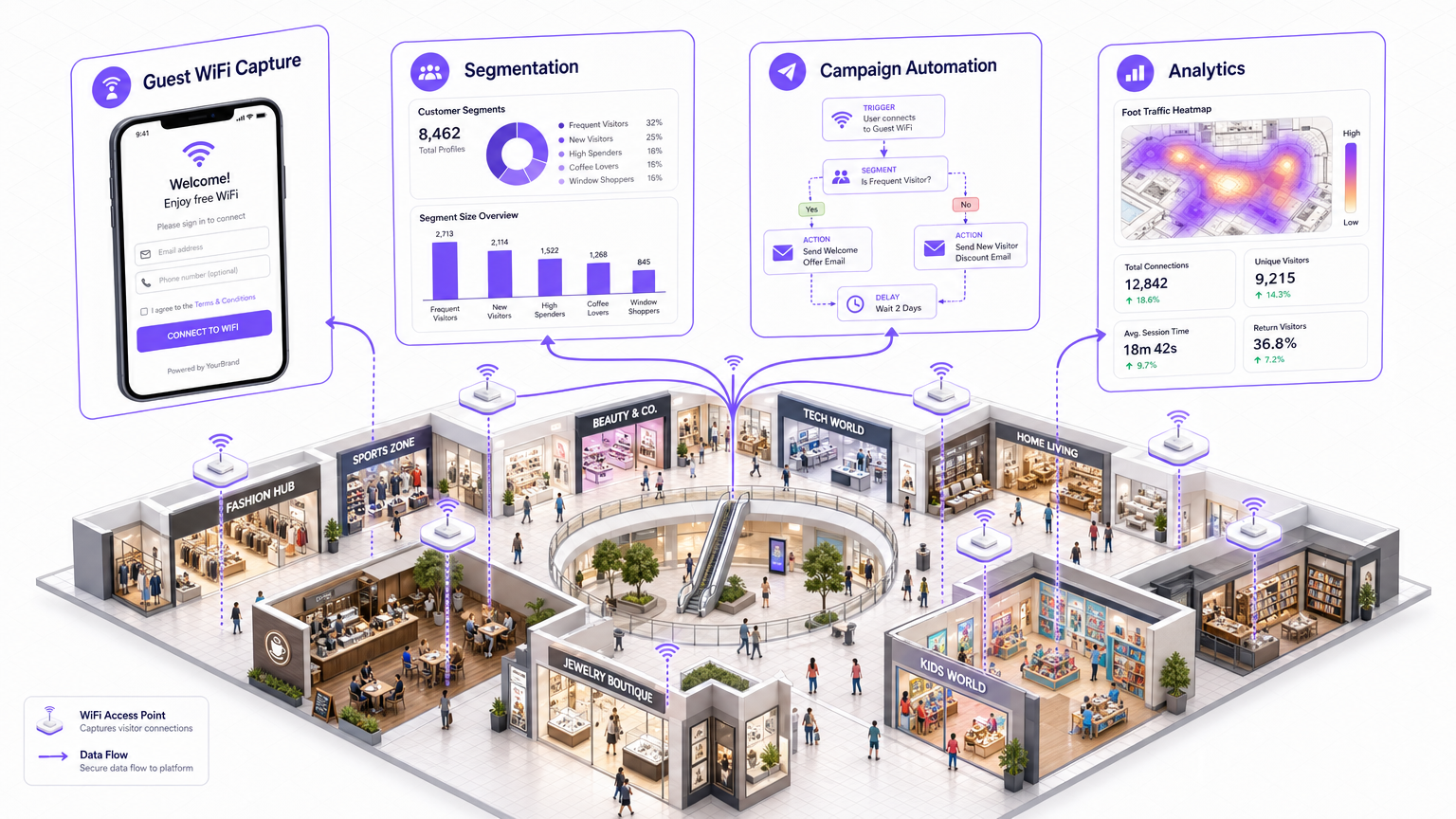
Resumo Executivo
Para gestores de TI, arquitetos de rede e diretores de operações de espaços, a rede WiFi empresarial para convidados representa um ativo estratégico significativo, mas muitas vezes subutilizado. Historicamente vista como uma despesa operacional obrigatória — uma comodidade básica exigida pelos convidados — a infraestrutura WLAN moderna é agora um motor crítico para a aquisição de dados primários e marketing automatizado.
O WiFi marketing preenche a lacuna entre a presença física no espaço e o envolvimento digital do cliente. Ao alavancar o Captive Portal como uma camada segura de captura de identidade, as organizações podem construir perfis de clientes ricos e determinísticos. Este guia descreve a arquitetura técnica, as estratégias de implementação e os frameworks de medição de ROI necessários para implementar uma solução robusta de WiFi marketing. Exploraremos como capturar dados em conformidade (aderindo ao GDPR e PCI DSS), segmentar públicos usando análises de presença e acionar campanhas automatizadas que geram um impacto comercial mensurável. Seja implementado num único estádio ou numa propriedade de retalho com vários locais, os princípios aqui detalhados permitirão à TI fornecer uma solução que impacta diretamente os resultados financeiros.
Análise Técnica Detalhada: Arquitetura e Padrões
No seu cerne, o WiFi marketing baseia-se na interceção do processo de associação do cliente e na imposição de autenticação antes de conceder acesso total à rede. Isto é conseguido através de uma combinação de hardware de rede (Access Points e Controladores) e uma plataforma de Captive Portal e análise baseada na cloud, como o Guest WiFi da Purple .
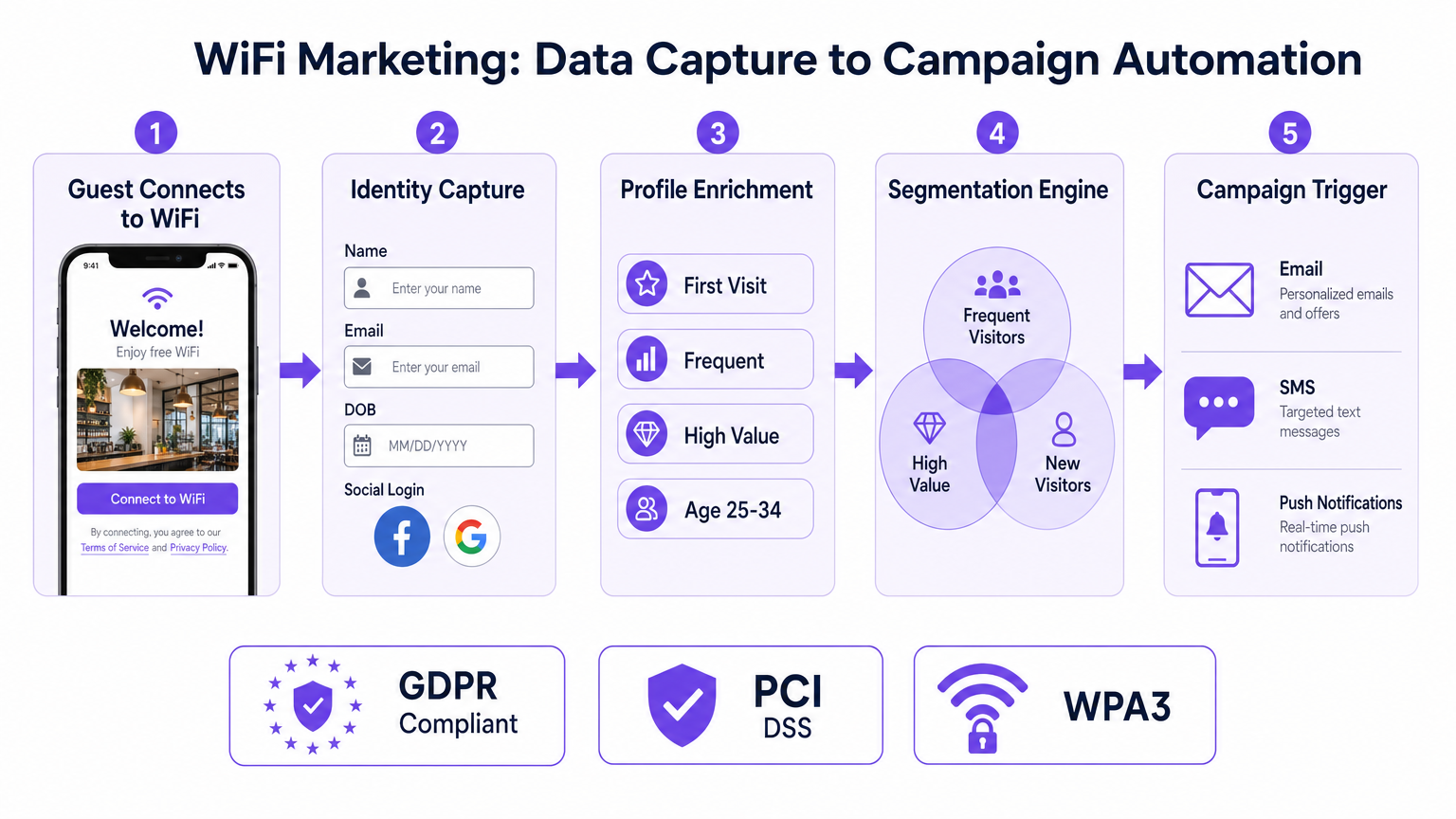
O Pipeline de Captura de Identidade
- Associação do Cliente: Um dispositivo de convidado (p. ex., smartphone) associa-se ao SSID de convidado aberto.
- Interceção de Tráfego: O controlador de rede ou AP interceta o pedido HTTP/HTTPS inicial (muitas vezes usando uma configuração de walled garden para permitir o acesso a domínios de autenticação específicos).
- Redirecionamento para Captive Portal: O cliente é redirecionado para uma página splash de Captive Portal alojada.
- Autenticação e Captura de Dados: O utilizador autentica-se através de preenchimento de formulário (Nome, E-mail, Data de Nascimento) ou OAuth (Login Social). Este passo é crítico para a captura de dados primários verificados.
- Autorização RADIUS: Após autenticação bem-sucedida, a plataforma envia uma mensagem RADIUS Access-Accept ao controlador, autorizando o endereço MAC e aplicando políticas de largura de banda apropriadas.
Autenticação Avançada: OpenRoaming e Passpoint
Embora os Captive Portals tradicionais sejam eficazes, a indústria está a mover-se em direção a uma autenticação contínua e segura. Tecnologias como Passpoint (Hotspot 2.0) e OpenRoaming permitem que os dispositivos se conectem automaticamente e de forma segura a redes participantes sem intervenção manual. A Purple atua como um fornecedor de identidade gratuito para serviços como OpenRoaming sob a licença Connect, proporcionando uma experiência de integração encriptada e sem atritos, enquanto ainda captura dados essenciais de presença.
Privacidade de Dados e Conformidade
As equipas de TI devem garantir o cumprimento rigoroso das regulamentações de proteção de dados. Uma plataforma de WiFi marketing em conformidade irá:
- Garantir a Conformidade com GDPR/CCPA: Implementar mecanismos explícitos de opt-in e termos de serviço transparentes na página splash.
- Evitar Armazenamento Local de PII: Nunca armazenar Informações de Identificação Pessoal (PII) em access points locais. Os dados devem ser encriptados em trânsito (TLS 1.2+) e em repouso numa base de dados segura na cloud.
- Manter PCI DSS: Segmentar a rede de convidados (via VLANs) inteiramente das redes corporativas e de Ponto de Venda (POS).
Guia de Implementação: Da Implementação à Automação
A implementação de uma solução de WiFi marketing requer um planeamento cuidadoso para garantir uma experiência de utilizador contínua e uma recolha de dados precisa. Isto é particularmente relevante para ambientes complexos; consulte o nosso guia sobre Como Configurar WiFi Numa Grande Área ou Propriedade Multi-Local para considerações arquitetónicas detalhadas.
Passo 1: Configuração de Rede e Walled Gardens
Configure o seu controlador de rede (p. ex., Cisco, Aruba, Meraki) para apontar para o Captive Portal externo via RADIUS. Crucialmente, configure o 'Walled Garden' — uma lista de endereços IP ou domínios que o utilizador pode aceder antes de autenticar. Isto deve incluir o URL do portal, domínios de autenticação de redes sociais (se usar login social) e quaisquer endpoints CDN necessários para carregar os ativos do portal.
Passo 2: Design da Página Splash e Estratégia de Dados
Desenhe a página splash para equilibrar a captura de dados com a fricção do utilizador. Peça o que precisa, não tudo o que quer. Uma implementação típica de retalho pode pedir E-mail e Data de Nascimento (para campanhas de aniversário). Garanta que o design está alinhado com as diretrizes da marca e é totalmente responsivo.
Passo 3: Análise de Presença e Segmentação
Uma vez conectado, a rede monitoriza continuamente o RSSI (Received Signal Strength Indicator) do dispositivo para rastrear a presença. Estes dados alimentam o motor de WiFi Analytics , permitindo a segmentação com base em:
- Tempo de Permanência: Quanto tempo o convidado permaneceu.
- Frequência: Visitante pela primeira vez vs. cliente fiel.
- Movimento: Quais zonas visitaram (requer serviços de localização avançados; consulte Sistema de Posicionamento Interior: Guia UWB, BLE e WiFi ).
Passo 4: Automação de Campanhas via Integrações API
Os dados só são valiosos se forem utilizados. Integre a plataforma WiFi com o seu CRM ou ferramenta de automação de marketing (p. ex., Salesforce, HubSpot) via webhooks ou REST APIs. Crie gatilhos automatizados:
- Gatilho: Convidado faz login pela primeira vez.
- Ação: Enviar um e-mail de 'Boas-vindas' com um código de desconto de 10%.
- Gatilho: Cliente fiel não visita há 60 dis.
- Ação: Enviar uma oferta SMS 'Sentimos a sua falta'.
Melhores Práticas para Verticais Específicas
Diferentes indústrias exigem abordagens personalizadas ao marketing WiFi:
- Retalho : Concentre-se na captura de endereços de e-mail para construir uma base de dados de fidelidade e no rastreamento do tempo de permanência para otimizar os layouts das lojas.
- Hotelaria : Integre com o Sistema de Gestão de Propriedades (PMS) para autenticar hóspedes através do número do quarto e apelido, oferecendo largura de banda por níveis (por exemplo, básico gratuito, premium pago).
- Saúde : Priorize a privacidade do paciente e a segmentação segura da rede. Consulte WiFi em Hospitais: Um Guia para Redes Clínicas Seguras para detalhes de conformidade.
- Transporte : Lide com conexões transitórias de alta densidade. Concentre-se na autenticação rápida e na monetização através de páginas de apresentação patrocinadas. (Também relevante: O Seu Guia para Soluções Wi-Fi Empresariais em Carros ).
Resolução de Problemas e Mitigação de Riscos
- Aleatorização de MAC: Os sistemas operativos móveis modernos aleatorizam os endereços MAC para evitar o rastreamento. No entanto, geralmente usam um MAC aleatório consistente por SSID. Certifique-se de que a sua configuração de rede permanece estável para que os dispositivos que regressam sejam reconhecidos.
- Captive Portal Não Aparece: Frequentemente causado por um "walled garden" configurado incorretamente ou por interceção agressiva de DNS. Verifique se o dispositivo cliente consegue resolver o URL do portal e aceder aos recursos necessários antes da autenticação.
- Consumo Excessivo de Largura de Banda: Implemente modelagem de largura de banda rigorosa e limites de sessão (por exemplo, 2 horas por sessão, 5 Mbps de download/1 Mbps de upload) para garantir o uso justo e proteger o desempenho da rede principal.
ROI e Impacto no Negócio
O marketing WiFi transforma a rede de um centro de custos num gerador de receita. O ROI é medido através de atribuição de ciclo fechado: rastreando a campanha digital até à visita física.
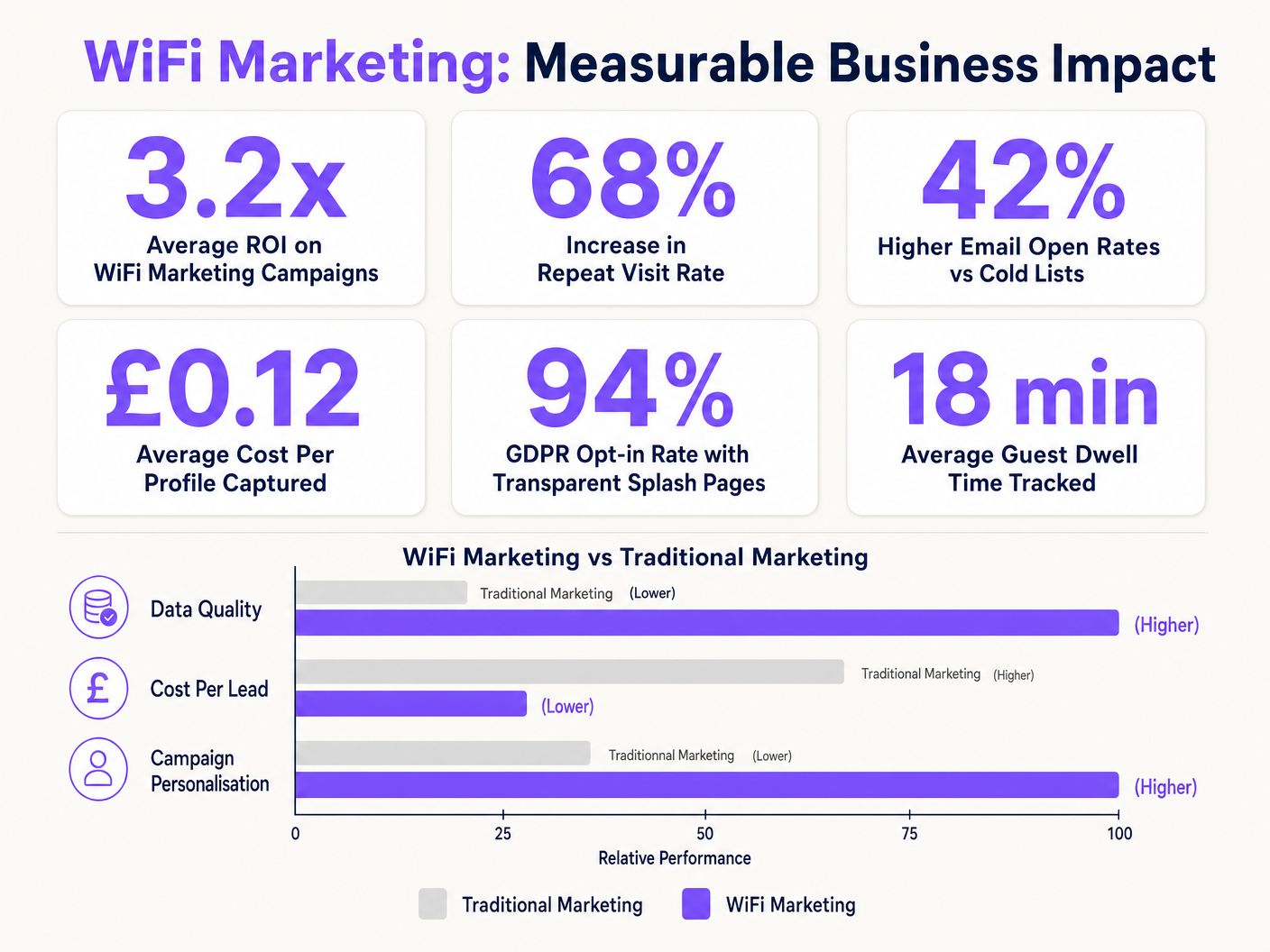
Ao comparar o custo da infraestrutura WiFi com a receita gerada por campanhas automatizadas (por exemplo, o valor de um cliente que regressa impulsionado por uma oferta SMS), as organizações podem demonstrar claramente o impacto comercial da rede.
Termos-Chave e Definições
Captive Portal
A web page that the user of a public-access network is obliged to view and interact with before access is granted.
This is the primary interface for identity capture and brand engagement in WiFi marketing.
Walled Garden
A restricted environment that controls the user's access to web content and services pre-authentication.
Essential for allowing devices to load the captive portal assets and access social login providers before full internet access is granted.
RADIUS (Remote Authentication Dial-In User Service)
A networking protocol that provides centralized Authentication, Authorization, and Accounting (AAA) management.
The core protocol used by the network controller to communicate with the cloud platform to authorise a user's MAC address after they complete the captive portal flow.
MAC Address (Media Access Control)
A unique identifier assigned to a network interface controller (NIC) for use as a network address.
The primary identifier used to track device presence and associate a physical device with a digital profile captured via the portal.
RSSI (Received Signal Strength Indicator)
A measurement of the power present in a received radio signal.
Used by access points to estimate the distance of a client device, enabling location analytics and dwell time calculations.
OpenRoaming
A roaming federation service enabling an automatic and secure WiFi experience globally.
Represents the future of seamless onboarding, replacing manual captive portal logins while still allowing venues to capture presence data securely.
Closed-Loop Attribution
The ability to track a marketing interaction (like an email open) directly to a physical business outcome (like a store visit).
The ultimate metric for proving the ROI of WiFi marketing, demonstrating that digital campaigns drive physical footfall.
VLAN (Virtual Local Area Network)
A logical subnetwork that groups a collection of devices from different physical LANs.
Critical for security; guest WiFi traffic must be isolated on a separate VLAN from corporate and Point-of-Sale (POS) systems.
Estudos de Caso
A 200-room hotel needs to implement guest WiFi that captures marketing data but also integrates with their Property Management System (PMS) to provide tiered internet access (free basic, paid premium for conferences).
- Deploy APs with dual SSIDs: one for corporate (802.1X) and one for guests (Open with Captive Portal).
- Configure the guest SSID to redirect to a cloud-hosted portal.
- Implement a PMS integration via API. On the splash page, guests enter their Room Number and Last Name.
- The portal queries the PMS to verify the guest. If verified, they receive standard bandwidth.
- For conference attendees or premium users, offer an 'Upgrade' path via a payment gateway integration (PCI compliant, offloaded from the local network), adjusting the RADIUS attributes to increase bandwidth limits.
A national retail chain with 50 locations wants to build a first-party data list to reduce reliance on expensive third-party advertising. They need to track the effectiveness of their email campaigns in driving physical store visits.
- Standardise the guest WiFi architecture across all 50 locations, pointing to a centralised captive portal.
- Design the splash page to require an Email Address and opt-in for marketing communications.
- Integrate the WiFi platform with the central CRM via API.
- When a marketing email is sent, the CRM tracks the digital open/click.
- When that customer later walks into any of the 50 stores, the APs detect their MAC address (previously linked to their email during initial login).
- The WiFi platform logs the physical visit and sends this data back to the CRM, attributing the visit to the email campaign.
Análise de Cenários
Q1. Your organisation is deploying guest WiFi across 10 retail locations. The marketing team wants to implement a Facebook Social Login option on the captive portal to capture rich demographic data. What critical network configuration step must the IT team perform to ensure this works?
💡 Dica:Consider how the client device communicates before it has been fully authenticated by the RADIUS server.
Mostrar Abordagem Recomendada
The IT team must configure the 'Walled Garden' on the network controller. They need to whitelist the specific IP ranges or domains associated with Facebook's authentication servers. Without this, the client device cannot reach Facebook to complete the OAuth process, and the captive portal will fail to load or authenticate the user.
Q2. A venue operations director reports that the new guest WiFi system is causing performance issues on the corporate network, specifically slowing down the Point-of-Sale (POS) terminals during peak hours. What architectural flaw is the likely cause, and how should it be resolved?
💡 Dica:Think about network segmentation and resource allocation.
Mostrar Abordagem Recomendada
The likely cause is a lack of proper network segmentation and bandwidth management. The guest WiFi traffic is likely sharing the same logical network or bandwidth pool as the corporate/POS traffic. To resolve this, IT must ensure the guest SSID is mapped to a dedicated VLAN, completely isolated from the POS network (crucial for PCI DSS compliance). Additionally, they must implement bandwidth shaping rules on the controller (e.g., capping guest traffic to 10% of total throughput or applying per-user rate limits).
Q3. The marketing department is frustrated because they are seeing a high drop-off rate on the captive portal; many users connect to the SSID but never complete the login process. The portal currently asks for Name, Email, Phone Number, Date of Birth, and Postal Code. What is the recommended strategy to improve conversion?
💡 Dica:Balance the desire for rich data against user friction.
Mostrar Abordagem Recomendada
The recommended strategy is to reduce user friction by simplifying the data capture form. The principle is 'ask for what you need, not what you want.' The IT/Marketing teams should implement a 'progressive profiling' approach. For the initial login, require only a single, high-value identifier (like Email). Once the device MAC is associated with that email, subsequent visits can be tracked seamlessly, or the portal can be configured to ask for one additional piece of information (like DOB) on the next visit.




