
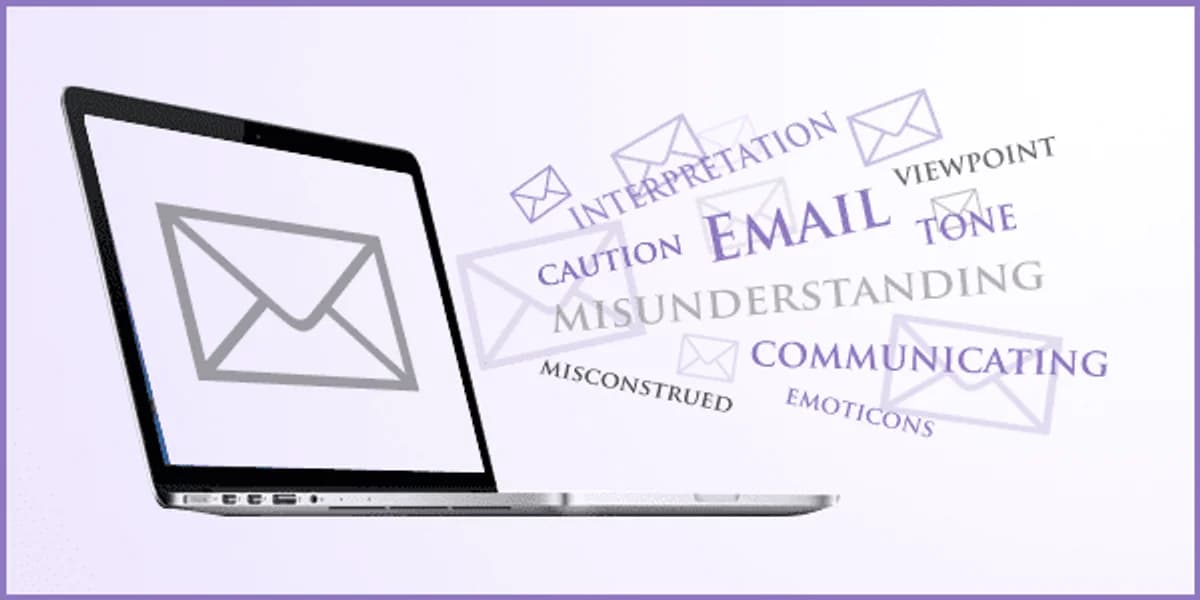
The language of email

By Richard Ellor
10 May 2014
3 min read
The language of email
Interactive research toolKruger & Epley benchmark

Email tone and clarity advisor

In Kruger & Epley's (2005) experiments, recipients correctly identified whether an email was sarcastic or serious only about 56% of the time, so roughly 44% were misread. Use this tool to estimate how that baseline shifts for your audience and format, then apply the rewrite patterns below.

Total outbound team, marketing, and client messages per month.
Colleagues often rely on informal shorthand, which increases ambiguity when emotional cues and vocal inflection are absent.
1 = Ambiguous shorthand; 5 = Explicit context, bulleted action items, defined deadlines.
1 = Blunt and clipped; 5 = Cordial greeting, conversational context, gratitude.
Communication risk estimateElevated risk
Estimated misinterpretation rate:
51%(Benchmark: 44%)
Misread emails / month:~1,275
Lost productivity hours:~255 hrs
Sentiment alignment index:41 / 100
Add explicit intent tags (e.g. [FYI] or [Action Needed by 3 PM]) and state emotional valence openly.
Citation: Kruger, J., Epley, N., Parker, J., & Ng, Z. W. (2005). Egocentrism over e-mail: Can people communicate as well as they think? Journal of Personality and Social Psychology, 89(6), 925-936. Method: the 44% baseline is adjusted by illustrative multipliers for recipient (1.0-1.35x) and format (0.95-1.15x), minus 6 points per clarity level and 4 points per warmth level above 3, clamped to 12-65%. Each misread email is costed at 12 minutes of clarification. The multipliers are editorial estimates, not study findings.
Power high-converting guest engagement through WiFiLearn how leading venues capture verified customer emails and automate personalised campaigns in our WiFi marketing guide.
Useful? Link to this tool

Emails - can we communicate as well as we think we can?

Are you trying to be funny? Do you tend to be sarcastic? Or are you deadly serious when sending your emails?

A Journal of Personality and Social Psychology report found that people greatly overestimate their ability to convey their tone over email. The reply you get could be misinterpreted too. They did realize you were only joking... didn't they?

Humans by nature tend to be egocentric, unable to step outside of their own perspectives and be understanding of others. We often believe that most people 'surely' think the same way that we do. Which is part of the problem.

Miscommunication is common.

Via any written communication, we cannot hear the tone in someone's voice, see facial expressions (though we could use an emoticon) or see other cues such as gestures or emphasis. Emails tend to be typed and sent off more quickly than a letter, with less thought put into them.

So, should we respond to emails with caution?

Kruger and Epley, cited in the American Psychological Association, compared vocal message interpretation and email message interpretation. They found that over the phone, the intended tone was correctly identified three - quarters of the time, but only 56% of the time over email, which is a little over half the chance of guessing correctly. Interestingly, when asked whether they thought they had interpreted the message correctly, 90% were confident that they had. Seemingly only 10% of email correspondence interpretation is ever questioned by the receiver.

Kruger explains that when you write an email, you 'hear' the tone you are intending to convey, while forgetting that the receiver of the email doesn't have access to such information.

The limitation of email communication may be highly underappreciated and individuals believe that they are communicating more effectively than they actually are.

So, here are our tips for avoiding miscommunication by email. Can you think of any others?

  1. Positive emails can seem neutral, while neutral emails can seem negative. So make sure your emails are extra friendly.
  2. Take caution when using emoticons to show your feelings, as you can't counteract what may be seen as a disrespectful email by adding an emoticon. Also, it could come across as unprofessional to a business associate in the workplace.
  3. Think about the email from the recipient's viewpoint. Emailers overestimate how effectively they communicate feelings, as do recipients who think they can effectively understand. Jokes are often seen as less funny by the recipient than by the sender.
  4. Take your time when writing an email; short messages can be interpreted as rude.
  5. Try not to make them too long either. Say just what needs to be said and then there is less to be misinterpreted.
  6. Try to get to know the person whom you are emailing. Small differences can grow into nuisances, so try to understand your contacts better.

The good news is that as you become more familiar with your email contacts, the chance of your messages being misconstrued is reduced. It's therefore worth getting to know the people behind the email address!

Frequently asked questions

Why do recipients misinterpret tone in emails so frequently?

Psychological research by Kruger and Epley shows that senders overestimate their ability to communicate tone: senders expect recipients to detect sarcasm or nuance 78% of the time, but recipients only detect it 56% of the time (barely above chance). Because written text lacks paralinguistic cues such as vocal tone, inflection, pacing, and facial expressions, readers mentally project their own ambient stress or assumptions onto neutral text.

What is the negativity effect in workplace email communication?

The negativity effect or negativity bias in digital communication describes how recipients systematically perceive neutral phrasing as mildly negative or cold, and mildly negative phrasing as hostile or angry. To achieve perceived neutrality, senders must intentionally inject positive politeness tokens, such as warm salutations, explicit affirmations, and expressions of gratitude.

How can businesses prevent misunderstandings in automated customer emails?

Automated customer messaging (such as post-visit WiFi follow-ups or loyalty vouchers) succeeds when senders maintain high specificity, personalized visit context, and clear calls to action. High-converting emails avoid sarcasm, state the exact offer upfront, explain why the recipient is receiving the communication (e.g., connected to venue WiFi), and provide immediate one-click value.

What are the most effective email etiquette rules for executive communication?

Executive communication requires the BLUF framework (Bottom Line Up Front): state the required decision or takeaway in the opening two sentences. Add explicit intent tags in the subject line (e.g., [DECISION REQUIRED BY FRIDAY]), isolate deliverables into bulleted lists with named owners, and eliminate ambiguous passive voice.

When should an email thread transition to a voice call or meeting?

Under the three-reply rule, if an email exchange exceeds three messages without reaching consensus or clarity, senders should immediately transition to a brief voice call or direct sync. Prolonged email ping-pong escalates defensive emotional interpretations and consumes disproportionate clarification time.

Ready to get started?

Book a demo with one of our experts to see how Purple can help you achieve your business goals.

Speak to an expert