跳至主要内容

动物园和主题公园WiFi:高客流量场馆连接指南

本指南为IT领导者和网络架构师提供了一个全面的框架,用于在动物园和主题公园部署高性能WiFi。涵盖了户外射频规划、Captive Portal部署、家庭安全内容过滤,以及将连接性转化为可操作运营分析的策略。

📖 6 分钟阅读📝 1,317 🔧 2 应用实例3 练习题📚 8 关键定义

收听本指南

查看播客转录
动物园和主题公园WiFi:高客流量场馆连接指南 Purple技术简报 | 大约10分钟 --- [引言与背景 — 1分钟] 欢迎来到Purple技术简报系列。我是主持人,今天我们将探讨一个处于消费者体验和企业网络建设交叉点的问题:在动物园和主题公园部署WiFi。 现在,你可能认为这是一个小众问题——在某些方面确实如此——但实际上,这里的工程挑战是你在任何场馆部署中都会遇到的最艰巨的挑战之一。你需要应对户外环境、不可预测的人群密度、拥有多台设备的家庭,以及对于儿童内容过滤的真正责任。做对了,你就拥有了一个强大的数据资产和推动收入的宾客体验工具。做错了,你就会面临投诉、安全事件,以及一年中最繁忙的周六网络瘫痪的困境。 那么,让我们开始吧。 --- [技术深度探究 — 5分钟] 让我们从根本挑战开始:户外覆盖规划。 室内WiFi部署相对直接——你处理的是可预测的射频环境、已知的墙壁材料和固定的占用负载。户外则完全不同。在动物园或主题公园,你需要应对开阔空间、树冠干扰、金属围栏、水景,以及可能在高峰期从几乎空无一人变为每小时数千人的游客通道。 首先需要做出的决定是接入点选择。对于户外部署,至少需要IP66或IP67防护等级的硬件——这意味着完全的防尘保护和防喷水保护。在英国,八月的星期二会下雨,这不是可选项。你需要AP能够在零下二十到六十摄氏度的温度范围内工作,并且要仔细考虑在公共区域位置的防破坏能力。 对于无线技术本身,Wi-Fi 6——即IEEE 802.11ax——应作为2024年及以后任何新部署的基准。相比Wi-Fi 5的关键改进不仅仅是原始吞吐量;而是OFDMA——正交频分多址——它允许单个AP在子信道上同时为多个客户端服务。在像主题公园排队区或动物园主通道这样的高密度环境中,这就是网络在负载下性能下降与为每个连接设备保持可接受吞吐量的区别。 现在,我们来谈谈回程。这是很多户外部署失败的地方。你的AP分布在一个可能占地五十英亩的场地上,需要将数据传回核心交换基础设施。选择有:光纤,这是黄金标准,但在大型场地铺设沟槽昂贵;点对点无线网桥,适用于无法铺设沟槽的长距离;以及PoE——以太网供电——用于可以拉Cat6A电缆的较短距离。实际上,大多数大型场馆部署采用混合方法:光纤环网到分布点,然后通过PoE连接到每个区域内的各个AP。 有一点值得指出——如果你考虑使用专线作为主要的互联网上行链路,请确保了解SLA。专线提供专用、对称的带宽和保证的正常运行时间,这正是当你有数千个并发会话时所需要的。消费级宽带对于这种规模的场馆来说根本不够。 好的,接下来我们谈谈Captive Portal和访客WiFi层,因为商业价值从这里开始释放。 Captive Portal是一个认证网关,它拦截新设备的HTTP请求,并将其重定向到一个品牌登录页面,然后才授予网络访问权限。对于动物园或主题公园,这是你的主要数据收集接触点。你正在以GDPR合规的方式捕获第一方数据——电子邮件地址、人口统计信息、访问频率——因为访客在连接时主动表示同意。 这里的注册流程至关重要。你希望提供社交登录——Facebook、Google、Apple——以及电子邮件注册,因为此处的摩擦直接影响连接率。行业数据表明,提供社交登录的场馆连接率比需要填写表单注册的场馆高出30%到40%。这意味着CRM中多出30%到40%的访客档案。 现在,对于家庭友好型场馆,内容过滤是不可或缺的。你负有责任,坦率地说,如果孩子在你网络上访问不当内容,你将面临声誉风险。基于DNS的内容过滤是最具扩展性的方法——你在DNS解析层进行过滤,而不是进行深度包检测,这保持低延迟且不需要昂贵的串联硬件。你配置基于类别的阻止——成人内容、赌博、暴力——并将其默认应用到你的访客SSID。这也是像Purple这样的平台增加显著价值的地方,因为过滤策略是集中管理的,并一致应用于你园区内的每个AP。 我们来谈谈网络分段。你的访客WiFi应与运营网络完全隔离。这意味着独立的VLAN、独立的防火墙策略,如果预算允许,最好有独立的物理上行链路。你的运营网络承载着销售点系统、闭路电视、门禁控制,可能还有动物管理系统。这些都不应从访客网络可达。IEEE 802.1X基于证书的身份验证处理员工和运营设备的认证;WPA3-Personal或WPA3-Enterprise分别处理访客和管理SSID。 现在,WiFi分析。这部分在最初的商业案例中往往被低估,但它是长期投资回报所在。当你部署一个托管的访客WiFi平台时,每个连接的设备都会产生位置和停留时间数据。你可以看到哪些展品吸引了最多的人流,访客在哪里花费最多时间,以及——关键的是——他们不去哪里。这对你的运营团队来说是可行的情报。如果新的爬行动物馆停留时间短,是内容问题还是导视问题?你的WiFi数据可以帮助回答这个问题。 Purple的分析平台通过热力图、访客流量报告和重复访问跟踪呈现这些数据。你可以按每周的天、每天的时间或访客类型(首次访问与回头客)进行细分。对于一个试图优化布局、人员配置和餐饮定位的场馆来说,这是真正有价值的运营情报。 --- [实施建议及常见陷阱 — 2分钟] 让我给你一个实际的实施顺序,然后指出我最常见的陷阱。 从现场勘测开始。不是桌面推演——而是使用频谱分析硬件进行实际的射频勘测。你需要了解现有的射频环境,识别干扰源——尤其是在有大型金属结构或水的地方——并逐区域绘制覆盖需求图。为此合理预算;糟糕的现场勘测是导致部署后修复工作的最大原因。 然后定义你的区域。对于动物园或主题公园,我通常建议至少四个区域:入口和出口、主要访客通道、高密度区域(如餐饮广场和表演场)以及展区。每个区域有不同的密度要求,可能还有不同的内容政策。 基础设施先行。在开始安装AP之前,先完成光纤和管道铺设。这听起来很明显,但我见过有些项目AP安装超前于回程工作,结果昂贵的硬件闲置,等待土建赶上。 然后部署你的控制器基础设施——无论是本地还是云管理——在将AP上线之前配置好SSID、VLAN和安全策略。在暂存环境中端到端测试Captive Portal流程。 现在,陷阱。最常见的是低估峰值密度。场馆始终低估在售罄活动或学校假期周末期间会有多少设备。为峰值设计,而非平均值。一个好的经验法则是假设每个访客有2到3台设备——智能手机、平板电脑、智能手表——并相应设计AP密度。 第二个陷阱:忽视回程。我见过精心设计的AP布局被回程中的单点故障完全破坏——一个没有冗余的交换机,或一条没有保护路径的光纤线路。在分布层构建冗余。 第三:Captive Portal的GDPR合规性。你的隐私声明必须清晰,同意机制必须明确,数据保留政策必须记录在案。这不仅是法律要求——更是与访客的信任问题。Purple平台处理同意管理工作流程,但你仍需确保与WiFi提供商签订了数据处理协议。 --- [快速问答 — 1分钟] 我经常被问到的关于这个主题的问题。 “我们需要Wi-Fi 6E吗?”对于今天大多数动物园和主题公园部署,Wi-Fi 6已经足够。Wi-Fi 6E增加了6 GHz频段,在极其密集的环境中很有用,但对于大多数场馆来说,硬件成本溢价尚不合理。在下次设备更新周期中重新审视这个问题。 “每公顷需要多少个AP?”大致的经验法则:在高密度区域,每500平方米活跃访客空间一个AP,在低密度区域每1000平方米一个。始终通过适当的现场勘测进行验证。 “我们可以将WiFi数据用于营销吗?”可以,但需获得同意。Purple的平台与主流的CRM和营销自动化工具集成,因此你可以根据访问行为触发访问后的电子邮件活动、忠诚度计划注册和定向优惠——全部在GDPR限制范围内。 “蜂窝网络分流呢?”如果你的场地有良好的手机信号覆盖,值得考虑,但不能依赖它。你的访客期望WiFi,而密集户外环境中的蜂窝覆盖通常不稳定。 --- [总结与后续步骤 — 1分钟] 总结一下:在动物园或主题公园部署WiFi是一个严肃的基础设施项目,但也是一个重大的商业机会。你构建的网络不仅仅是一个连接工具——它是一个数据平台、一个营销渠道,以及一个宾客体验的差异化因素。 关键决策是:适用于户外部署的Wi-Fi 6硬件、内置冗余的稳健回程策略、一个在减少摩擦和GDPR合规数据捕获之间取得平衡的Captive Portal、用于家庭安全的基于DNS的内容过滤,以及一个将连接数据转化为运营情报的WiFi分析平台。 如果你正在计划部署或更新,我建议从专业的现场勘测和明确的网络业务目标定义开始——不仅仅是连接,还包括数据、营销和运营。Purple团队与英国及全球的休闲娱乐场所合作,我们很乐意进行一次范围界定对话。 感谢收听。你可以在purple.ai找到完整的书面指南、架构图和实施清单。下次再见。 --- [脚本结束] 总预计运行时间:以自然对话速度大约10分钟。

header_image.png

Executive Summary

For large-scale leisure venues like zoos and theme parks, deploying reliable Guest WiFi is no longer a luxury—it is a foundational operational requirement. Visitors expect seamless connectivity to access digital maps, book ride times, and share their experiences on social media. Concurrently, venue operators rely on this infrastructure to power point-of-sale systems, mobile ticketing, and real-time crowd management.

However, outdoor deployments present unique engineering challenges. Unpredictable crowd densities, complex RF environments involving water and foliage, and the need for robust content filtering require a strategic approach to network design. This guide provides IT managers, network architects, and CTOs with actionable, vendor-neutral recommendations for architecting high-density wireless networks in high-footfall outdoor environments. We will explore access point selection, backhaul strategies, captive portal optimization, and how to leverage WiFi Analytics to drive tangible ROI.

Technical Deep-Dive

Outdoor RF Planning and Access Point Selection

Deploying wireless infrastructure across expansive outdoor areas requires hardware engineered for harsh conditions. Indoor access points (APs) will fail rapidly when exposed to moisture, temperature fluctuations, and UV radiation.

For outdoor zones, IT teams must specify APs with an IP66 or IP67 rating, ensuring complete protection against dust ingress and high-pressure water jets. Furthermore, the hardware must support an operating temperature range suitable for the local climate, typically -20°C to +60°C. In areas accessible to the public, such as queue lines or low-hanging structures, vandal-resistant enclosures are mandatory to protect the investment.

From a protocol perspective, IEEE 802.11ax (Wi-Fi 6) is the baseline standard for new deployments. The critical advantage of Wi-Fi 6 in high-footfall environments is Orthogonal Frequency Division Multiple Access (OFDMA). OFDMA allows a single AP channel to be subdivided into smaller resource units, enabling simultaneous transmission to multiple clients. This significantly reduces latency and improves efficiency in dense areas like food courts or animal exhibits, where hundreds of devices may compete for airtime. While Wi-Fi 6E introduces the 6 GHz band, the hardware premium is currently difficult to justify for most outdoor venue deployments, making Wi-Fi 6 the pragmatic choice for balancing performance and budget.

Backhaul Architecture and Redundancy

A robust RF design is irrelevant if the backhaul infrastructure cannot support the aggregated throughput. Zoos and theme parks often span dozens or hundreds of acres, making traditional copper cabling unviable for connecting edge switches back to the core.

A hybrid backhaul approach is typically required:

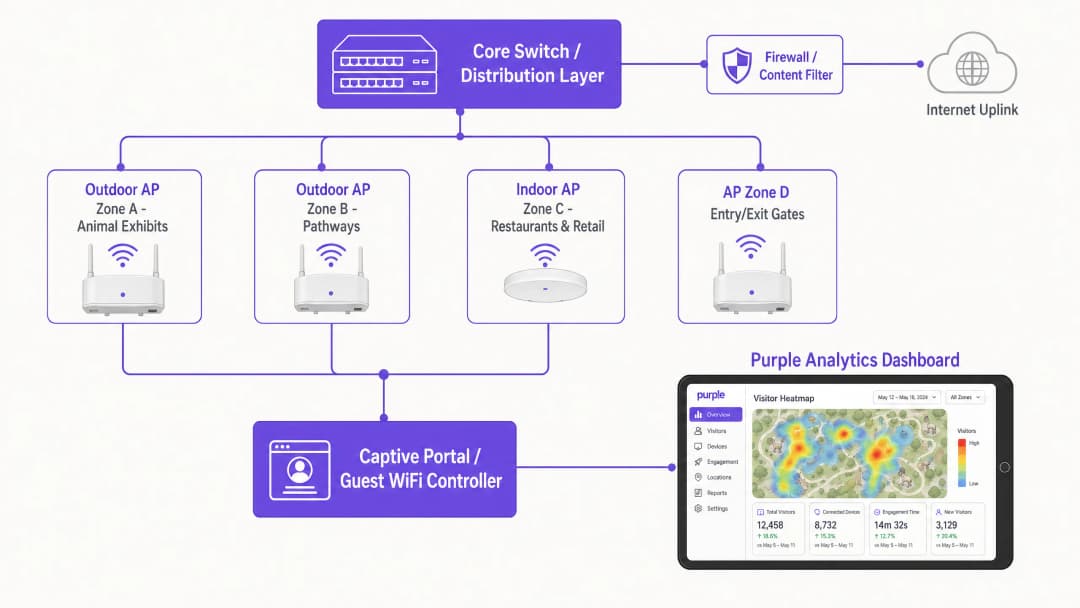
  1. Fibre Optic Rings: Deploy single-mode fibre rings to connect distribution switches across the site. This provides high bandwidth and resilience; if one path is severed (e.g., during groundworks), traffic can route in the opposite direction.
  2. Point-to-Point Wireless: In areas where trenching fibre is environmentally sensitive or prohibitively expensive (e.g., across a lake or through a dense woodland exhibit), high-capacity point-to-point or point-to-multipoint wireless bridges provide reliable connectivity.
  3. Power over Ethernet (PoE): From the distribution switches, run Cat6A cable to provide both data and power to the individual APs, ensuring runs do not exceed the 100-metre standard.

For the primary internet uplink, consumer broadband is insufficient. Venues must procure a dedicated leased line, as detailed in our guide What Is a Leased Line? Dedicated Business Internet , to guarantee symmetric bandwidth and strict Service Level Agreements (SLAs).

architecture_overview.png

Network Segmentation and Security

Security is paramount when mixing public guest access with critical venue operations. The network must be logically segmented using Virtual Local Area Networks (VLANs).

  • Guest Network: Configured with WPA3-Personal (or WPA2/WPA3 mixed mode for legacy device support) and strictly isolated from all internal resources. Client isolation should be enabled at the AP level to prevent guest devices from communicating with one another.
  • Operational Network: Dedicated VLANs for point-of-sale (POS) terminals, digital signage, and IoT devices. Access should be secured using IEEE 802.1X with certificate-based authentication to ensure only corporate-owned devices can connect.

For further insights on securing venue infrastructure, refer to our article: Protect Your Network with Strong DNS and Security .

Implementation Guide

Step 1: Comprehensive Site Survey

Never rely solely on predictive modeling for outdoor environments. Conduct an active RF site survey using spectrum analysis tools. Trees, water features, and metal enclosures (like cages or ride structures) absorb and reflect RF signals unpredictably. The survey must map coverage requirements zone by zone, identifying interference sources and optimal AP mounting locations.

Step 2: Captive Portal and Authentication Flow

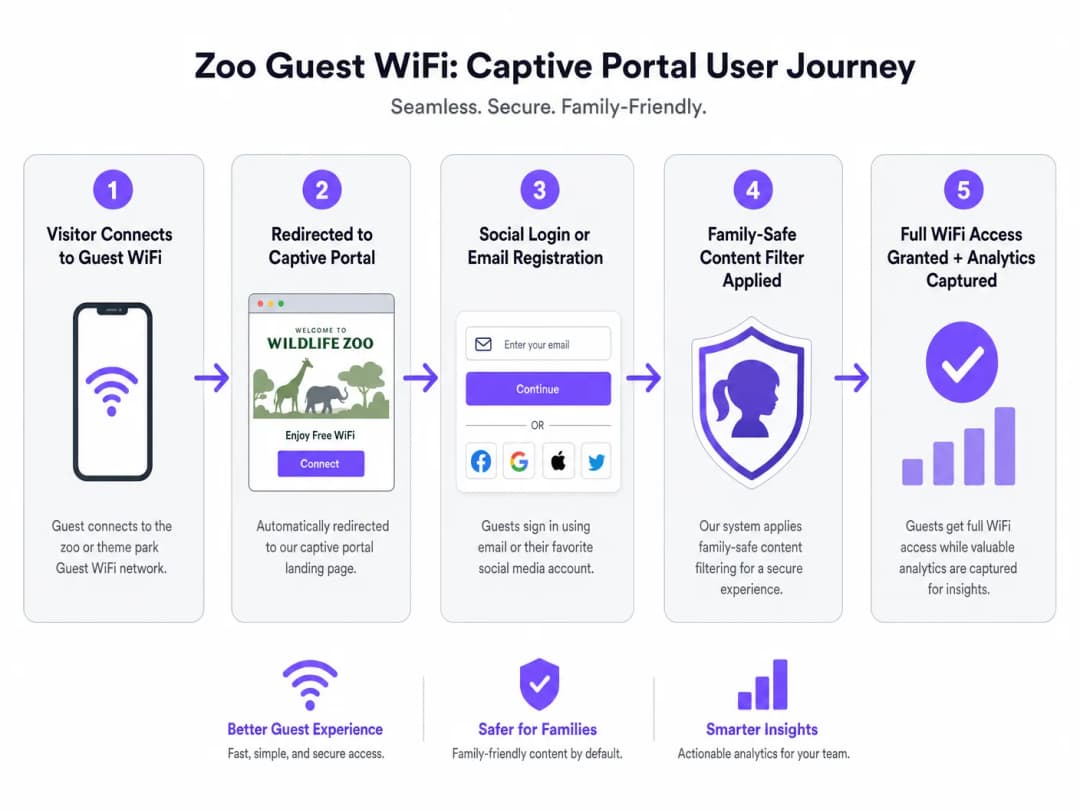
The captive portal is the gateway to the guest network and the primary mechanism for data capture. A seamless onboarding experience is critical for maximizing connection rates.

  1. Authentication Options: Offer social login (Facebook, Google, Apple) alongside traditional email registration. Venues offering social login typically observe connection rates 30-40% higher than those relying exclusively on form-fills.
  2. Compliance: Ensure the portal explicitly captures consent for data processing and marketing communications, adhering strictly to GDPR or local privacy regulations.
  3. Frictionless Re-authentication: Utilize MAC address caching or platforms like OpenRoaming to automatically reconnect returning visitors without requiring them to complete the captive portal flow again.

captive_portal_flow.png

Step 3: Implementing Family-Safe Content Filtering

Zoos and theme parks have a duty of care to provide a safe digital environment. DNS-based content filtering is the most efficient method for achieving this at scale. By intercepting DNS requests and blocking resolution for domains categorized as adult content, gambling, or violence, venues can enforce acceptable use policies without the latency introduced by deep packet inspection (DPI). This filtering must be applied by default to the guest SSID.

Best Practices

  • Design for Peak Density, Not Averages: Venues frequently underestimate device counts during peak periods (e.g., bank holidays). Assume 2-3 devices per visitor (smartphone, smartwatch, tablet) and engineer AP density accordingly. A general rule of thumb is one AP per 500 square metres in high-density zones (food courts, show arenas) and one per 1,000 square metres in lower-density transit areas.
  • Prioritize the User Journey: The captive portal must be mobile-optimized and load rapidly. Any delay in rendering the portal will lead to abandonment.
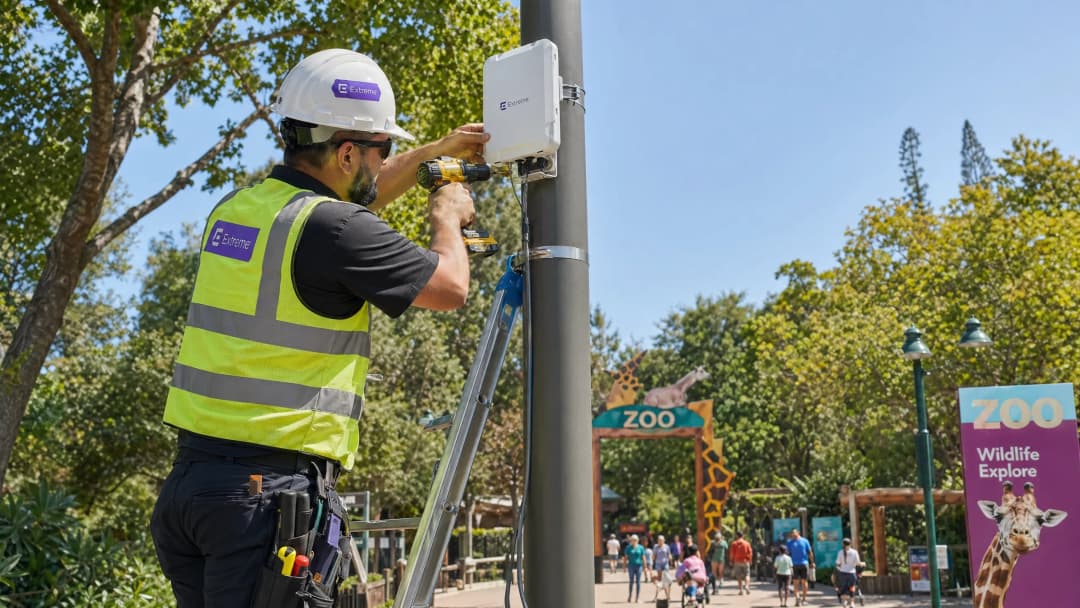
  • Leverage Existing Infrastructure: When mounting outdoor APs, utilize existing lighting columns, CCTV poles, or building facades to minimize installation costs and visual impact.

Troubleshooting & Risk Mitigation

Failure Mode Root Cause Mitigation Strategy
Network Collapse Under Load Insufficient AP density; lack of OFDMA support. Upgrade to Wi-Fi 6 infrastructure; redesign coverage maps based on peak concurrent user estimates.
Captive Portal Fails to Load DNS misconfiguration; aggressive mobile OS security settings. Ensure the walled garden includes all necessary domains for social login APIs and captive portal detection URLs (e.g., captive.apple.com).
Poor Roaming Performance AP transmit power set too high, causing clients to "stick" to distant APs. Implement dynamic radio management; lower TX power to encourage client devices to roam to closer APs; enable 802.11k/v/r.

ROI & Business Impact

The business case for deploying high-performance WiFi extends far beyond basic connectivity. When integrated with a robust analytics platform, the network becomes a strategic asset.

  1. Operational Intelligence: By tracking MAC addresses (even anonymized), venues can generate heatmaps and analyze visitor flow. This data identifies congestion points, measures dwell times at specific exhibits, and informs staffing and security deployments.
  2. Marketing and Revenue Generation: First-party data captured via the captive portal feeds directly into the venue's CRM. This enables targeted post-visit email campaigns, loyalty program enrollment, and personalized offers, driving repeat visits and increasing lifetime value.
  3. Enhanced Guest Experience: Reliable connectivity enables the use of venue-specific mobile applications for wayfinding, mobile food ordering, and virtual queuing, directly improving guest satisfaction scores and reducing operational friction.

As seen in similar deployments across the Hospitality and Retail sectors, the integration of connectivity and analytics transforms IT infrastructure from a cost center into a revenue-enabling platform. For further reading on temporary deployments, see our guide on Event WiFi: Planning and Deploying Temporary Wireless Networks .

关键定义

Captive Portal

拦截用户在公共网络上的初始HTTP请求的网页,在授予互联网访问权限之前要求认证或接受条款。

在场馆部署中捕获访客数据并执行可接受使用策略的主要机制。

OFDMA (Orthogonal Frequency Division Multiple Access)

Wi-Fi 6的一项功能,允许AP将无线信道划分为更小的子信道(资源单元),从而同时向多个设备传输数据。

通过减少延迟和开销,对于维持像排队区和餐饮广场等高密度区域的网络性能至关重要。

IP67 Rating

一种防护等级标准,表示设备完全防尘并能承受暂时浸入水中。

在户外动物园和主题公园环境中部署的硬件所需的最低环境保护等级。

Walled Garden

在完全认证之前控制用户对Web内容和服务访问的受限环境。

必须配置为在访客完全连接之前允许访问社交媒体登录API和Captive Portal检测URL。

DNS-Based Content Filtering

一种安全技术,通过阻止域名系统(DNS)将受限URL解析为IP地址,来阻止访问不适当的网站。

确保场馆访客网络上家庭安全浏览的标准方法,且不影响性能。

Client Isolation

一种无线安全功能,防止连接到同一AP或VLAN的设备相互直接通信。

在访客网络上强制实施,以防止恶意软件的横向移动并保护访客设备免受未经授权的访问。

VLAN (Virtual Local Area Network)

一组网络设备的逻辑分组,它们的行为就像在同一物理网络上,无论实际位置如何。

用于安全地将访客流量与关键运营系统(例如销售点、闭路电视)分隔开来。

MAC Caching

一种功能,记住先前已认证设备的媒体访问控制(MAC)地址,使其在后续访问时绕过Captive Portal。

通过为回头客提供无缝连接,显著改善访客体验。

应用实例

一个占地40英亩的地区动物园正在升级其传统的Wi-Fi 4网络。IT总监注意到,在暑假期间,主餐饮广场(一个2000平方米的户外广场)的网络完全瘫痪,客人无法加载Captive Portal。团队应该如何设计餐饮广场的覆盖?

  1. 升级到Wi-Fi 6(802.11ax)接入点,具备IP67防护等级,利用OFDMA实现高密度客户端处理。
  2. 部署高密度定向天线(平板天线)而非全向天线,以创建更小、聚焦的射频小区,最大限度减少同频干扰。
  3. 在餐饮广场周边安装4-6个AP,方向朝内,确保降低发射功率以鼓励漫游并防止小区重叠。
  4. 确保支持该区域的回程交换机至少有10Gbps的上行链路连接到核心,以处理聚合流量。
考官评语: 这种方法正确地识别出高密度环境需要更小的射频小区和定向覆盖,而不是简单地增加更多全向AP,后者会增加干扰。引入Wi-Fi 6和充足的回程解决了网络崩溃的根本原因。

一个主题公园营销团队希望增加通过访客WiFi捕获的电子邮件地址数量。目前,访客必须填写一个包含5个字段的表单(姓名、电子邮件、电话、邮编、出生日期)。连接率仅为12%。应该实施哪些技术和战略变更?

  1. Captive Portal上实施社交登录(Facebook、Google、Apple),提供一键认证选项。
  2. 对于更喜欢不使用社交登录的用户,将手动表单字段减少为仅姓名和电子邮件。
  3. 启用“无缝MAC认证”(MAC缓存),使回头客无需再次看到门户即可自动重新连接,改善用户体验。
  4. 确保围墙花园配置允许在用户完全授权之前访问社交网络认证API。
考官评语: 该解决方案直接解决了入门过程中的摩擦。通过实施社交登录并减少表单字段,场馆将在保持GDPR合规性的同时显著提高数据捕获率。关于围墙花园的技术说明是一个关键的部署细节。

练习题

Q1. 您正在为一个新的5英亩户外灵长类动物围场设计WiFi覆盖。景观设计师指定了密集的树木种植和一个大型中央水景。主要的射频考虑因素是什么,以及您应该如何定位AP?

提示:考虑水和树叶如何与射频信号相互作用,特别是在5GHz频段。

查看标准答案

树叶(含水分)和中央水景会大量吸收和反射射频信号,特别是在5GHz频段。预测建模在这里会不准确。您必须进行主动现场勘测。AP应沿周边面向内侧放置,使用定向天线穿透树叶,而不是依赖中央的全向AP。确保所有硬件都达到IP67防护等级,因为处于户外环境。

Q2. 在一个繁忙的银行假日周末,IT帮助台收到报告称主广场的访客可以连接到WiFi网络但无法访问互联网。Captive Portal无法加载。AP显示高利用率但在线。最可能的原因是什么,如何解决?

提示:考虑设备在到达Captive Portal之前的IP寻址过程。

查看标准答案

最可能的原因是DHCP池耗尽。大量的设备(包括只是路过和探测网络的设备)耗尽了访客VLAN中的所有可用IP地址。缓解措施是减少DHCP租约时间(例如,减少到30分钟或1小时),以快速回收离开区域的设备的IP地址,并扩大访客VLAN的子网大小(/22或/21而不是标准的/24)。

Q3. 场馆的运营总监希望使用WiFi分析来跟踪访客在各个展品前的停留时间,以优化人员配置。然而,他们担心GDPR合规性,因为他们正在跟踪MAC地址。您如何设计解决方案以提供分析同时保持合规?

提示:考虑匿名位置数据与个人身份信息(PII)之间的区别。

查看标准答案

为了保持合规,如果用户尚未认证,WiFi分析平台必须在收集时立即对MAC地址进行匿名化或假名化(例如,通过加密哈希)。对于通过Captive Portal认证的用户,必须获得明确同意,才能将其位置数据与其PII(电子邮件/社交资料)关联起来。隐私政策必须明确说明正在收集位置分析数据,并提供退出机制。