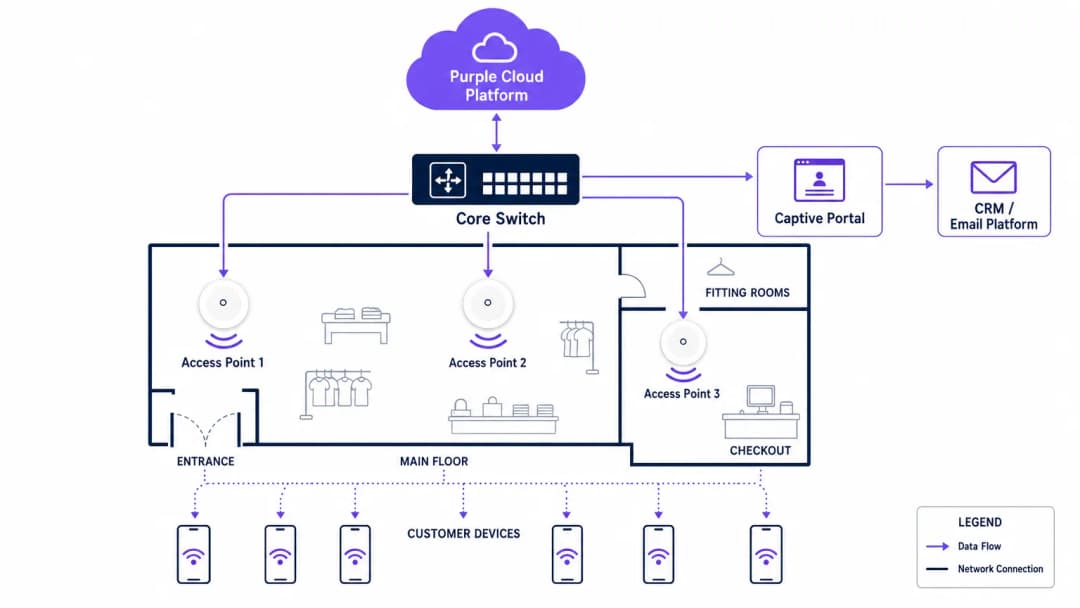
零售WiFi:店内WiFi如何推动销售、忠诚度和客流
本权威技术参考指南详细介绍了企业IT和运营团队如何将零售WiFi部署为战略商业资产。它涵盖了从基本连接到通过第一方数据采集、客流分析以及安全、高密度网络架构转变为收入生成基础架构的过程。
收听本指南
查看播客转录
- Executive Summary
- Technical Deep-Dive: Architecture and Standards
- The Radio Access Layer
- Network Infrastructure and Switching
- Authentication and the Captive Portal
- Security and Compliance
- Implementation Guide
- Step 1: Requirements Gathering and Stakeholder Alignment
- Step 2: RF Site Survey and Predictive Modelling
- Step 3: Infrastructure Deployment and Configuration
- Step 4: Captive Portal and CRM Integration
- Step 5: Analytics Calibration and Review
- Best Practices
- Troubleshooting & Risk Mitigation
- ROI & Business Impact

Executive Summary
For modern venue operators and retail enterprises, providing in-store WiFi is no longer merely a utility or a minor customer convenience; it is a critical commercial infrastructure layer. When IT architects and marketing leaders align on deployment, retail store WiFi transforms into a powerful engine for first-party data capture, footfall analytics, and personalised customer engagement.
This guide provides senior IT managers, CTOs, and network architects with a strategic framework for deploying high-density WiFi in retail stores. It moves beyond the basic provisioning of internet access to explore how the network access layer, captive portals, and analytics integrations combine to deliver measurable Return on Investment (ROI). We will examine the technical architecture required to support hundreds of simultaneous connections securely, the compliance mandates governing data collection, and the integration of platforms like Purple's Guest WiFi to drive loyalty and sales. Whether you are upgrading a single flagship location or standardising infrastructure across a global retail chain, this reference outlines the vendor-neutral best practices and architectural decisions necessary to build a network that serves both the user and the business.
Technical Deep-Dive: Architecture and Standards
A robust retail WiFi deployment requires a structured, multi-tiered architecture to ensure reliability, security, and data extraction capabilities. The infrastructure must support high client density while maintaining strict isolation between guest traffic and corporate or Point-of-Sale (POS) systems.
The Radio Access Layer
The foundation of any modern retail deployment is the radio access layer, which must be built on the IEEE 802.11ax standard, commercially known as Wi-Fi 6. For any new deployment in retail stores with WiFi, Wi-Fi 6 is the mandatory baseline. Its primary advantage in retail environments is not merely peak throughput, but its ability to handle high client density efficiently through Orthogonal Frequency-Division Multiple Access (OFDMA) and Basic Service Set (BSS) Colouring.
OFDMA allows a single wireless channel to be divided into smaller sub-channels, enabling an access point to communicate with multiple client devices simultaneously. In a busy retail environment, such as a department store during a peak trading period, this prevents the network degradation that plagued older Wi-Fi 5 deployments. BSS Colouring mitigates co-channel interference, which is particularly critical in multi-tenant retail parks where adjacent networks often overlap.
Network Infrastructure and Switching
Access points must connect back to a resilient wired infrastructure. Core and edge switches should provide adequate Power over Ethernet (PoE+) to support modern access points, alongside sufficient uplink capacity. A standard mid-sized retail store requires at least a 1-Gigabit uplink from edge to core, while high-density environments or flagship stores should aggregate at 10-Gigabit speeds.
The external internet circuit is frequently a neglected bottleneck. Venue operators should prioritise dedicated, symmetrical connections. As detailed in our guide on What Is a Leased Line? Dedicated Business Internet , a dedicated circuit provides the Service Level Agreements (SLAs) necessary to guarantee uptime for both guest services and critical retail operations.

Authentication and the Captive Portal
The captive portal is the critical interface where technical infrastructure meets commercial strategy. When a user connects to the guest network, they are intercepted and redirected to a branded portal requiring authentication. This is the mechanism for capturing first-party data.
Authentication methods typically include email, SMS, or social login, though email remains the most robust for long-term CRM integration. The portal must operate over HTTPS to secure user credentials in transit. Furthermore, the authentication process must integrate seamlessly with a WiFi Analytics backend to correlate the device's MAC address with the authenticated user profile, enabling subsequent behavioural tracking.
Security and Compliance
Security in a retail WiFi environment is twofold: protecting the corporate network and protecting the guest.
- Network Segmentation: Guest traffic must be logically isolated from corporate and POS traffic using Virtual Local Area Networks (VLANs). This is a mandatory requirement for Payment Card Industry Data Security Standard (PCI DSS) compliance. Mixing guest and payment traffic on the same subnet will result in an immediate audit failure.
- Encryption Standards: While open networks with captive portals remain common, the industry is shifting towards WPA3 encryption. WPA3-SAE (Simultaneous Authentication of Equals) provides forward secrecy, protecting past sessions even if a password is compromised. For enterprise devices, 802.1X authentication should be strictly enforced.
- Data Privacy (GDPR): The collection of first-party data via the captive portal must comply with regional privacy regulations, such as the GDPR in Europe. Consent must be explicitly given, specific, and unbundled from general terms and conditions. The WiFi platform provider must act as a compliant data processor.
Implementation Guide
Deploying a commercial-grade WiFi network requires a systematic approach to ensure both technical performance and business alignment.
Step 1: Requirements Gathering and Stakeholder Alignment
IT must not operate in a silo. Before selecting hardware, IT architects must align with marketing and operations directors to define the commercial objectives. Determine the required data capture fields for the captive portal, the integration points with existing CRM systems, and the specific analytics required (e.g., dwell time, zone flow).
Step 2: RF Site Survey and Predictive Modelling
A professional Radio Frequency (RF) site survey is non-negotiable. Relying on floor plans to estimate access point placement often results in coverage gaps in critical areas like fitting rooms or checkout queues.
Engineers should use predictive modelling software, followed by an active on-site survey, to account for attenuation caused by shelving, inventory, and architectural features. A general rule of thumb is one access point per 150-200 square metres, but high-density zones require specific capacity planning rather than just coverage planning.
Step 3: Infrastructure Deployment and Configuration
During physical installation, ensure all cabling meets Cat6a standards to support future multi-gigabit access points. Configure the network controllers to enforce client isolation on the guest VLAN, preventing peer-to-peer communication between connected devices. Implement Quality of Service (QoS) policies to throttle guest bandwidth, ensuring that critical retail operations (such as inventory scanners and POS terminals) receive priority.
Step 4: Captive Portal and CRM Integration
Design the captive portal to reflect the brand's identity while minimising friction. Keep data capture fields to a minimum—typically name and email address—to maximise conversion rates. Integrate the portal with the brand's CRM or marketing automation platform via API. This ensures that when a customer authenticates, their profile is immediately updated or created in the central database, triggering automated welcome workflows or loyalty program integrations.
Step 5: Analytics Calibration and Review
Once the network is live, calibrate the analytics platform to define specific physical zones within the store (e.g., 'Menswear', 'Entrance', 'Checkout'). Establish a monthly review cadence where IT and marketing teams analyse footfall trends, dwell times, and network performance metrics to refine both the network configuration and the store layout.

Best Practices
To maximise the ROI of retail WiFi, adhere to the following industry best practices:
- Prioritise First-Party Data: With the deprecation of third-party cookies, in-store WiFi is one of the most reliable sources of first-party data. Ensure your captive portal strategy is optimised for consent-driven data capture.
- Implement Profile-Based Authentication: Moving towards seamless, secure authentication methods, such as Passpoint (Hotspot 2.0), allows users to connect automatically across different venues without repeatedly navigating captive portals, significantly improving the user experience and data continuity.
- Leverage Location Analytics: Use the presence data generated by connected devices to understand customer flow. As seen in Retail environments, analysing which aisles receive the most traffic can inform merchandising and staffing decisions.
- Ensure Vendor Neutrality: Choose an analytics and captive portal overlay, like Purple, that is hardware-agnostic. This prevents vendor lock-in at the infrastructure layer and allows for standardised analytics across a mixed-hardware estate.
Troubleshooting & Risk Mitigation
Even well-designed networks encounter issues. Understanding common failure modes is essential for maintaining service continuity.
| Failure Mode | Symptom | Root Cause & Mitigation |
|---|---|---|
| Captive Portal Failure | Users connect to the SSID but receive no internet access and no login prompt. | Cause: DNS redirection failure or SSL certificate errors on the portal controller. Mitigation: Ensure the Walled Garden configuration allows DNS resolution and access to the portal's IP/hostname before authentication. Verify SSL certificates are valid and trusted. |
| High-Density Degradation | Slow throughput and frequent disconnects during peak trading hours. | Cause: Co-channel interference or insufficient AP capacity (too many clients per radio). Mitigation: Implement dynamic channel assignment. Upgrade to Wi-Fi 6 access points. Reduce transmit power to shrink cell sizes and encourage roaming to less congested APs. |
| Rogue Access Points | Unauthorised networks appearing with similar SSIDs (Evil Twin attacks). | Cause: Malicious actors attempting to intercept guest credentials. Mitigation: Enable Wireless Intrusion Prevention Systems (WIPS) on the network controller to detect and suppress rogue APs automatically. |
| VLAN Leakage | Guest devices can ping corporate IP addresses. | Cause: Misconfigured switch ports or missing Access Control Lists (ACLs) on the core router. Mitigation: Conduct regular penetration testing. Strictly enforce client isolation and verify ACLs block all RFC 1918 private address space from the guest VLAN. |
ROI & Business Impact
The ultimate measure of a retail WiFi deployment is its impact on the bottom line. IT leaders must articulate this value to the wider business.
- Increased Dwell Time: Reliable WiFi encourages customers to spend more time in-store, which directly correlates with increased basket size.
- Marketing Attribution: By tracking device MAC addresses, retailers can measure the offline impact of online campaigns. If a customer receives a promotional email and visits the store three days later, the WiFi network provides the attribution data.
- Loyalty Acquisition: The captive portal is a high-conversion acquisition channel for loyalty programs. Offering high-speed access in exchange for loyalty registration rapidly scales the program's user base.
- Operational Efficiency: Footfall analytics enable dynamic staffing models, ensuring adequate coverage during peak periods and reducing wage costs during quiet times.
By treating in-store WiFi as a strategic asset rather than a sunk cost, retail enterprises can build a network that not only connects devices but fundamentally drives sales, loyalty, and operational intelligence.
关键定义
Captive Portal
公共接入网络的用户在获得访问权限之前必须查看和交互的网页。这是认证、接受服务条款和数据采集的主要机制。
IT团队部署强制门户以保护网络并确保合规,而营销团队使用它们来获取客户数据并推动忠诚度计划注册。
MAC 地址 (媒体访问控制)
分配给网络接口控制器(NIC)的唯一标识符,用于在网络段内的通信中作为网络地址。
在零售WiFi分析中,MAC地址用于匿名跟踪设备在商店内的移动,提供停留时间和重复访问的数据,即使用户尚未认证。
Wi-Fi 6 (802.11ax)
第六代Wi-Fi标准,专门设计用于通过OFDMA和BSS着色等技术改善高密度环境中的性能。
升级零售基础设施时,IT经理指定Wi-Fi 6以确保网络能够处理数百个同时购物的顾客而不会降低性能。
VLAN(虚拟局域网)
一种逻辑子网络,将来自不同物理LAN的设备组合在一起。它允许网络管理员对单个交换网络进行分区,以匹配其系统的功能和安全需求。
VLAN在零售业中至关重要,用于将不受信任的访客WiFi流量与高度敏感的销售点(POS)流量分离,确保PCI DSS合规。
第一方数据
公司直接从其客户处收集并完全拥有的信息,例如电子邮件地址、购买历史和WiFi会话数据。
随着第三方跟踪Cookie的衰落,零售营销人员严重依赖访客WiFi网络来采集第一方数据以进行定向营销活动。
围墙花园
一种网络配置,允许未经认证的用户访问一组有限的特定网站或IP地址,同时阻止所有其他互联网访问。
IT团队配置围墙花园,以便用户在完全授权访问网络之前,可以访问强制门户登录页面和必要的认证服务(如社交媒体API)。
停留时间
客户在商店特定区域花费的时间长度,通过跟踪其设备与WiFi接入点的连接或探测请求来测量。
运营总监使用停留时间分析来评估商店布局、橱窗展示和促销端架的有效性。
PCI DSS(支付卡行业数据安全标准)
针对处理主要卡组织品牌信用卡的组织的信息安全标准。
IT架构师必须设计零售网络,确保访客WiFi接入不会危及支付基础设施的安全,避免严重的财务处罚。
应用实例
一家拥有50个地点的全国性零售连锁店,其当前访客WiFi网络的营销选择加入率很低(低于5%),该网络使用通用、非品牌化的登录页面。CTO需要增加数据采集以支持一项新的全渠道忠诚度计划。
IT团队在所有50个地点部署了集中的、硬件无关的强制门户解决方案。他们用一个品牌化、响应式的门户取代了通用登录页面,该门户清晰地阐述了价值交换:“登录即可免费使用高速WiFi并立即获得10%折扣码”。门户配置为仅采集姓名和电子邮件,减少摩擦。至关重要的是,该平台通过API与零售商的CRM集成。当用户认证时,其详细信息被推送到CRM,触发一封包含折扣码的自动电子邮件。网络还配置为记住设备的MAC地址,允许在后续访问这50个地点中任何一个时无缝认证。
一家大型百货商店在周末遭受严重的网络拥塞。顾客抱怨访客WiFi无法使用,商店经理报告销售点终端(共享物理网络基础设施)偶尔会断开连接。
网络架构师进行RF频谱分析,识别出严重的同频干扰和AP饱和。修复计划包括三个步骤:1) 将最高密度区域(美食广场、主入口)升级到Wi-Fi 6接入点以利用OFDMA。2) 在核心路由器上实施严格的服务质量策略,保证POS VLAN的带宽,并将访客VLAN流量限制在每个客户端5Mbps。3) 启用动态信道分配并降低接入点的发射功率以缩小小区尺寸,鼓励客户端设备更有效地漫游并减少重叠。
练习题
Q1. 您的零售客户想要实施访客WiFi网络来采集客户电子邮件。他们计划使用现有的扁平网络架构,将新的访客接入点直接连接到处理POS终端的同一交换机,而不进行VLAN分段。这种方法的主要风险是什么?
提示:考虑处理支付所需的安全标准。
查看标准答案
主要风险是严重违反PCI DSS合规性。扁平网络允许不受信任的访客设备可能通信或拦截来自POS终端的流量。必须使用VLAN将卡持人数据环境与访客网络隔离。
Q2. 一家场所运营商注意到,尽管店内人流量很高,但强制门户的采集率低于2%。门户目前要求填写名字、姓氏、电子邮件、电话号码、出生日期和邮政编码。IT和营销团队应如何解决这个问题?
提示:考虑认证过程中的摩擦。
查看标准答案
低采集率是由于认证过程中摩擦过多。团队应重新设计强制门户,只要求最低必要信息——通常仅姓名和电子邮件,或提供社交登录选项。一旦建立了初步关系,可以使用渐进式资料收集来获取更多详细信息。
Q3. 一家繁忙购物中心新部署的Wi-Fi 6网络性能不佳。IT经理注意到所有接入点都在2.4GHz频段以最大功率传输。需要进行什么配置更改?
提示:考虑RF信号在密集环境中如何交互。
查看标准答案
接入点可能因为小区尺寸过大且重叠而导致严重的同频干扰。IT经理应降低接入点的发射功率,特别是在2.4GHz频段,以缩小小区尺寸。他们还应确保启用动态信道分配,并鼓励客户端在可能的情况下转向5GHz频段。
继续阅读本系列
Staff WiFi 对比 Guest WiFi:企业网络分段最佳实践
针对 IT 领导者的全面技术指南,介绍如何对 staff 和 guest WiFi 网络进行分段。内容涵盖 VLAN 架构、802.1X 认证、防火墙策略以及安全网络设计对业务的影响。
公寓 WiFi 解决方案:面向企业的全面指南
本指南涵盖了 BTR(建设出租)和多户住宅物业中公寓 WiFi 解决方案的架构、部署和商业案例。它解释了 Identity Pre-Shared Key (iPSK) 技术如何为每位住户创建安全、隔离的网络气泡,同时支持智能设备和物联网。物业开发商、房东和 BTR 运营商将在此找到具有可行性的部署指导、投资回报率 (ROI) 数据以及实际实施场景。
Cox business managed WiFi:企业综合指南
本指南详细介绍了房地产开发商和 BTR 运营商如何利用 Cox Business 托管 WiFi 部署可扩展且安全的网络。它涵盖了网络架构、独立于厂商的硬件部署,以及将网络连接从运营烦恼转变为可靠基础设施对业务产生的影响。