What is your in-store WiFi worth?
Estimate the contacts, campaign revenue and analytics value guest WiFi adds to a store, with every assumption on show.
Your store
WiFi and marketing
Returning shoppers are already on your list.
Unticked box, WiFi available either way.
Analytics
Your own estimate of what better layout, staffing and hours add. Set to 0% to count marketing only.
Estimated annual value, year one
How this is calculated
- Contacts = footfall x 25% sign-in x 65% new shoppers x 40% marketing opt-in, x 12 months.
- Campaign revenue = average year-one list (half the year-end list) x 3% extra purchases per contact per month x 12 x average basket.
- Analytics uplift = footfall x basket x 12 x the uplift you set. It is your assumption, not a benchmark.
- Unsubscribes and WiFi platform costs are not deducted. Prove campaign attribution with a hold-out group that receives no messages.
Welcome, win-back and post-visit messages sent by email or SMS to shoppers who opted in on the splash page. Triggers use visit recency and frequency from WiFi sign-ins.
- Welcome message on first sign-in, win-back after a set number of days away
- Post-visit feedback survey while the visit is fresh
- Sync to Salesforce, HubSpot, Klaviyo or Mailchimp so campaigns use one list
Get this modelled for your store estate
Works on the access points you already have: Cisco Meraki, HPE Aruba, Ruckus, Juniper Mist, Ubiquiti UniFi, Cambium, Extreme and Fortinet.
Every day, millions of us use our cell phones, laptops, tablets, and wearable technology to connect to public WiFi access points (WAP). Ultimately, we expect to be connected wherever we go, and rely on established venues like shopping malls, department stores, and chain stores to provide us with reliable and secure in-store WiFi.
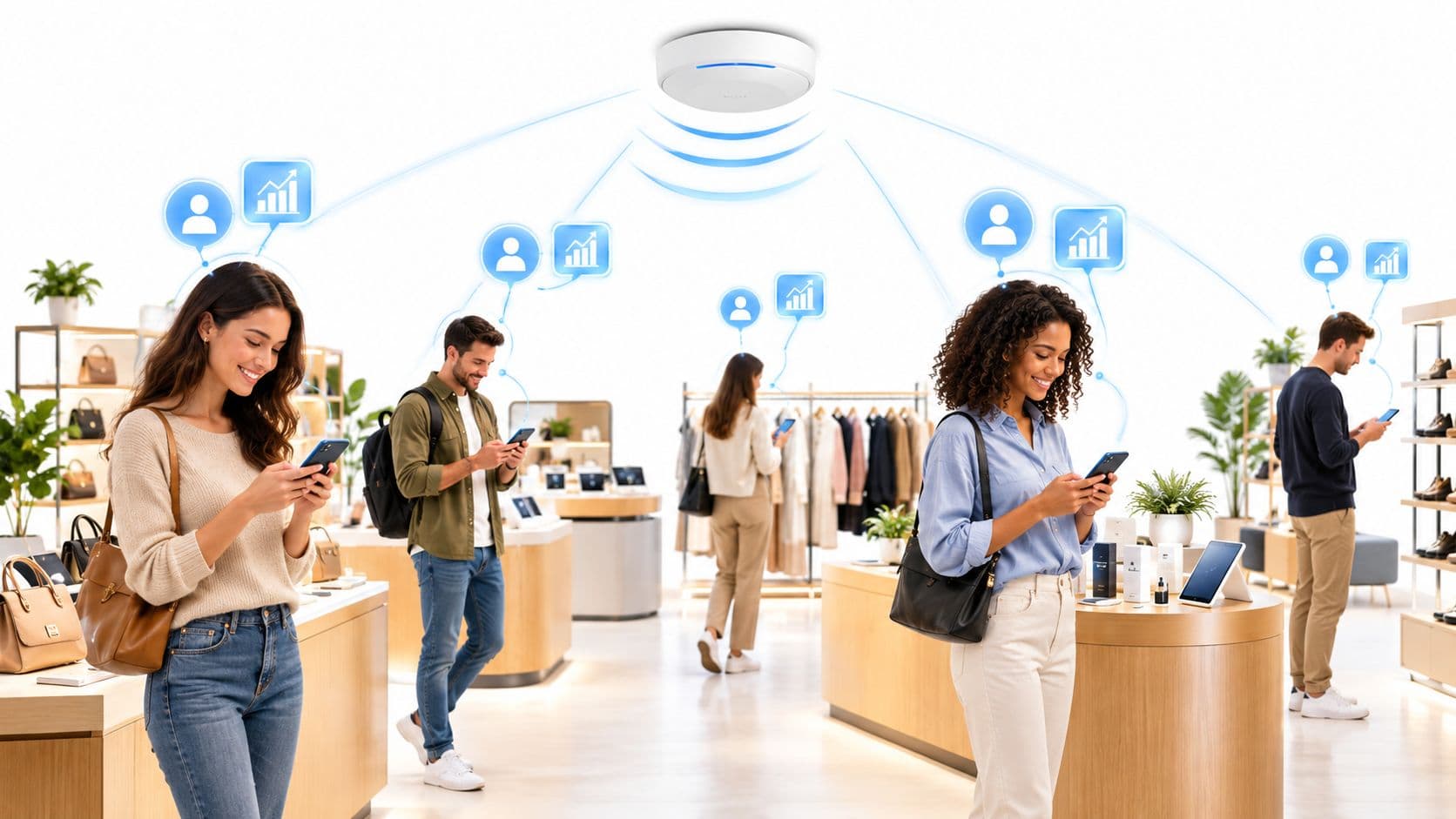
With so many shoppers eagerly connecting to in-store WiFi in retail, the opportunity exists for retailers to turn a simple connectivity service like WiFi into a business analytics tool. By truly understanding customer behavior, such as what stores they enter, where they spend their time, and their general path through the venue, essential marketing and operational teams can deliver more value to their business and its customers in a multitude of ways. For example, retail venues can change where products are placed in the store along popular walkways to encourage sales; shape the flow of foot traffic to better serve customers at peak times; understand how employees are using spaces in the business; and ensure the store layout is clear enough to enable customers to find things easily and enjoy their shopping experience.
In addition to gaining a wealth of customer location data, businesses can also tailor their WiFi offering to continually learn and adapt to the needs of their customers. For example, if a customer signs up to public WiFi using a social media login method, retailers can then use their volunteered profile data (age, gender, location, likes), to inform the customer of relevant product information and tailored offers in real-time. This can be achieved easily via SMS messaging and emails, as deals can be sent to a customer when visiting certain aisles; remind customers of areas they've missed based on their previous traffic flow; guide customers to where they can be better served or where an associate is free; and help customers gather in the right places for product demos.
In the same way that the web has revolutionized advertising by allowing direct measurement of marketing success, WiFi location analytics is helping marketing teams drive KPIs that are tied to relevant location metrics. This is particularly true for retail businesses interested in how effective their advertising, store layout and marketing communications are. For instance, if you were a marketing or sales team for a product in a supermarket, it's highly beneficial to know how many people reached certain points in your store. With this sort of data, retailers can ensure their product is seen by more customers, and can ultimately drive profits through in-store WiFi technology. Marketing teams could also consider the other possibilities with WiFi marketing, such as 'sales funnels' like we do in web advertising.
Overall, there is a great deal of business opportunity surrounding wireless - it's far more than just a basic WAP providing an internet connection. It's changing the way retailers (and many other industries) do business, and is an integral part of bringing the world of retail forward as we integrate further into the Internet of Things. Having the vision and tools to accomplish this has not always been easy, but nowadays there are companies out there that are paving the way with WiFi analytics for businesses. With networking specialists like Softcat and companies like us, Purple, who have created cloud-based software that overlays WiFi hardware to create 'Intelligent Spaces', there are options to start using your in-store WiFi to its full potential.