
How to Optimize Captive Portals for Maximum Network Security and User Conversion
本指南為企業場域最佳化 Captive Portal 提供完整的技術藍圖,涵蓋網路分段架構、驗證方式選擇、符合 GDPR 規範的同意書設計以及轉換率最佳化。本書專為飯店、連鎖零售、體育場館和公共部門機構的 IT 經理、網路架構師及 CTO 撰寫,協助其在網路安全與第一方數據收集之間取得平衡。Purple 在全球超過 80,000 個場域營運 Captive Portal 基礎設施,並於 2024 年處理了 4.4 億次登入,本指南中的框架即反映了這些實務營運經驗。
收聽此指南
查看播客逐字稿
執行摘要
Captive Portal 是公共 WiFi 上的登入頁面。它也是您最重要的網路安全決策;如果您正在執行行銷專案,它更是您最寶貴的數據收集介面。安全與轉換這兩個目標並不衝突,但它們需要不同的設定決策,本指南將同時涵蓋這兩者。
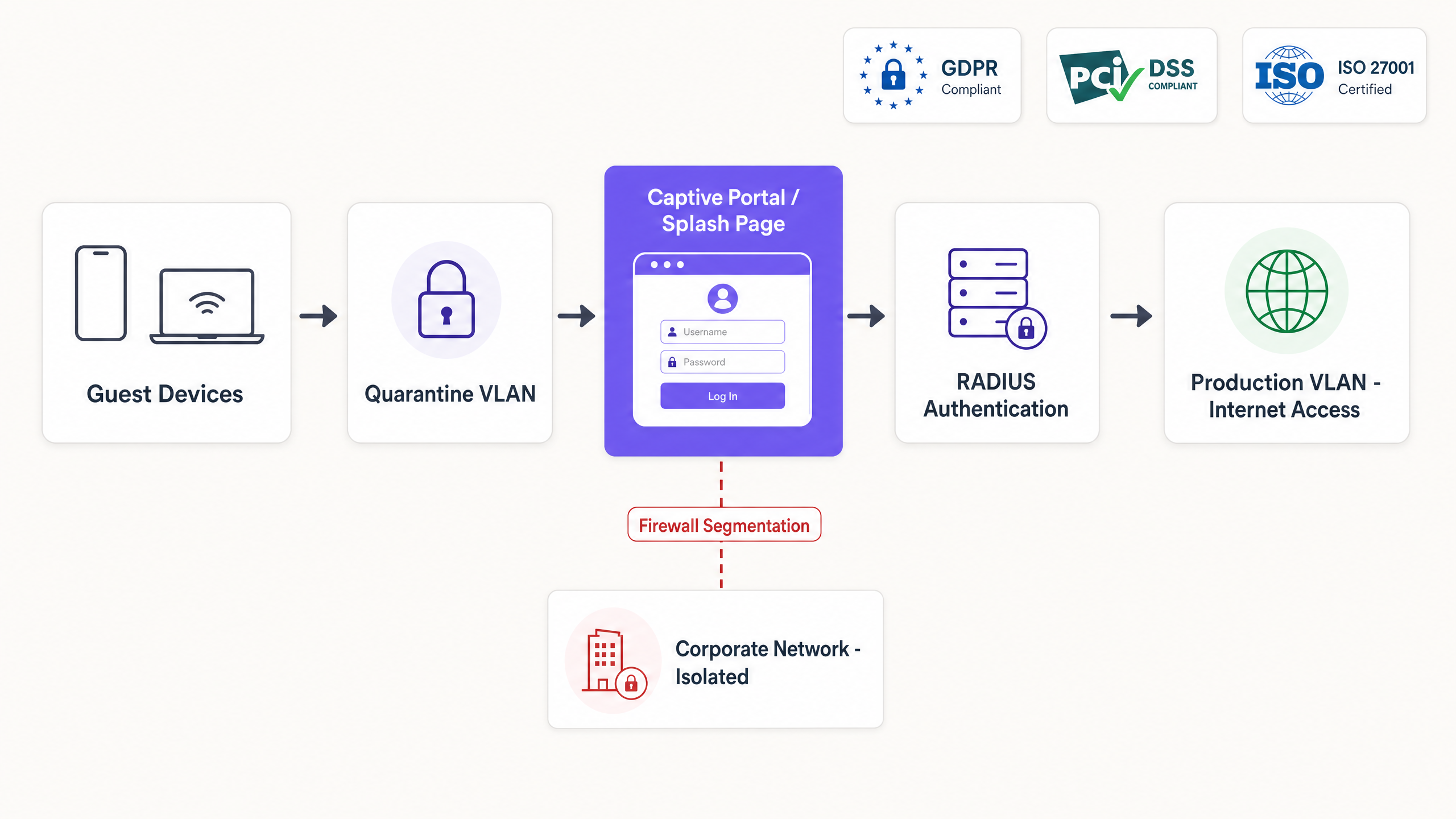
核心架構會將每個訪客裝置置於隔離 VLAN 中,直到驗證完成。RADIUS 伺服器負責管理工作階段,並透過授權變更 (CoA) 訊息將裝置釋放至生產 VLAN。網路分段可確保訪客流量絕不會接觸到企業基礎設施或銷售點 (POS) 系統。在付款終端與訪客 WiFi 共用實體基礎設施的任何環境中,這都是 PCI DSS 的規範要求。
在轉換率方面,每增加一個表單欄位,選擇加入率 (opt-in rate) 就會降低 8% 到 12%。選擇合適的驗證方式取決於您的場域類型和數據目標。收集電子郵件可帶來 65% 至 80% 的轉換率,並能直接擁有數據。透過 OAuth 2.0 進行社群登入可減少阻力,但會帶來第三方依賴風險。簡訊一次性密碼 (SMS OTP) 提供最高的數據品質,但轉換率最低。一鍵登入 (Click-through) 則是無行銷目標之公共部門環境的正確選擇。
Purple 在全球超過 80,000 個場域營運 Guest WiFi 基礎設施。本文件中的指引反映了 2024 年處理的 4.4 億次登入(Purple 內部數據,2024 年)。
技術深度解析
Captive Portal 的實際運作原理
在裝置與 SSID 建立關聯後,Captive Portal 會攔截 HTTP 和 HTTPS 請求。無線基地台 (AP) 會將裝置置於隔離 VLAN 中,此時防火牆僅允許 DNS 查詢和一組少數預先核准的目的地(即圍牆花園,walled garden)。裝置的作業系統會透過探測已知 URL(例如 iOS 上的 captive.apple.com 或 Android 上的 connectivitycheck.gstatic.com)來偵測此受限狀態。當探測返回非預期的回應時,作業系統會自動啟動該 Portal。
使用者進行驗證。Portal 透過 CoA 訊息將結果傳送至網路的 RADIUS 伺服器。存取控制器 (AC) 會解除隔離限制,將裝置移至生產 VLAN,並記錄包含時間戳記、MAC 位址、身分和套用原則的工作階段。根據驗證方式的不同,此端到端流程需要一到十秒不等。
網路分段
隔離 VLAN 是必不可少的。若沒有它,開放式 SSID 上未經驗證的裝置就可以探測內部網路、存取管理介面或接觸銷售點 (POS) 系統。在 PCI DSS 適用範圍的環境中(即刷卡終端與客用 WiFi 共用實體基礎設施的任何場域),支付卡產業資料安全標準 (PCI DSS) v4.0 要求持卡人資料環境與客用網路之間必須進行完全的網路隔離。
分段是在存取控制器層級實作的。在 Cisco Meraki 上,這是透過群組原則 (Group Policies) 進行設定;在 HPE Aruba 上,透過使用者角色 (User Roles);在 Ruckus 上,透過區域 (Zone) 設定;在 Juniper Mist 上,則透過 WLAN 原則。這四個平台的原理完全相同:未經驗證的裝置會收到受限原則,而已驗證的裝置會收到生產原則。RADIUS 伺服器負責執行此轉換。
對於有多種使用者類型(訪客、員工、承包商)的場域,請部署獨立的 SSID,每個 SSID 各自對應到具有專屬防火牆規則和頻寬原則的獨立 VLAN。請勿嘗試透過單一 SSID 和單一 Captive Portal 來服務所有使用者類型。原則管理的複雜性遠超過任何想像中的便利性。
保護無線邊緣安全
Captive Portal 運作於第 7 層(應用層)。它不會加密無線連結。在開放式 SSID 上,裝置與無線基地台之間的流量是未加密的,且對無線電訊號範圍內的任何裝置都是可見的。
有三種方法可以解決此問題:
結合 Captive Portal 的 WPA3。 WPA3-Personal 提供對等同時驗證 (SAE),可消除針對 WPA2-PSK 的離線字典攻擊。Captive Portal 仍會觸發進行驗證,但無線連結已加密。這是 2026 年新部署的最低可接受標準。
結合 802.1X 的 Passpoint (Hotspot 2.0)。 Passpoint 使用 EAP-TLS 或 PEAP 提供基於憑證或憑證認證的驗證。Captive Portal 處理初始的引導上線 (onboarding) 和同意書收集。在第二次造訪時,Passpoint 會使用已配置的設定檔自動對裝置進行驗證,完全繞過 Portal。這是電信級漫遊標準 OpenRoaming 所採用的架構。如需有關 EAP 方法的更多詳細資訊,請參閱我們的指南: EAP 方法 WiFi:安全網路存取指南 。
iPSK (Identity Pre-Shared Key)。 iPSK 透過 Portal 為每個使用者或裝置分配唯一的 WPA2 或 WPA3 密碼。該密碼儲存在 RADIUS 伺服器中,並對應到特定的 VLAN 和原則。這在共享的 SSID 上提供了個人化的加密和歸責性,而無需完整 802.1X 部署的基礎設施開銷。這是專建專租 (build-to-rent) 和學生住宿環境中多租戶 WiFi 的標準架構。
如需基於憑證的驗證詳細資訊,請參閱 WiFi 憑證驗證:安全網路存取 。
實作指南
步驟 1:定義圍牆花園
對應驗證所需的每個外部相依關係在設定入口網頁之前。如果您提供 Google 社群登入,請將 accounts.google.com 及相關的 Google 驗證網域加入白名單。如果您使用 Stripe 進行付費存取,請將 Stripe 的 API 端點加入白名單。如果您使用 Apple 登入,請將 appleid.apple.com 加入白名單。
未能維護精確的圍牆花園(walled garden)是生產環境中 Captive Portal 載入失敗的主要原因。請使用圍牆花園驗證工具為您的特定控制器生成可直接複製貼上的規則。Purple 提供免費的 Walled Garden Domain Validator,可為 Cisco Meraki、Ubiquiti UniFi、HPE Aruba 和 Catalyst 控制器輸出即用型規則。
步驟 2:設定 RADIUS 整合
將您的存取控制器與雲端 RADIUS 供應商整合。設定控制器將未經驗證的流量重導向至入口網頁 URL,並指定用於驗證和計費的 RADIUS 伺服器。確保 RADIUS 共用金鑰至少為 22 個字元,包含大小寫字母與特殊字元,且每 90 天輪替一次。
對於 Cisco Meraki 部署,請在「Wireless > Access Control」下設定 RADIUS 伺服器。對於 HPE Aruba,請在「Security > Authentication Servers」下設定。對於 Ruckus,請在「Services > Authentication」下設定。對於 Juniper Mist,請在「Network > WLAN」下設定。
步驟 3:選擇驗證方式
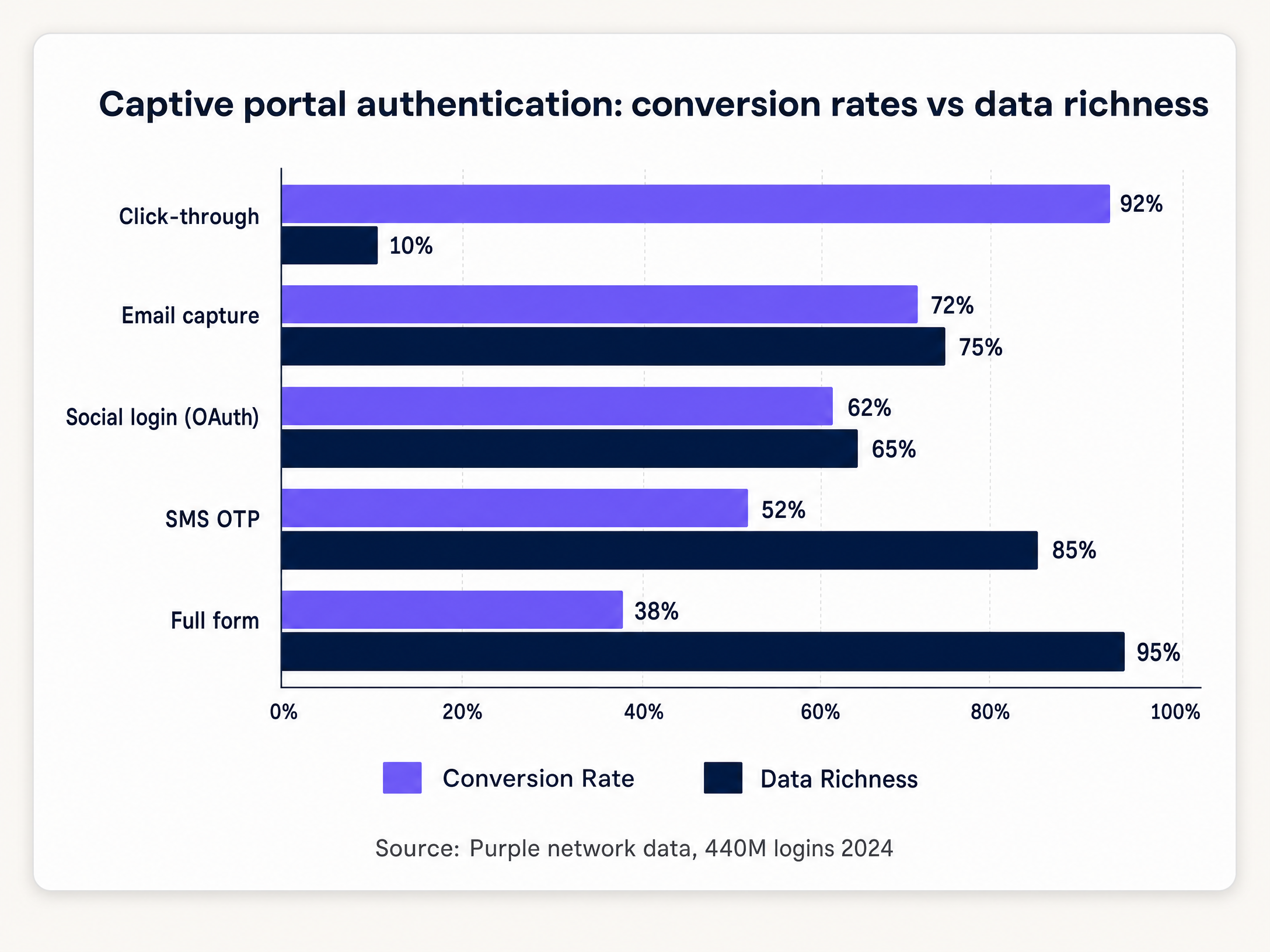
下表將場域類型與建議的驗證方式及預期轉換率範圍進行對照。
| 場域類型 | 建議方式 | 預期轉換率 | 收集的資料 |
|---|---|---|---|
| 飯店與餐旅 | 電子郵件收集 + 社群登入 | 65-80% | 電子郵件、姓名、選填的人口統計資料 |
| 零售 | 電子郵件收集 | 68-75% | 電子郵件、姓名 |
| 體育場與活動 | 簡訊一次性密碼 (SMS OTP) | 45-55% | 已驗證的手機號碼 |
| 會議中心 | 社群登入 + 電子郵件 | 60-70% | 電子郵件、專業個人檔案 |
| 公共部門 | 一鍵登入 (Click-through) | 90-95% | 僅限 MAC 位址、時間戳記 |
| 醫療保健 | 一鍵登入 (Click-through) | 90-95% | 僅限 MAC 位址、時間戳記 |
來源:Purple 網路數據,4.4 億次登入,2024 年。
步驟 4:設計同意流程
將網路存取所需的條款與行銷傳播所需的同意區分開來。根據英國 GDPR(保留在英國法律中的歐盟法規 (EU) 2016/679),這是兩個不同的合法基礎。
網路存取可根據第 6(1)(f) 條的合法利益授予,涵蓋網路管理與安全。行銷傳播則需要根據第 6(1)(a) 條取得明確同意。同意必須是自由給予、具體、知情且明確的。預先勾選的核取方塊並不符合此標準。
在入口網頁上實作兩個不同的核取方塊。第一個為必填,涵蓋服務條款與網路存取。第二個為選填且預設不勾選,涵蓋行銷訂閱。記錄每個工作階段的時間戳記、IP 位址、MAC 位址和同意狀態。此稽核軌跡是您在面臨監管機構查詢時的合規證據。
步驟 5:透過 RADIUS VSA 套用頻寬原則
設定 RADIUS 伺服器在驗證成功後傳回廠商專屬屬性 (VSA)。VSA 會指示存取點套用特定的頻寬限制、內容過濾和工作階段逾時。
在 HPE Aruba 上,Aruba-User-Role VSA 會將使用者分配到具有預定義原則的具名角色。在 Cisco Meraki 上,群組原則 ID 會透過 Filter-Id 屬性傳回。在 Ruckus 上,Ruckus-User-Groups 屬性會將使用者對照到已設定的群組。此機制可實現動態原則強制執行,而無需為不同的使用者層級設定個別的 SSID。
最佳實作
轉換率最佳化
漸進式剖析(Progressive profiling)的效果優於單一工作階段的資料收集。在首次造訪時詢問電子郵件地址。在第二次造訪時,要求提供出生日期或郵遞區號。在第三次造訪時,詢問行銷偏好。這種方法能在維持高轉換率的同時,隨著時間建立更豐富的使用者設定檔。
超過 85% 的 Captive Portal 互動發生在行動裝置上(Purple 內部數據,2024 年)。請針對小螢幕進行設計。按鈕必須足夠大,以便在不縮放的情況下進行點擊。文字在預設字型大小下必須清晰易讀。登入流程必須在三次點擊內完成。
對於 零售 部署,請將入口網頁與您的 CRM 或會員平台整合。Pizza Express 使用品牌專屬的 Captive Portal,在兩年內將 370 萬名顧客加入其 CRM,將每次 WiFi 連線轉化為已驗證的行銷訂閱(Purple 客戶數據,Pizza Express)。該入口網頁成為會員註冊和促銷再行銷的主要管道。
行為分析整合
Captive Portal 工作階段是實體場域分析與數位行銷系統之間的關聯鍵(join key)。每個經過驗證的工作階段都會生成一個包含時間戳記、停留時間和重複造訪狀態的客流量事件。與 WiFi Analytics 整合後,這些數據可推動客流量歸因、人口統計區隔以及行銷活動投資報酬率 (ROI) 的衡量。
如需深入了解來自 WiFi 網路的行為數據如何為場域營運提供資訊,請參閱 行為分析:WiFi 網路洞察 。
安全強化
僅透過 HTTPS 提供入口網頁,並使用來自受信任憑證授權單位 (CA) 的有效 TLS 憑證。HTTP 入口網頁會使使用者憑證面臨被攔截的風險,並觸發會降低轉換率的瀏覽器安全警告。實作 HTTP 嚴格傳輸安全 (HSTS),其最小 max-age 為 31536000 秒。
在驗證端點上實作速率限制。若沒有速率限制,入口網頁很容易受到憑證填充(credential stuffing)和針對優惠券代碼的暴力破解攻擊。限制驗每個 IP 位址每分鐘的驗證嘗試限制為五次。
每年至少對 Portal 應用程式進行一次滲透測試。Purple 擁有 ISO 27001 認證和 Cyber Essentials 認證,並定期接受第三方滲透測試。對於 醫療保健 和 交通運輸 部署,每季測試是合適的標準。
疑難排解與風險緩釋
Portal 頁面未顯示
這是最常見的故障模式。裝置的作業系統會向已知 URL 發送 Captive 探測。如果防火牆封鎖了該網域,作業系統就無法偵測到 Captive 狀態,且 Portal 永遠不會自動啟動。使用者必須手動導覽至非 HTTPS URL 才能觸發重新導向。
請先檢查圍牆花園(Walled Garden)設定。確保在驗證前可存取以下網域:captive.apple.com、www.apple.com、connectivitycheck.gstatic.com、clients3.google.com 和 msftconnecttest.com。這些分別是 iOS、Android 和 Windows 所使用的探測 URL。
MAC 位址隨機化
iOS 14 和 Android 10 預設引入了針對每個網路的 MAC 位址隨機化。再次連線的裝置在每次連線時都會呈現新的 MAC 位址,從而破壞了工作階段(Session)的持續性。Portal 會重新要求使用者進行驗證,他們必須重新登入。
若要緩解此問題,可在首次登入時佈署 Passpoint 設定檔。該設定檔包含裝置用於後續連線的憑證,從而完全繞過基於 MAC 的識別。或者,使用基於應用程式的驗證流程,該流程依賴於儲存在 App 中的身分識別權杖,而不是裝置的 MAC 位址。
大規模部署下的 DHCP 與 DNS 耗盡
在大型場館(如體育場、會議中心、交通樞紐)中,數千台裝置會在活動或會議開始時同時連線。如果 DHCP 網址池容量不足,裝置將無法取得 IP 位址。如果 DNS 伺服器無法處理龐大的查詢量,Captive 探測就會失敗,且 Portal 頁面不會顯示。
請根據尖峰同時連線數(而非平均值)來規劃 DHCP 網址池的大小。對於擁有 60,000 個座位的體育場,假設有 40,000 台同時連線的裝置。分配一個至少包含 50,000 個位址的 DHCP 網址池,並設定較短的租期(15 至 30 分鐘)以快速回收位址。為訪客網路部署專用的 DNS 解析器,與企業 DNS 基礎架構分開。
OAuth 供應商 API 變更
社群登入供應商會在不另行通知的情況下變更其 API 條款。Facebook 已逐步限制透過其 Graph API 可取得的資料。如果社群登入是您唯一的驗證方式,且供應商變更了其條款,您的 Portal 將對所有使用者失效。
請務必在社群登入之外,部署至少一種非 OAuth 方法。收集電子郵件是標準的備用方案。在 OAuth 驗證端點上設定監控,以便在錯誤率上升時發出警報,這通常發生在 API 變更之前或與之同時發生。
投資報酬率(ROI)與商業影響
如果僅以基礎架構支出來衡量,Captive Portal 是一個成本中心。但如果以其擷取的資料價值以及所實現的行銷計畫來衡量,它就是一項營收資產。
一個擁有 500 家分店的零售連鎖品牌,若每家分店每月處理 10,000 次登入,且訂閱率(Opt-in rate)為 65%,每年可產生 3,900 萬個經驗證的 CRM 聯絡人。保守估計,每年每個聯絡人的電子郵件行銷營收歸因值為 0.10 英鎊,那麼單一資料擷取管道就能帶來 390 萬英鎊的歸因營收。
對於 餐旅 營運商而言,Portal 是顧客旅程中的第一個接觸點。Premier Inn 和 Whitbread 使用訪客 WiFi 資料來規劃忠誠度計畫的設計,並衡量 WiFi 互動與重複訂房率之間的關聯性(Purple 客戶資料,Whitbread)。
對於交通運輸營運商而言,Portal 提供了旅客流量資料,可用於評估零售配置、人力安排決策和特許經營表現。曼徹斯特機場集團(MAG)使用 WiFi 分析來衡量航廈區域的旅客停留時間,並將 WiFi 工作階段資料與每位旅客的零售消費進行關聯分析(Purple 客戶資料,MAG)。
請根據三個指標來衡量 Portal 的效能:訂閱率(電子郵件收集目標高於 60%)、資料品質率(通過驗證的電子郵件地址百分比,目標高於 80%)以及重複造訪率(無需重新輸入憑證即可進行驗證的返回使用者百分比,目標高於 70%)。
Purple 的 WiFi 分析 平台在所有場館中即時提供這些指標,並可按地點、時間段和使用者群體進行細分。
關鍵定義
Captive portal
A web application that intercepts network traffic after a device associates with an SSID, requiring user interaction (authentication, payment, or terms acceptance) before granting internet access.
The primary mechanism for onboarding visitors onto public or guest WiFi networks. Every device that connects passes through it, making it the most consistent data capture surface in a physical venue.
Walled garden
A restricted network environment that allows access only to specific, approved IP addresses or domains prior to authentication.
Required to allow devices to reach the captive portal page, DNS servers, and necessary third-party authentication services before full internet access is granted. Misconfiguration is the leading cause of portal rendering failures.
RADIUS (Remote Authentication Dial-In User Service)
A networking protocol that provides centralised authentication, authorisation, and accounting management for users connecting to a network service.
The standard protocol used by captive portals to communicate with access points and controllers. Every enterprise-grade access point from Cisco Meraki, HPE Aruba, Ruckus, Juniper Mist, and Ubiquiti UniFi supports RADIUS.
Change of Authorisation (CoA)
A RADIUS extension defined in RFC 5176 that allows a server to dynamically modify the authorisation attributes of an active session.
Used by the captive portal to instruct the access controller to move a device from the quarantine VLAN to the production VLAN immediately after successful login, without requiring the device to reconnect.
Passpoint (Hotspot 2.0)
An IEEE 802.11u-based standard that enables mobile devices to automatically discover and connect to WiFi networks securely using 802.1X authentication, without manual portal interaction.
The standard approach for returning-user authentication in enterprise venues. The captive portal handles first-visit onboarding and consent capture; Passpoint handles all subsequent visits silently and securely.
VLAN (Virtual Local Area Network)
A logical subnetwork that groups devices from different physical network segments, enforcing traffic isolation at the data link layer.
Used to segment guest traffic from corporate traffic. Without VLAN segmentation, a guest device on the same physical switch as a point-of-sale terminal can probe or attack it.
iPSK (Identity Pre-Shared Key)
A security method where each user or device is assigned a unique WPA2 or WPA3 passphrase for the same SSID, stored and enforced by the RADIUS server.
Provides individualised encryption and per-user policy enforcement on a shared SSID without the infrastructure overhead of a full 802.1X deployment. Standard architecture for Multi-Tenant WiFi.
MAC address randomisation
A privacy feature in iOS 14+, Android 10+, and Windows 10+ that generates a per-network randomised MAC address to prevent cross-network device tracking.
Breaks MAC-based session persistence on captive portals. A returning device presents a new MAC address, triggering re-authentication. Mitigated by Passpoint profiles or app-based identity tokens.
Vendor-Specific Attribute (VSA)
A RADIUS attribute in the vendor-specific namespace (attribute 26) that carries hardware-vendor-specific policy instructions from the RADIUS server to the access controller.
Used to assign bandwidth limits, VLAN IDs, content filter policies, and session timeouts dynamically based on the authenticated user's profile. Each hardware vendor (Aruba, Meraki, Ruckus) defines its own VSA namespace.
範例
A 200-room hotel using HPE Aruba access points needs tiered WiFi: basic free access for standard guests and high-speed access for loyalty members. How should the captive portal and network be configured?
Deploy a single guest SSID across the property. Configure the captive portal to integrate with the hotel's Property Management System (PMS) via API. Present two authentication options on the portal: 'Log in with Room Number and Name' and 'Log in with Loyalty Credentials'. When a loyalty member authenticates, the portal queries the PMS, verifies the tier, and sends a RADIUS CoA to the Aruba controller. The RADIUS response includes an Aruba-User-Role VSA assigning the user to a high-bandwidth role (for example, 50 Mbps down, 20 Mbps up). Standard guests receive a default rate-limited role (5 Mbps down, 2 Mbps up). Both user types connect to the same SSID and VLAN, but receive different bandwidth policies enforced by the controller.
A national retail chain with 500 locations wants to implement guest WiFi to capture email addresses for marketing. The legal team has flagged GDPR compliance concerns. How should the portal consent flow be designed?
Design a portal with a single email input field. Below the field, implement two distinct checkboxes. Checkbox 1 (mandatory, unticked by default): 'I accept the Terms of Service and Privacy Policy. I understand that my device data will be processed to provide network access.' Checkbox 2 (optional, unticked by default): 'I consent to receive marketing communications, offers, and promotions by email.' Configure the backend to log the timestamp, IP address, MAC address, and the state of both checkboxes for each session. Store this consent audit trail in a GDPR-compliant data store with a retention period aligned to the marketing programme (typically 24 months from last interaction). Integrate the email addresses from Checkbox 2 opt-ins directly into the CRM via API.
練習題
Q1. A stadium IT director reports that during halftime, the captive portal fails to load for thousands of users simultaneously, even though WiFi signal strength is strong across the venue. What is the most likely architectural bottleneck, and what is the remediation?
提示:Consider the services a device requires before it can even request the portal page. Signal strength is not the constraint.
查看標準答案
The most likely bottleneck is DHCP pool exhaustion or DNS resolver overload. When thousands of devices connect simultaneously, each must obtain an IP address via DHCP and resolve the OS captivity probe URL via DNS before the portal can load. If the DHCP pool is undersized or the DNS server cannot handle the query volume, the process stalls before the user sees anything. Remediation: size the DHCP pool for peak concurrent connections (not average), set a short lease time of 15 to 30 minutes to recycle addresses, and deploy a dedicated DNS resolver for the guest network with sufficient capacity for peak query rates.
Q2. You are deploying a captive portal in a hospital waiting room. The primary goal is providing internet access for patients and visitors. There is no marketing objective. Which authentication method should you choose, and what are the compliance implications?
提示:Balance friction against the value of the data collected. Consider what happens when you collect personal data you do not need.
查看標準答案
Click-through (terms and conditions only) is the correct choice. It delivers 90 to 95% conversion with minimal friction. Since there is no marketing objective, collecting personal data such as email addresses introduces GDPR compliance obligations (lawful basis, data minimisation, retention policies, subject access rights) without providing any business value. In a healthcare environment, the reputational risk of a data breach involving patient or visitor personal data is particularly significant. Click-through limits data collection to MAC address and timestamp, which is sufficient for network management under legitimate interest.
Q3. A retailer wants to offer Google and Apple social login on their captive portal. Their network uses Cisco Meraki access points. What network configuration is mandatory for social login to function, and what is the fallback risk?
提示:How does the device reach the identity provider before it has internet access? What happens if the provider changes its terms?
查看標準答案
You must configure the walled garden on the Meraki access controller to whitelist the authentication domains for both providers: accounts.google.com and associated Google OAuth endpoints, and appleid.apple.com and associated Apple authentication endpoints. Without these entries, the quarantine VLAN will block the OAuth request, and social login will fail silently. The fallback risk is provider API change: if Google or Apple modifies its OAuth terms or API endpoints, the authentication flow breaks for all users who rely on that method. Always deploy email capture as a parallel authentication option so users have a non-OAuth fallback.
Q4. A conference centre operator wants to use SMS OTP as the primary authentication method for a three-day event with an expected 8,000 unique logins per day. What cost implications should be modelled before committing to this method?
提示:SMS OTP has a per-message cost. Calculate the total at scale and consider the conversion rate impact.
查看標準答案
At 8,000 logins per day over three days, you are processing 24,000 SMS messages. At a typical UK carrier rate of 2 to 5 pence per message, the cost is between £480 and £1,200 for the event. If attendees are international, costs increase significantly (up to 10 to 15 pence per message for some markets). Additionally, SMS OTP conversion rates are 45 to 55%, meaning approximately 4,400 to 4,800 of the 8,000 expected logins will complete. The remaining attendees will need an alternative method. Model the per-message cost, factor in the conversion rate, and ensure a fallback method (email capture or click-through) is available for users who do not complete SMS verification.
繼續閱讀本系列
如何在 Starlink 上設定 Captive Portal:偏遠地區與海事場所指南
本指南詳細介紹如何繞過 Starlink 原生硬體,並使用企業級路由設備整合雲端管理的 Captive Portal。您將學習如何克服 CGNAT 限制、強制執行 VLAN 隔離、管理衛星頻寬限制,並確保符合法規規範。
飯店客房 WiFi 管理:整合 PMS、Captive Portal 與品牌標準
本技術指南詳細介紹如何建構企業級飯店 WiFi 網路,重點關注 VLAN 切割、用於自動化工作階段管理的 PMS 整合,以及符合 GDPR 規範之數據收集的 Captive Portal 最佳化。
Captive Portal 最佳做法:針對高轉換率與合規性的設計
本技術指南為 IT 經理、網路架構師和場域營運總監提供了部署 Captive Portal 的完整藍圖,在網路安全與高用戶轉換率之間取得平衡。內容涵蓋從 VLAN 區隔和 RADIUS 驗證,到符合 GDPR 規範的同意書設計與驗證方法選擇的完整架構。結合 Purple 於 2024 年在 80,000 多個場域和 4.4 億次登入的營運經驗,每項建議均基於真實的部署數據。