跳至主要內容

部署 SCEP 實現高等教育機構安全 BYOD 與 WiFi 驗證

本技術指南為網路架構師和 IT 經理提供了一個與廠商無關的藍圖,用於部署基於 SCEP 的憑證登冊以保護高等教育機構的 WiFi 安全。它詳細介紹了從易受攻擊的密碼驗證轉向 EAP-TLS 的過程,並重點關注可擴充的 BYOD 登入和 MDM 整合。

📖 5 分鐘閱讀📝 1,242 字數🔧 2 範例3 練習題📚 8 關鍵定義

收聽此指南

查看播客逐字稿
歡迎來到 Purple 技術簡報。我是您的主持人,今天我們要探討高等教育 IT 領域中經常出現的主題:部署 SCEP 以實現安全的 BYOD 與 WiFi 驗證。 如果您一直在校園網路中執行 PEAP-MSCHAPv2,那麼這場簡報與您息息相關。如果您已經計劃遷移到基於憑證的驗證,我們將為您提供架構、常見陷阱以及實現此目標的部署順序。 讓我們從問題開始。大學在設計上是開放式環境。學生在九月入學時,會攜帶兩部、三部,有時甚至是五部個人裝置。他們期望能立即、安全地連線,且無需聯絡服務台。對大多數機構而言,現實情況是,在開學後的四十八小時內,服務台的工單量就達到了兩千張。這不是人員配置的問題,而是架構的問題。 根本原因幾乎總是相同的:基於密碼的 WiFi 驗證。當您執行帶有 PEAP 和 MSCHAPv2 的 WPA2-Enterprise 時,您是在要求學生在每部裝置上手動配置 802.1X 設定。只要一個設定錯誤,他們就容易受到中間人攻擊。更糟糕的是,當大學每九十天強制重設一次密碼時,校園內的所有裝置都會同時失去 WiFi 連線。這是一場可以預測且可以避免的災難。 解決方案是使用 EAP-TLS 的憑證型驗證,而使其具備擴充性的機制就是 SCEP:簡單憑證註冊協定。IETF 於 2020 年在 RFC 8894 中將 SCEP 正式化,儘管它自 2000 年代初期就已開始使用。它使在裝置上請求和安裝 X.509 數位憑證的過程自動化,而無需對每部裝置進行任何手動的 IT 干預。 以下是它的高階運作原理。不論是 Microsoft Intune 還是 Jamf,您的 MDM 平台都會將 SCEP 承載資料(payload)推送到每部已註冊的裝置。該承載資料包含兩樣東西:SCEP 閘道 URL 和共用挑戰密碼。裝置會產生一個憑證簽署請求(CSR),將其傳送至 SCEP 閘道,閘道會驗證挑戰密碼,並將請求轉發給您的憑證授權單位(CA)。CA 會簽署憑證並將其傳回給裝置。從那時起,裝置會使用 EAP-TLS 向您的 WiFi 網路進行驗證:憑證向 RADIUS 伺服器證明裝置的身分,而 RADIUS 伺服器的憑證向裝置證明網路的身分。雙向驗證,無需透過無線傳輸交換密碼。 雙向驗證這點至關重要。使用 PEAP,當學生連線到廣播您的 SSID 的惡意存取點時,會很樂意交出他們的憑證。而使用 EAP-TLS,裝置在繼續操作之前會先檢查 RADIUS 伺服器憑證。如果它與信任的 CA 不相符,連線就會在背景無聲無息地失敗。您剛剛就消除了一整類的邪惡雙生攻擊。 現在我們來談談架構。適用於大學的生產環境 SCEP 部署有六個核心元件。第一,您的身分識別提供者:Microsoft Entra ID、Okta 或 Google Workspace。第二,您的 MDM 平台:適用於 Windows 與 Android 的 Intune,以及適用於 macOS 與 iOS 的 Jamf。第三,您的憑證授權單位 (CA):可以是本地部署的 Microsoft Active Directory 憑證服務,或是雲端 PKI。第四,您的 SCEP 閘道:接收憑證請求的 HTTP 端點。第五,用於驗證的 RADIUS 伺服器。第六,您的存取層:設定為 802.1X 的 Cisco Meraki、HPE Aruba、Ruckus 或 Juniper Mist 基地台。 信任鏈的運作方式如下:CA 核發根憑證。該根憑證透過 MDM 發行至每台裝置,以建立信任。接著,CA 透過 SCEP 向裝置核發用戶端憑證。當裝置連線時,它會向 RADIUS 伺服器出示其用戶端憑證,而 RADIUS 伺服器也會向裝置出示其伺服器憑證。雙方皆對照受信任的根憑證進行驗證。系統會根據憑證的有效性而非密碼來允許或拒絕存取。 讓我為您說明實作順序。這是最行之有效的順序。 第一步:清理您的身分識別存放區。確保您的 Active Directory 或 Entra ID 具有定義明確的學生、教職員與訪客群組。憑證原則和 VLAN 指派將與這些群組綁定。 第二步:部署您的憑證授權單位。如果您使用的是 Microsoft ADCS,請建立雙層架構:離線根 CA 與線上發行 CA。初始設定完成後,根 CA 應進行實體隔離 (air-gapped)。 第三步:設定您的 SCEP 閘道。這是您的 MDM 將裝置導向的 HTTP 端點。確保從裝置執行初始註冊的網路區段(通常是您的 onboarding SSID)可以存取該端點。 第四步:設定您的 RADIUS 伺服器。將發行 CA 憑證匯入為受信任的 CA。將 EAP-TLS 設定為您的驗證方法。設定 VLAN 回傳屬性,以便 RADIUS 可以動態地將學生指派到正確的網路區段。 第五步:設定您的 MDM 設定檔。在 Intune 中,先建立一個「受信任的憑證」設定檔,接著建立一個「SCEP 憑證」設定檔,然後再建立一個參照該 SCEP 憑證的 WiFi 設定檔。請嚴格按照此順序進行部署。每個設定檔皆依賴於前一個設定檔的就位。 第六步:設定您的基地台。在 Cisco Meraki、HPE Aruba、Ruckus 或 Juniper Mist 上,將您的安全 SSID 設定為 WPA2-Enterprise 或 WPA3-Enterprise。將 RADIUS 逾時時間設定為至少五秒,以因應註冊高峰期時的憑證驗證延遲。 接下來,談談常見的陷阱。我曾多次看到這些問題導致部署失敗。 第一個是部署 MDM 設定檔的順序錯誤。如果 WiFi 設定檔在 SCEP 憑證設定檔之前抵達裝置,裝置將沒有可用於驗證的憑證。連線將會失敗,使用者就得向服務台求助。 第二個陷阱是遺漏了 BYOD 裝置。Intune 和 Jamf 可管理您機構所屬的裝置,但學生的個人裝置並未註冊到您的 MDM 中。針對這些裝置,您需要一個自助式的引導上線入口網頁。學生透過其大學憑證進行單一登入(Single Sign-On)驗證,然後入口網頁會使用 SCEP 來配置憑證。Purple 的平台將此引導上線流程直接整合到 Captive Portal 體驗中,讓學生在無需 IT 人員參與的情況下,於兩分鐘內完成註冊。 第三個陷阱是高峰上線期間的 RADIUS 逾時失敗。請在 9 月之前(而非 9 月期間)對您的 RADIUS 基礎架構進行壓力測試。在至少兩個 RADIUS 節點之間實施負載平衡。 第四個陷阱是憑證廢止。當學生離校、或者裝置遺失或被盜時,您需要立即廢止憑證。確保您的 CA 發佈了憑證廢止清單(CRL),並且您的 RADIUS 伺服器在每次驗證時都會進行檢查。 接下來是針對我們最常聽到的問題進行快速問答。 SCEP 在沒有 MDM 的情況下可以運作嗎?技術上可以,但實際上不行。如果沒有 MDM 來推送 SCEP 承載資料和 WiFi 設定檔,您就必須回到手動設定裝置的狀態。 憑證有效期應該是多久?對於學生裝置,一到兩年是標準做法。這段時間足夠撐過一整個學年而不會產生更新摩擦,同時也足夠短,以便在憑證遭受破解時限制曝露風險。 對於不支援 802.1X 的 IoT 裝置該怎麼辦?請將 MAC 驗證繞過(MAB)與自助服務裝置註冊入口網頁結合使用。學生註冊其遊戲主機或智慧電視的 MAC 位址,然後您的 NAC 系統會將其放入正確的 VLAN 中。 這適用於 eduroam 嗎?是的。eduroam 聯盟完全支援 EAP-TLS。由您校園 CA 核發的憑證可以在全球任何參與該計畫的機構中驗證 eduroam 學生身份。 最後,以下是決定 SCEP 部署成功的的三個關鍵決策。 第一:首先選擇您的 CA 架構。地端 ADCS 讓您擁有完全的主導權,雲端 PKI 則為您帶來營運簡化。這裡如果選錯,會花費您數個月的時間重新修改。 第二:從第一天起就自動化 BYOD 引導上線。不要假設學生會手動設定他們的個人裝置。他們不會這麼做。在學期開始之前,建置好自助服務入口網頁。 第三:在 9 月之前測試您 RADIUS 在負載下的承載能力。學期第一天發生 RADIUS 斷線是完全可以預防的。 Purple 的平台支援以上所有三項:雲端重疊 PKI 整合、透過我們 Captive Portal 實現的自助式 BYOD 引導上線,以及在 8 萬個實際場域進行過測試、達到 99.999% 可用性運作時間的 RADIUS 基礎架構。 感謝您加入 Purple 技術簡報。如需進一步指導,請造訪 purple.ai。

header_image.png

Executive Summary

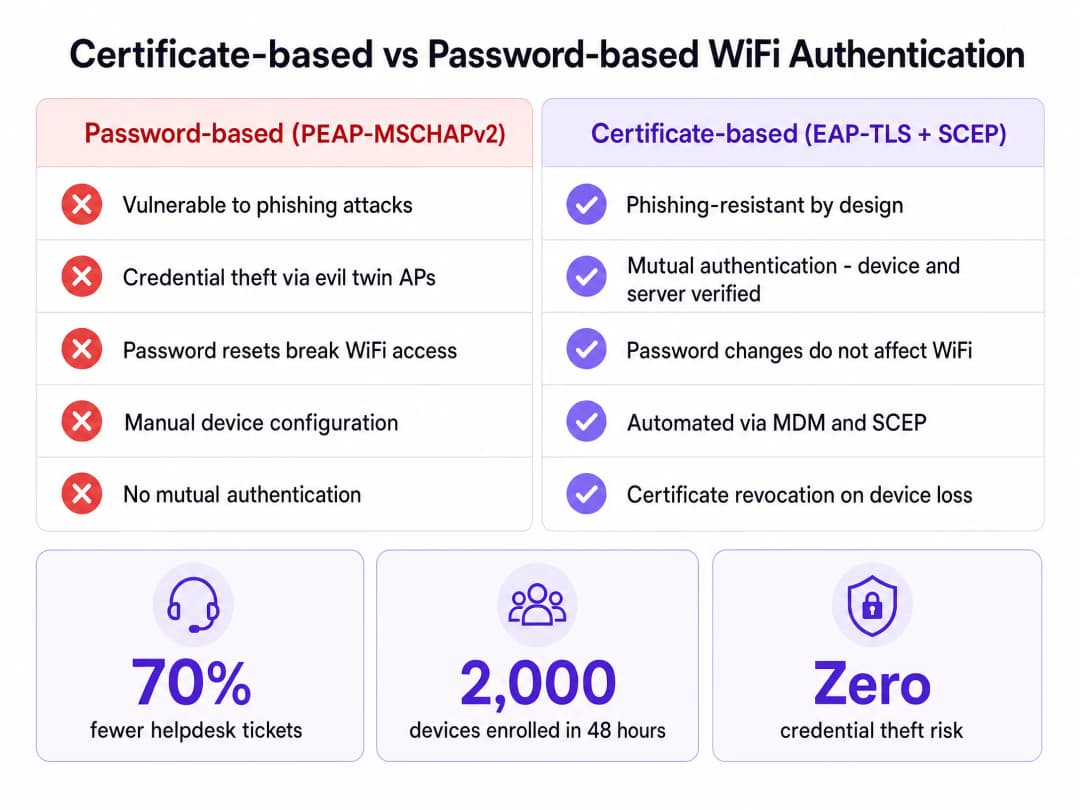
For higher education IT teams, the start of the academic year brings an immediate stress test. Thousands of students arrive on campus with multiple unmanaged devices, expecting instant, secure connectivity. When universities rely on password-based authentication like PEAP-MSCHAPv2, this influx predictably results in massive helpdesk queues, configuration errors, and severe vulnerabilities to credential theft via evil twin access points.

The architectural solution to this scale and security challenge is certificate-based authentication using EAP-TLS. To make certificate deployment viable across tens of thousands of endpoints, universities must implement the Simple Certificate Enrollment Protocol (SCEP). SCEP automates the provisioning of digital certificates to both managed devices via MDM and unmanaged student devices via self-service onboarding portals. This guide details the technical requirements for deploying SCEP in a higher education environment, providing actionable steps to eliminate password-related helpdesk tickets and secure the campus perimeter.

The Architecture of SCEP Certificate Enrollment

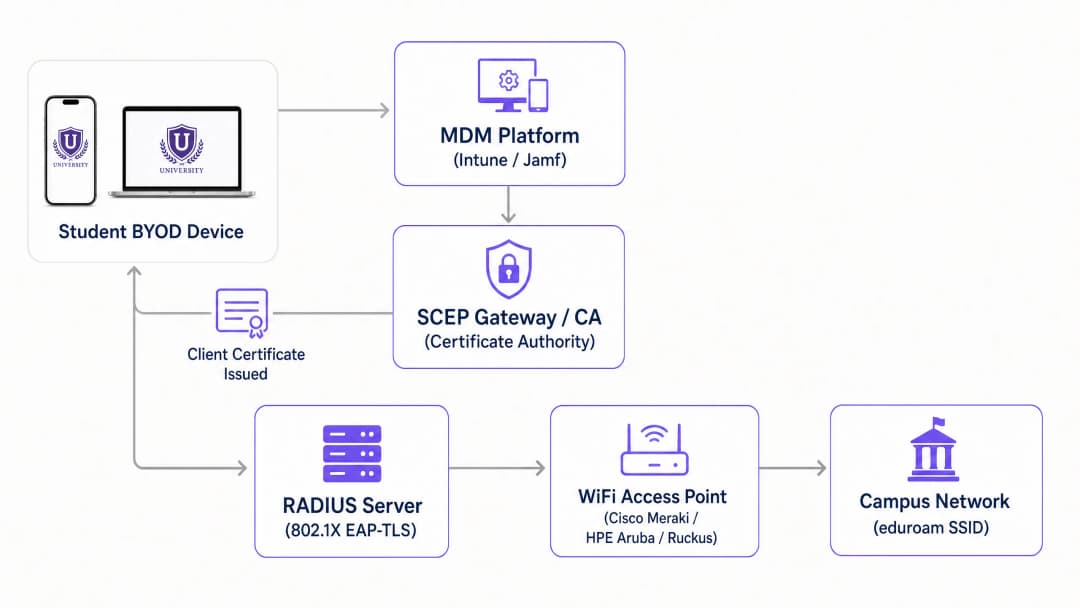
Transitioning to certificate-based WiFi requires a fundamental shift from validating user knowledge (a password) to validating device identity (a certificate). The SCEP protocol acts as the bridge between your device management layer and your Public Key Infrastructure (PKI).

scep_architecture_diagram.png

Core Infrastructure Components

A production-ready SCEP deployment requires six integrated components working in sequence:

  1. Identity Provider (IdP): The authoritative directory (Microsoft Entra ID, Okta, or Google Workspace) that verifies the user's identity before certificate issuance.
  2. Mobile Device Management (MDM): Platforms like Microsoft Intune or Jamf that push the SCEP payload to institution-owned devices.
  3. Certificate Authority (CA): The PKI engine that signs and issues the certificates. This can be an on-premises Microsoft ADCS deployment or a cloud-native PKI overlay.
  4. SCEP Gateway: The HTTP endpoint that receives Certificate Signing Requests (CSRs) from devices, validates the challenge password, and forwards the request to the CA.
  5. RADIUS Server: The authentication server that evaluates the presented client certificate against network access policies during the 802.1X EAP-TLS exchange.
  6. Wireless Access Network: The physical access points (Cisco Meraki, HPE Aruba, Ruckus, or Juniper Mist) configured to enforce 802.1X authentication.

The SCEP Enrollment Flow

The enrollment process executes without user intervention on managed devices. The MDM platform pushes a configuration profile containing the SCEP gateway URL and a dynamically generated challenge password. The device generates a private key locally and constructs a CSR. It then transmits this CSR to the SCEP gateway over HTTP.

The gateway intercepts the request and validates the challenge password against the MDM API to confirm the device is authorised. Once verified, the gateway forwards the CSR to the CA. The CA signs the certificate and returns it through the gateway to the device. The private key never leaves the endpoint, ensuring cryptographic integrity.

Implementation Guide: A Phased Deployment Strategy

Deploying SCEP requires precise sequencing. Profile dependencies mean that executing these steps out of order will result in authentication failures.

Step 1: Directory Synchronisation and Group Policy

Before touching certificates, ensure your identity store is clean. Create distinct security groups for students, staff, and faculty in Entra ID or Active Directory. Your RADIUS server will use these group memberships, embedded as Subject Alternative Names (SAN) in the certificates, to assign devices to the correct VLANs dynamically.

Step 2: PKI and SCEP Gateway Configuration

Establish your CA hierarchy. If building on-premises, deploy an offline Root CA and an online Issuing CA. For higher education environments looking to reduce infrastructure footprint, cloud PKI solutions offer operational simplicity. Configure the SCEP gateway to communicate with your CA and expose the enrollment endpoint to the network segment where devices will initially connect.

Step 3: RADIUS Server Integration

Import the Issuing CA certificate into your RADIUS server's trusted certificate store. Configure the authentication protocol strictly to EAP-TLS. Define network policies that map certificate attributes (such as the User Principal Name) to specific VLAN return attributes, enabling micro-segmentation across the campus.

Step 4: MDM Profile Sequencing

For institution-owned devices managed by Intune or Jamf, profile deployment order is critical. You must deploy profiles in this exact sequence:

  1. Trusted Certificate Profile: Distributes the Root CA certificate to establish trust.
  2. SCEP Certificate Profile: Directs the device to the gateway to obtain its client certificate.
  3. WiFi Profile: Configures the SSID to use WPA3-Enterprise with EAP-TLS, explicitly referencing the certificate acquired in the previous step.

Step 5: BYOD Self-Service Onboarding

Students will not manually install certificates on their personal devices. You must provide an automated onboarding pathway. Deploy an open SSID that restricts traffic exclusively to the captive portal and the SCEP gateway. When a student connects, the portal prompts them to authenticate via Single Sign-On using their university credentials. Upon successful authentication, the portal provisions the SCEP payload to the device. Purple integrates this onboarding flow directly into the captive portal experience, enabling students to complete enrollment in under two minutes without IT intervention.

Best Practices and Risk Mitigation

Transitioning to EAP-TLS eliminates credential theft, but introduces new operational considerations. Network architects must anticipate scale and lifecycle events.

scep_vs_password_comparison.png

RADIUS Capacity Planning

The computational overhead of EAP-TLS certificate validation is significantly higher than PEAP password checking. During the first week of term, thousands of devices will attempt to authenticate simultaneously. A single RADIUS node will likely exhaust its resources and drop requests, leading to widespread connection failures. You must implement load balancing across multiple RADIUS nodes and increase the authentication timeout on your access points to at least five seconds to accommodate peak latency.

Certificate Lifecycle Management

Certificates for student devices should typically carry a validity period of one to two years. This duration covers the academic cycle while limiting exposure if a device is compromised. Crucially, you must implement a robust revocation mechanism. When a student graduates or reports a lost device, the certificate must be revoked immediately. Ensure your CA publishes a Certificate Revocation List (CRL) or operates an Online Certificate Status Protocol (OCSP) responder, and configure your RADIUS server to check revocation status on every authentication attempt.

Handling Headless IoT Devices

Smart TVs, gaming consoles, and wireless printers in residence halls lack the native 802.1X supplicants required for SCEP enrollment. For these devices, implement MAC Authentication Bypass (MAB). Provide a self-service device registration portal where students can register the MAC addresses of their IoT hardware. The Network Access Control (NAC) system then authenticates these registered addresses and places them into the appropriate student VLAN.

Listen to the Technical Briefing

For a deeper dive into the architecture and real-world deployment scenarios, listen to our 10-minute technical briefing podcast.

ROI and Business Impact

The business case for SCEP deployment in higher education rests on two pillars: security posture and operational efficiency.

From a security perspective, EAP-TLS provides mutual authentication. The device verifies the RADIUS server's certificate before transmitting any data, entirely mitigating the risk of evil twin access points harvesting credentials. This architecture aligns with zero-trust principles, ensuring that only cryptographically verified devices access the campus network.

Operationally, decoupling WiFi authentication from directory passwords yields immediate financial returns. When a university forces a 90-day password reset, students using PEAP must update their credentials on every device. Inevitably, many fail, resulting in a surge of helpdesk tickets. With SCEP and EAP-TLS, the certificate remains valid regardless of password changes. Universities deploying automated certificate onboarding consistently report up to a 70% reduction in WiFi-related support tickets during peak periods, allowing IT staff to focus on strategic initiatives rather than basic connectivity troubleshooting.

關鍵定義

SCEP (Simple Certificate Enrollment Protocol)

一種自動化向網路設備請求和發行數位憑證的協定,無需手動干預。

對於擴展 EAP-TLS 部署至關重要,因為它允許 MDM 和登入入口網站無縫地向數萬台學生設備發放憑證。

EAP-TLS (Extensible Authentication Protocol - Transport Layer Security)

最安全的 802.1X 驗證方法,需要伺服器端和用戶端憑證進行雙向驗證。

取代了 PEAP 等易受攻擊的基於密碼的協定,消除了透過邪惡雙子(evil twin)存取點竊取憑證的風險。

MDM (Mobile Device Management)

用於管理和保護機構擁有設備的軟體平台,例如 Microsoft Intune 或 Jamf。

用於將 SCEP 承載資料和 WiFi 設定檔靜默推送至受管理設備,確保它們在部署前已配置好網路存取。

CSR (Certificate Signing Request)

由用戶端裝置產生的編碼文字區塊,包含公開金鑰與身分識別資訊,發送至 CA 以申請憑證。

在 SCEP 工作流程中,設備在本地生成私鑰,且僅將 CSR 發送至閘道器,以確保私鑰在終端上保持安全。

RADIUS (Remote Authentication Dial-In User Service)

提供集中化驗證、授權與計費管理之網路協定。

在 802.1X 交換過程中,評估裝置所出示之用戶端憑證,並指示 VLAN 分配的伺服器。

Evil Twin Attack

一種安全性攻擊,攻擊者設定與合法網路相同 SSID 的惡意存取點,以竊取使用者憑證。

EAP-TLS 可防止此攻擊,因為用戶端裝置在傳輸任何資料之前,會先驗證 RADIUS 伺服器的憑證;若攻擊者缺乏受信任的伺服器憑證,連線將會中斷。

MAB (MAC Authentication Bypass)

一種備用驗證方法,使用裝置的 MAC 位址作為其憑證。

在無法支援 802.1X 或 SCEP 的學生宿舍中,註冊無前端畫面的 IoT 裝置(如遊戲主機)時所需。

CRL (Certificate Revocation List)

由憑證授權單位發佈的清單,包含在到期日之前已失效的憑證序號。

對網路安全至關重要;RADIUS 伺服器必須檢查 CRL,以確保被盜裝置或已畢業學生的存取權限能立即被拒絕。

範例

一所有 20,000 名學生的大學正從 PEAP-MSCHAPv2 遷移到 EAP-TLS。他們使用 Microsoft Intune 管理 3,000 台學校擁有的 Windows 筆記型電腦,但其餘 45,000 台設備是學生的 BYOD(手機、平板電腦、個人筆記型電腦)。他們應該如何規劃憑證部署架構,以確保所有設備都能在開學第一天進行驗證?

該大學必須實施分流登冊策略。針對 3,000 台受 Intune 管理的筆記型電腦,IT 團隊在 Intune 內配置 SCEP 憑證設定檔,將閘道器 URL 和挑戰密碼靜默推送至設備。針對 45,000 台 BYOD 設備,他們部署了一個開放的「Onboarding」SSID,將流量限制在自助式 Captive Portal 和 SCEP 閘道器。學生連接到 Onboarding SSID,透過 SAML SSO 向 Entra ID 進行驗證,並下載觸發 SCEP 登冊的組態承載資料(payload)。憑證安裝完成後,設備會自動使用 EAP-TLS 與安全的「eduroam」SSID 關聯。

考官評語: 此方法正確地指出,僅靠 MDM 無法解決 BYOD 的挑戰。透過針對未受管理設備利用 Captive Portal,該大學實現了 100% 的憑證覆蓋率,而無需學生手動配置 802.1X 設定,從而避免了湧入大量的技術支援工單。

在開學的第一週,大學的服務台收到報告,稱學生可以用筆記型電腦連接 WiFi,但他們在宿舍的智慧音箱和遊戲主機無法連接到 802.1X 網路。網路架構師應該如何解決這個問題?

架構師必須針對無螢幕/無輸入介面(headless)設備實施 MAC 驗證繞過(MAB)。由於智慧音箱和主機缺乏 802.1X 請求方(supplicant),它們無法處理 SCEP 承載資料或提供用戶端憑證。大學應部署一個自助式設備註冊入口網站,學生可以使用其大學憑證登入並輸入其 IoT 設備的 MAC 位址。RADIUS 伺服器配置為透過 MAB 接受這些已註冊的 MAC 位址,並將其分配給學生專屬的房內 VLAN。

考官評語: 此解決方案解決了無螢幕 IoT 設備的技術限制,同時保持了網路隔離。透過使用自助服務入口網站,IT 團隊避免了手動輸入 MAC 位址,從而將解決方案擴展到可容納宿舍中數千台消費型設備的規模。

練習題

Q1. 您的學校正在部署 EAP-TLS。您已設定好 SCEP 閘道與 MDM 設定檔。然而,當測試裝置嘗試連線至安全 SSID 時,連線無聲無息地失敗。RADIUS 記錄顯示用戶端憑證有效,但裝置拒絕了伺服器。最有可能的設定錯誤是什麼?

提示:請考慮雙向驗證的要求,以及裝置需要信任伺服器的哪些要素。

查看標準答案

這很可能是因為遺漏或設定錯誤 MDM 受信任憑證設定檔。在 EAP-TLS 中,雙向驗證要求裝置必須驗證 RADIUS 伺服器的憑證。如果裝置的受信任存放區中未安裝 Root CA 憑證,它將無法驗證伺服器的憑證,並會中斷連線以防止潛在的 Evil Twin Attack。

Q2. 一位學生反應,他們的筆記型電腦已透過 BYOD 入口網站成功註冊,且擁有有效的用戶端憑證,但在他們更改學校目錄密碼後,卻無法再存取網路。這代表了什麼架構上的缺陷?

提示:EAP-TLS 驗證完全依賴憑證,而非密碼。

查看標準答案

這代表該網路實際上並非使用 EAP-TLS,而是可能降級回退到 PEAP-MSCHAPv2 或其他基於密碼的協定。如果設定了真正的 EAP-TLS,RADIUS 伺服器會驗證憑證的密碼學簽章,使網路存取完全與目錄密碼脫鉤。網路架構師必須在 RADIUS 伺服器上強制執行嚴格的 EAP-TLS 原則,並停用回退協定。

Q3. 在學期第一週,RADIUS 伺服器的 CPU 使用率過高,並出現間歇性的逾時錯誤,導致大範圍的驗證失敗。這些伺服器的配置對於並行工作階段的總量是足夠的。是什麼原因導致了逾時?

提示:請考慮在初始連線階段,檢查密碼與驗證憑證鏈之間的運算開銷差異。

查看標準答案

逾時是由於返校學生爆發初始驗證潮時,EAP-TLS 密碼學握手所帶來的沉重運算開銷所致。架構師必須在無線存取點(例如 Cisco Meraki 或 HPE Aruba)上將 RADIUS 逾時值增加至至少 5 秒以因應延遲,並確保負載平衡將初始完整驗證請求均勻分配到所有 RADIUS 節點。