
The Network Administrator’s Guide to GDPR and Guest Data Privacy Compliance
本指南為 IT 經理、網路架構師和場域營運總監提供全面的技術參考,說明如何建構符合 GDPR 規範的訪客 WiFi 網路。內容涵蓋訪客網路收集的四類個人數據、每類數據的法律依據、Captive Portal 同意機制、VLAN 隔離、數據保留自動化,以及 Purple 與硬體無關的平台如何對應各項合規要求。場域營運商將學習如何將訪客 WiFi 合規性從監管負債轉化為可防禦的第一方數據資產。
收聽此指南
查看播客逐字稿
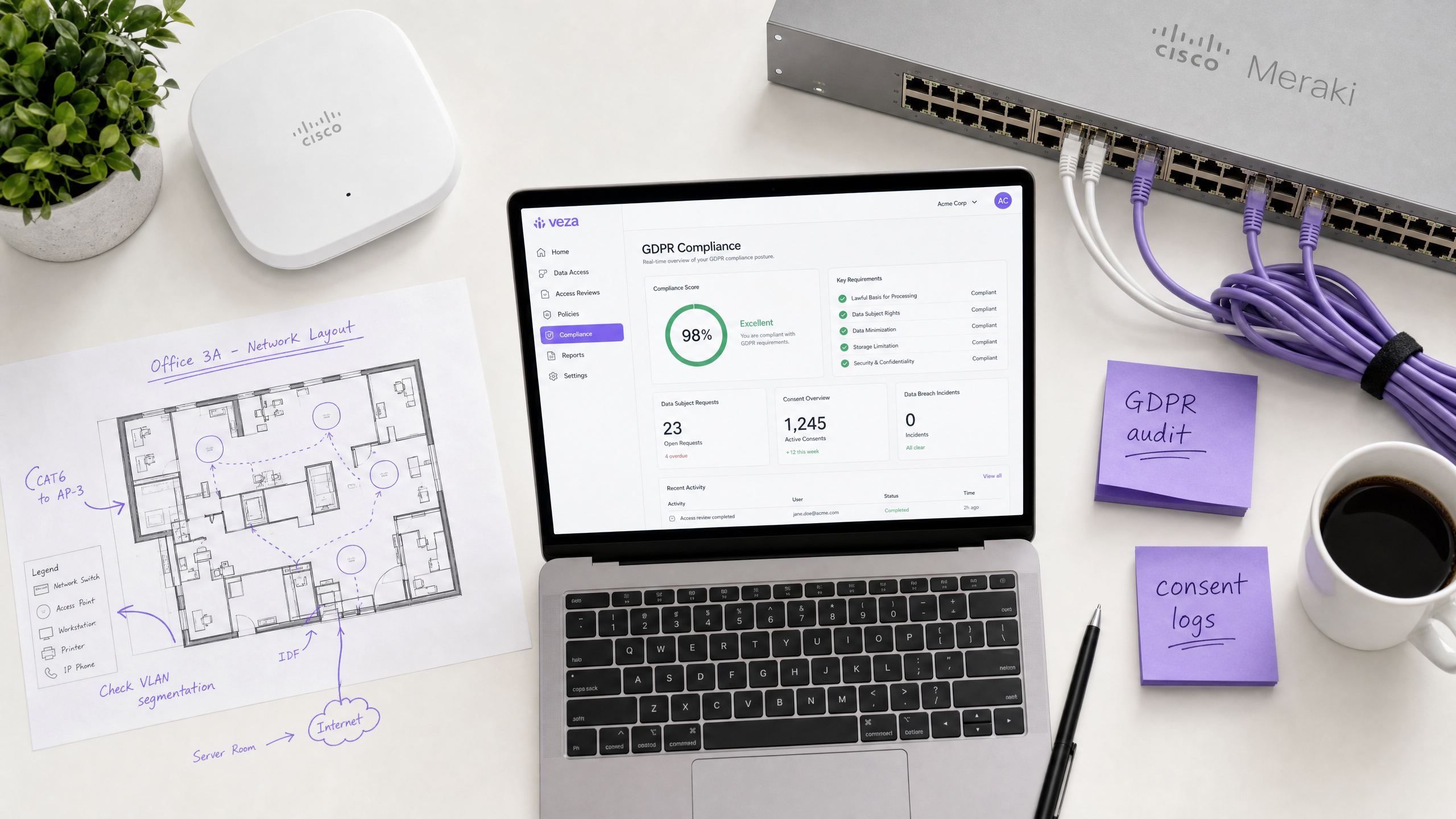
執行摘要
訪客 WiFi 是一個受監管的數據收集終端。在訪客連線的瞬間,任何提供公共網路存取的飯店、零售連鎖店、體育場和會議中心,都會成為《一般資料保護規則》(GDPR)規範下的資料控制者(Data Controller)。不合規行為可能面臨英國資訊專員辦公室(ICO)高達 2,000 萬歐元或全球年營業額 4% 的罰款——自 2018 年以來,已開出超過 2,800 筆 GDPR 罰單,總額超過 62 億歐元,其中違反同意規定是最常被執法的類別(SecurePrivacy,2026 年)。
本指南為您提供建構合規訪客網路的技術框架。我們將介紹您網路處理的四類個人數據、每類數據所需的合法依據、Captive Portal 同意架構、VLAN 隔離、WPA3 加密、RADIUS 整合以及自動化數據保留。我們還將展示 Purple 的 Guest WiFi 平台(已部署於 80,000 多個場域,並在 2024 年處理了 4.4 億次登入——Purple 內部數據)如何對應這些要求,讓您無需更換現有硬體即可消除合規漏洞。
無論您是在 Premier Inn、Harrods 旗艦店、曼徹斯特機場集團(Manchester Airports Group)航廈,還是多站點零售物業管理訪客連線,本指南中的架構都直接適用於您的環境。
技術深度解析
您的訪客網路實際上收集了哪些數據?
任何合規計畫的第一步都是進行誠實的數據盤點。訪客 WiFi 網路處理四種不同類別的個人數據,每種數據都有不同的法律影響。
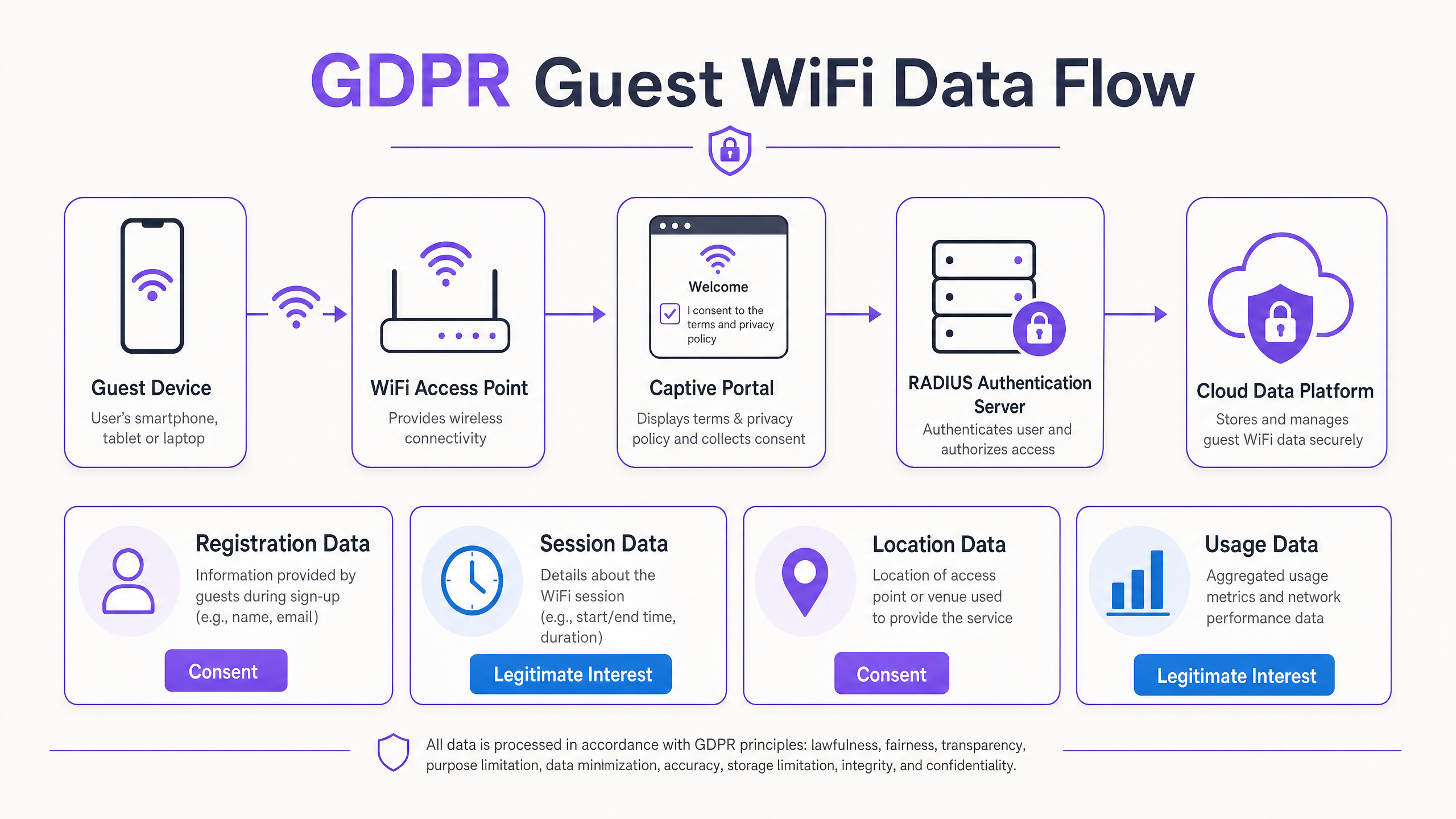
| 數據類別 | 範例 | 合法依據 | 關鍵合規考量 |
|---|---|---|---|
| 註冊數據 | 姓名、電子郵件、電話號碼、社群登入個人檔案 | 同意 | 必須透過明確、細緻的選擇加入(opt-in)進行收集。不得與網路存取條款綁定。 |
| 裝置與工作階段數據 | MAC 位址、IP 位址、連線開始/結束時間、消耗的頻寬 | 正當利益 | 需要進行正當利益評估(LIA)。保留不超過 30 天以用於疑難排解。 |
| 位置數據 | AP 關聯記錄、RSSI 三角定位、人流量熱圖 | 同意 | 在隱私聲明中明確揭露。在傳送到分析平台之前,先在邊緣端進行去識別化(Pseudonymise)。 |
| 使用數據 | DNS 查詢、目的地 IP 範圍 | 正當利益 | 僅限於安全過濾。未經明確同意,請勿建立個人瀏覽設定檔。 |
MAC 位址屬於個人數據。ICO 在 2023 年確認了這一立場:當 MAC 位址與連線時間戳記和場域位置結合時,足以識別個人的存在和行為。MAC 位址隨機化(目前在 iOS 14+、Android 10+ 和 Windows 10+ 上已成為預設設定)降低了裝置追蹤的持續性,但並未消除收集點的資料保護義務。
作為合規介面的 Captive Portal
Captive Portal(有時稱為歡迎頁面或圍牆花園)是一個網頁介面,它會攔截訪客的 HTTP 流量,並在授予網路存取權限之前,將其重定向到同意與驗證頁面。這是您建立數據處理合法依據的主要機制。
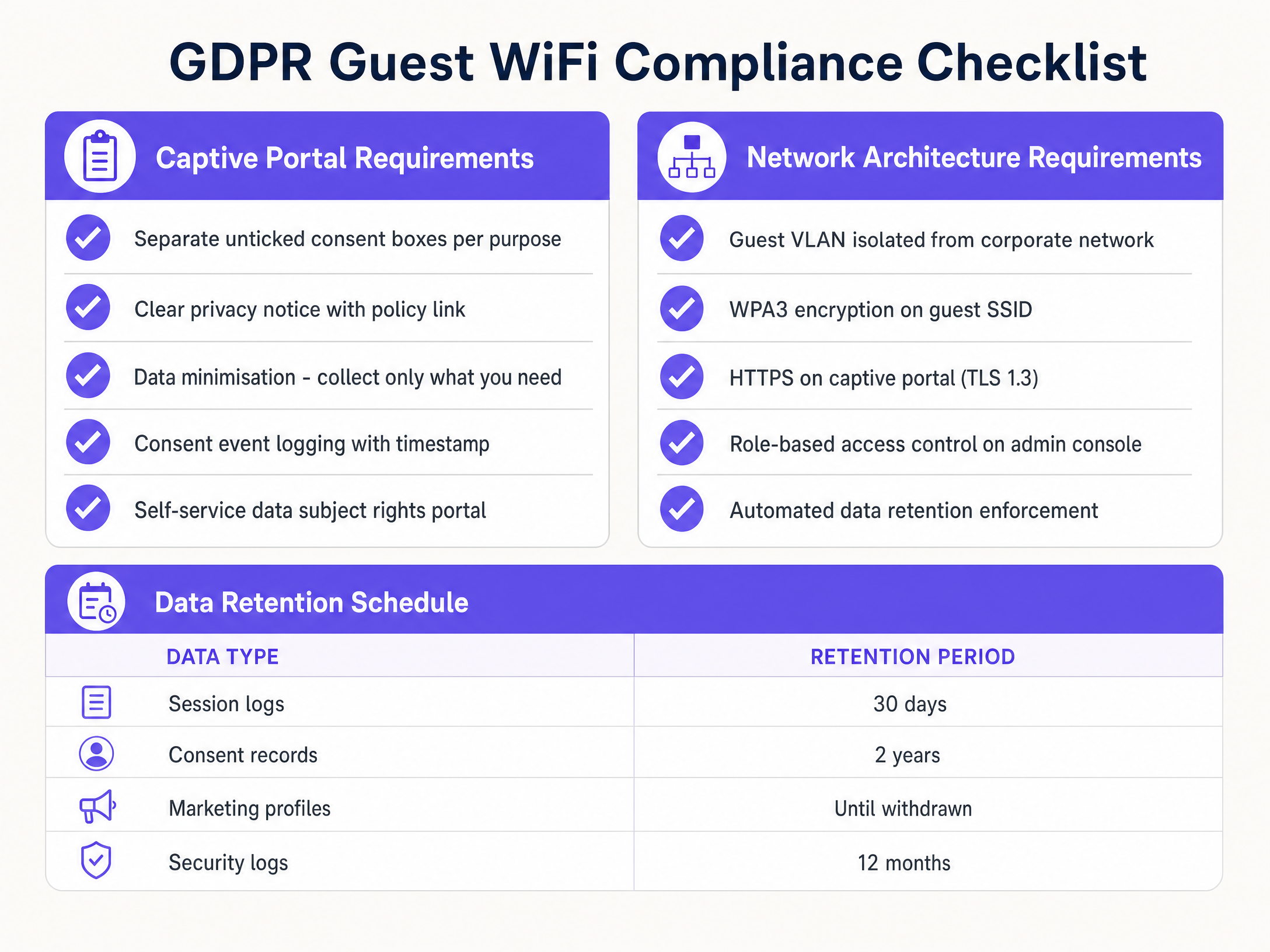
符合規範的 Captive Portal 架構必須滿足 GDPR 第 7 條和第 13 條規定的五項要求:
1. 非綁定式同意。 網路存取條款和行銷同意必須作為獨立元素呈現。使用者必須能夠在不同意行銷的情況下連線到 WiFi。如果無法做到這一點,則行銷同意並非自由給予,因此無效。這是歐盟最常引起訴訟的同意違規行為。
2. 未勾選的核取方塊。 每個選填的同意元素都必須呈現為未勾選的核取方塊。GDPR 前言第 32 條明確禁止預先勾選的方塊。使用者必須採取主動行為才能選擇加入。
3. 細緻的目的揭露。 每個處理目的都必須清晰描述。「出於商業目的」是不夠的。「向您發送關於我們會員計畫的促銷電子郵件」才是足夠的。
4. 同意稽核記錄。 您的系統必須記錄確切的時間戳記、使用者的 IP 位址、裝置的 MAC 位址、所做的特定同意選擇,以及所呈現的隱私聲明版本。Purple 會記錄每個同意事件,並將這些記錄在互動後保留兩年(Purple 內部數據),以提供可防禦的稽核軌跡。
5. 隱私聲明連結。 在使用者提交任何數據之前,歡迎頁面必須直接連結到您完整的隱私權政策。
網路架構:隔離與加密
合規的數據處理從網路層開始。訪客流量必須與您的企業基礎架構隔離。
VLAN 隔離。 為訪客 SSID 設定專用的 VLAN。套用 ACL 以阻止訪客裝置存取 RFC 1918 位址範圍(10.0.0.0/8、172.16.0.0/12、192.168.0.0/16)。在無線基地台(AP)層級啟用用戶端隔離,以防止訪客之間的流量互通。Cisco Meraki、HPE Aruba、Ruckus、Juniper Mist、Ubiquiti UniFi、Cambium、Extreme 和 Fortinet 平台原生支援此功能。
WPA3 加密。 在硬體支援的情況下,在您的訪客 SSID 上部署 WPA3。WPA3 的對等同時驗證(SAE)交握消除了 WPA2 四向交握中存在的 KRACK 漏洞,並提供正向保密(forward secrecy),這意味著即使工作階段金鑰遭到破解,也無法用於解密過去的流量。對於尚不支援的硬體若不支援 WPA3,請強制使用採用 AES-CCMP(而非 TKIP)的 WPA2。
Captive Portal 上的 HTTPS。 透過具有有效 TLS 1.2 或 1.3 憑證的 HTTPS 提供您的登入頁面。透過 HTTP 收集個人資料是一項嚴重的安全性缺失,這將成為任何 ICO 調查的重點。Purple 的雲端託管 Captive Portal 預設強制執行 HTTPS。
RADIUS 整合。 將您的無線區域網路控制器(WLC)與 RADIUS 伺服器整合以進行驗證。當使用者完成 Captive Portal 流程時,平台會向 WLC 發送 RADIUS Access-Accept 訊息,進而授予網路存取權限。這在驗證事件與資料收集層之間建立了清晰且可稽核的區隔。Purple 透過標準 RADIUS 協定與 Cisco Meraki、HPE Aruba、Ruckus、Juniper Mist、Ubiquiti UniFi、Cambium、Extreme 和 Fortinet 整合,無需部署地端伺服器。
如需深入瞭解企業驗證架構,請參閱我們的指南: 無 Active Directory 或地端伺服器的企業 WiFi 驗證 。
資料保留:隱形的合規風險
大多數組織將其合規工作集中在同意收集層,而忽略了儲存限制原則。根據 GDPR 第 5(1)(e) 條,個人資料的保存時間不得超過收集目的所需的時間。無限期保留工作階段記錄即屬違規,即使最初的收集是合法的。
合理的訪客 WiFi 資料保留時程表:
| 資料類型 | 建議保留時間 | 依據 |
|---|---|---|
| 工作階段記錄 (IP, MAC, 時間戳記) | 30 天 | 足以進行網路疑難排解和安全性調查 |
| 同意記錄 | 最後一次互動後 2 年 | 涵蓋潛在的法律訴訟和監管審計 |
| 行銷設定檔 | 直至撤回同意 | 選擇退出或收到 DSAR 刪除請求時立即刪除 |
| 網路安全性記錄 | 12 個月 | 符合 NCSC 的事件回應指南 |
| DHCP/DNS 記錄 | 30-90 天 | 支援安全性數位鑑識;需記錄其合理依據 |
Purple 對每個資料類別套用可設定的保留規則並自動執行刪除,因此您無需在多個場域中依賴手動流程。
資料處理增補協議(DPA)與供應商盡職調查
根據 GDPR 第 28 條,您的訪客 WiFi 供應商屬於資料處理者。在任何個人資料流向第三方平台之前,您必須簽署資料處理增補協議(DPA)。DPA 必須指明處理的資料類別、處理目的、所使用的次級處理者、已採取的安全措施,以及處理 DSAR 和資料外洩的程序。
評估供應商時,請要求提供 ISO 27001 認證、SOC 2 Type II 報告以及其自身的 GDPR 合規文件證明。Purple 擁有 ISO 27001 認證,符合 GDPR 和 CCPA 規範,並持有 Cyber Essentials 和 B Corp 認證。
如需了解企業 WiFi 安全架構的更多背景資訊,請參閱我們的 企業 WiFi 安全指南 。
實作指南
步驟 1:進行資料盤點
對應您訪客網路收集的每個資料點。包括 Captive Portal 欄位、WLC 產生的工作階段記錄、發送到第三方平台的任何分析資料,以及任何 CRM 整合。為每個資料類別分配一個合法依據。識別目前缺乏有效依據的任何處理活動。
步驟 2:重新設計您的 Captive Portal
根據上述五項要求稽核您目前的登入頁面。如果行銷同意與網路存取綁定,請將其分開。如果核取方塊已預先勾選,請取消勾選。如果您的隱私權聲明隱藏在服務條款文件中,請將其作為登入頁面上的直接連結呈現。Purple 的 Capture 方案提供符合合規要求的 Captive Portal 範本,隨插即用,滿足這些要求。
步驟 3:設定網路區隔
在您的 WLC 上建立專用的訪客 VLAN。套用 ACL 以封鎖對內部子網路的存取。啟用用戶端隔離。透過連接訪客裝置並嘗試存取內部資源來測試設定 — 您應該不會收到任何回應。
步驟 4:強制執行 HTTPS 和 WPA3
驗證您的 Captive Portal 是否透過 HTTPS 提供。檢查您的 SSL 憑證到期日並設定自動更新。如果您的存取點支援,請在訪客 SSID 上啟用 WPA3。對於 Cisco Meraki、HPE Aruba、Ruckus 和 Juniper Mist,WPA3 在目前的韌體版本中均已提供。
步驟 5:實作自動化資料保留
在您的 WiFi 分析平台中設定刪除時程。將工作階段記錄設定為 30 天後清除。將行銷設定檔設定為在撤回同意時立即刪除。在您的隱私權政策中記錄您的保留時程表。
步驟 6:建立 DSAR 流程
建立處理資料當事人權利請求(DSAR)的書面流程。您有 30 天的時間進行回應。自助式偏好設定中心(訪客可在其中查看、修改和刪除其資料)可顯著減輕營運負擔。Purple 的平台提供了一個偏好設定中心,訪客可以透過任何行銷電子郵件中的連結進行存取。
步驟 7:與所有供應商簽署 DPA
審查接收訪客資料的每個第三方平台:您的 WiFi 分析提供商、您的 CRM、您的電子郵件行銷平台以及任何廣告網路。確保與每個平台都簽署了 DPA。
最佳做法
採用漸進式剖析。 不要引導使用者在首次造訪時就填寫所有資訊。在首次連線時收集電子郵件地址。在第二次造訪時,詢問名字。在第三次造訪時,提供加入會員忠誠度計畫的選項。這能減少阻力、提高資料品質,並符合資料最小化原則。
**驗證電子郵件地址。**在 Captive Portal 上實施即時電子郵件驗證。虛假的電子郵件地址會污染您的 CRM、降低送達率,並在您因電子郵件地址無效而無法回應 DSAR 時,造成合規方面的複雜問題。
**在邊緣端對位置數據進行假名化。**如果您使用 WiFi 分析進行人流量追蹤(如許多 餐飲旅宿 和 零售 業者所做的那樣),請在數據到達您的分析平台之前,在存取點上對 MAC 地址進行假名化。這能顯著降低位置處理的隱私風險,並強化您的正當利益評估。
**在部署分析之前進行 DPIA。**根據 GDPR 第 35 條,在部署涉及大規模位置追蹤、行為剖析或處理弱勢群體數據的系統之前,法律強制要求進行數據保護影響評估(DPIA)。記錄該評估並予以保留。
**監控 MAC 地址隨機化。**iOS 14+、Android 10+ 和 Windows 10+ 預設會隨機化 MAC 地址。這意味著您的分析平台將面臨更高的裝置識別碼流失率。圍繞工作階段層級的數據來設計您的分析,而非持續性的裝置追蹤。
對於 醫療保健 和 交通運輸 業者而言,由於顧客可能包括處於弱勢情況的患者或旅客,請對您的正當利益評估進行更嚴格的審查,並考慮所有處理活動是否都需要明確同意。
疑難排解與風險降低
**失效模式:同意疲勞。**如果您的 Captive Portal 要求太多資訊或提供太多同意選項,使用者要麼會放棄連線,要麼會不經閱讀直接點擊通過。緩釋措施:將必填欄位限制為僅需電子郵件地址。提供單個選填的行銷同意核取方塊。使用清晰、通俗易懂的語言。測試完成率並進行優化。
**失效模式:過期的行銷數據。**保留多年未互動使用者的行銷設定檔違反了儲存限制原則,且會降低電子郵件送達率。緩釋措施:在未活動達 12 個月後實施重新互動行銷活動。刪除在收到重新互動電子郵件後 30 天內未回應的設定檔。
**失效模式:不安全的 Captive Portal。**透過 HTTP 提供歡迎頁面會使使用者憑證和個人數據面臨被攔截的風險。緩釋措施:強制執行 HTTPS。自動化憑證更新。使用網路掃描器進行測試,以確認無法降級回退至 HTTP。
**失效模式:缺失 DPA。**在未簽署 DPA 的情況下將顧客數據發送到第三方平台,會使您對該處理者的任何洩漏或濫用行為承擔共同責任。緩釋措施:每季審計所有數據流。在任何新整合上線之前,要求簽署 DPA。
**失效模式:錯過 72 小時資料洩漏通報。**GDPR 資料洩漏通報的計時從您得知洩漏的那一刻開始,而不是在您的調查完成時。緩釋措施:建立資料洩漏應對檢核表,將向 ICO 通報列為發現後前 24 小時內的步驟。確保您的團隊知道在調查完成之前就必須進行通報。
如需管理存取權限撤銷的指引(適用於員工離職或需要終止承包商存取權限的情況),請參閱我們的指南: 如何在員工離職時撤銷 WiFi 存取權限 。
投資報酬率(ROI)與商業影響
GDPR 合規並不單純是一個成本中心。一個架構良好、合規的顧客 WiFi 部署能產生可衡量的商業價值。
**第一方數據品質。**主動選擇加入行銷的顧客,比那些被綑綁同意強迫的使用者具有更高的參與度。使用 Purple 合規同意流程的場所報告的行銷加入率為 35-45%(Purple 內部數據),且與 GDPR 實施前的綑綁方式相比,電子郵件開啟率更高,退訂率更低。
**降低監管風險。**ICO 的執法記錄包括因數據安全不足對萬豪國際(Marriott International)處以 1,840 萬英鎊的罰款(ICO,2020 年),以及因安全缺失對 DSG Retail 處以 50 萬英鎊的罰款(ICO,2020 年)。合規的架構能直接降低這種風險敞口。
**營運效率。**自動化數據保留和自助式 DSAR 可減少管理合規所需的人力時間。Purple 的平台會自動處理同意記錄、保留執行和 DSAR 管理,將擁有 50 個場所的物業的合規開銷降低到手動流程所需的一小部分。
**客戶信任。**79% 的消費者表示,他們更傾向於信任對其數據使用方式保持透明的品牌(Cisco 消費者隱私調查,2022 年)。一個清晰、誠實的 Captive Portal,解釋了價值交換(提供免費 WiFi 以換取電子郵件地址),能建立信任而非削弱信任。
Purple 的 WiFi Analytics 平台為您提供了在保持完全合規的同時獲取此價值的工具。憑藉在 80,000 多個場所收集的 290 億個數據點(Purple 內部數據),我們擁有足夠的規模來驗證實踐中有效的方法,而不僅僅是理論。
對於 零售 領域的場所營運商而言,合規的第一方數據擷取與人流量分析相結合,能顯著改善行銷活動定位和店內體驗。對於 餐飲旅宿 業者而言,它能推動忠誠度計畫的成長和重複預訂。對於 交通運輸 樞紐而言,它能實現旅客流量管理和精準的零售優惠。
建構合規顧客 WiFi 系統的網路管理員不僅僅是在避免罰款。他們正在建立數據基礎設施,為其組織未來十年的行銷和營運策略提供支援。
關鍵定義
Data Controller
The entity that determines the purposes and means of processing personal data. In a guest WiFi deployment, the venue operator is the Data Controller and holds ultimate legal responsibility for GDPR compliance.
IT managers need to understand this designation because it means the venue - not the WiFi vendor - is primarily liable for any compliance failure.
Data Processor
An entity that processes personal data on behalf of the Data Controller, under a formal Data Processing Addendum. Purple acts as a Data Processor for its venue clients.
A signed DPA must be in place before any personal data flows to a third-party platform. Sending guest data to a vendor without a DPA makes the controller jointly liable for any misuse.
Captive portal
A web interface that intercepts a guest's HTTP or HTTPS traffic and redirects them to a consent and authentication page before granting network access. The primary mechanism for establishing a lawful basis for data processing on a guest network.
The design of the captive portal determines whether your consent collection is legally valid. Poorly designed portals are the most common source of GDPR violations in guest WiFi deployments.
RADIUS (Remote Authentication Dial-In User Service)
A networking protocol that provides centralised authentication, authorisation, and accounting for network access. In guest WiFi, a RADIUS Access-Accept message from the captive portal platform to the wireless LAN controller grants a guest network access after they complete the consent flow.
RADIUS integration creates an auditable, time-stamped record of every authentication event, which supports both security monitoring and GDPR compliance documentation.
MAC address
A unique hardware identifier assigned to a network interface controller. Classified as personal data under GDPR when it can be linked to an identifiable individual. iOS 14+, Android 10+, and Windows 10+ randomise MAC addresses by default to reduce persistent device tracking.
MAC addresses must be subject to your data retention policy. MAC address randomisation does not eliminate the data protection obligation at the point of collection.
Legitimate interest
A lawful basis under GDPR Article 6(1)(f) that permits processing where it is necessary for the controller's legitimate interests, provided those interests are not overridden by the data subject's rights. Requires a documented Legitimate Interest Assessment (LIA).
Often used to justify basic session logging for network security. Cannot be used as a catch-all basis for marketing or analytics without a robust LIA.
DSAR (Data Subject Access Request)
A formal request by an individual to access, rectify, or erase the personal data an organisation holds about them. Venues must respond within 30 days. Failure to respond is an ICO enforcement trigger.
A self-service preference centre reduces the operational burden of DSARs. Purple's platform allows guests to view and delete their own data without requiring manual intervention from your team.
DPIA (Data Protection Impact Assessment)
A structured risk assessment required under GDPR Article 35 before deploying processing activities that are likely to result in high risk to individuals. Mandatory for large-scale location tracking, behavioural profiling, and processing data from vulnerable groups.
Any venue deploying WiFi-based footfall analytics or crowd density monitoring must conduct a DPIA before go-live. The assessment must be documented and retained.
WPA3
The current generation of WiFi security protocol, standardised by the WiFi Alliance. Uses Simultaneous Authentication of Equals (SAE) to replace WPA2's four-way handshake, providing forward secrecy and resistance to offline dictionary attacks. Supported on Cisco Meraki, HPE Aruba, Ruckus, Juniper Mist, and Ubiquiti UniFi in current firmware.
Deploying WPA3 on guest SSIDs is a security best practice and demonstrates to regulators that appropriate technical measures are in place under GDPR Article 32.
VLAN (Virtual Local Area Network)
A logical network segment that isolates traffic at Layer 2. In guest WiFi, a dedicated guest VLAN prevents guest devices from accessing corporate network resources, even if they share the same physical infrastructure.
VLAN segmentation is the foundational network architecture control for guest WiFi. Without it, a guest device on the same physical switch as a corporate server can potentially access internal resources.
範例
A 200-room Premier Inn property needs to provide seamless guest WiFi while collecting emails for their marketing newsletter. Their current system requires guests to accept marketing communications as a condition of getting online. The property manager has received a complaint from a guest who was unaware their email would be used for marketing.
Deploy a compliant captive portal using Purple's Capture plan. Configure the portal with two separate consent elements: Checkbox 1 (mandatory, unticked until the user ticks it): 'I accept the Terms of Service for WiFi access.' Checkbox 2 (optional, unticked by default): 'I consent to receive marketing emails from Premier Inn.' The user must be able to tick Checkbox 1 and connect without touching Checkbox 2. Configure the portal to log both consent choices with a timestamp and the privacy policy version. Integrate the portal with the hotel's CRM via Purple's API, syncing only those users who ticked Checkbox 2. Set up automated deletion of marketing profiles upon opt-out. Test the flow by connecting a device, ticking only Checkbox 1, and verifying that no marketing record is created in the CRM.
A stadium IT team at a 60,000-capacity venue wants to use WiFi analytics to monitor crowd density in real time, identify pinch points, and improve safety. The legal team has flagged that tracking guest device locations without consent may violate GDPR. The stadium uses Cisco Meraki access points and currently has no captive portal.
Deploy Purple's Guest WiFi platform on the existing Cisco Meraki infrastructure via the Meraki API integration. Configure a captive portal that explicitly discloses location data processing: 'We use your device's WiFi signal to monitor crowd density and improve safety at this venue. This data is anonymised and not used to track individuals.' Enable MAC address pseudonymisation at the Meraki access point level using Purple's edge processing configuration, so that raw MAC addresses are replaced with pseudonymous identifiers before the data reaches the Purple analytics platform. Configure the analytics dashboard to display aggregated density data by zone, not individual device paths. Conduct a DPIA before go-live, documenting the privacy risks and the mitigations applied. Retain the DPIA in your compliance records.
練習題
Q1. A retail chain wants to use guest WiFi data to send promotional emails to shoppers. Their IT team proposes adding a pre-ticked checkbox on the splash page labelled 'Send me exclusive offers'. The marketing team argues this is fine because users can untick it. Is this approach compliant, and what should be done instead?
提示:Consider GDPR Recital 32 and the definition of unambiguous consent.
查看標準答案
No, this is not compliant. GDPR Recital 32 explicitly states that pre-ticked boxes do not constitute valid consent. Consent must be an affirmative act. The checkbox must be unticked by default, requiring the shopper to actively opt in. The fix is straightforward: change the checkbox to an unticked default. Also verify that the marketing consent is presented as a separate element from the terms of service for network access, so that shoppers can connect without agreeing to marketing.
Q2. Your network security team needs to retain DHCP and DNS logs from the guest network to investigate a malware outbreak that occurred three months ago. The logs are still held on the SIEM. The data retention policy states session logs should be purged at 30 days. How do you handle this conflict?
提示:Consider the lawful basis of legitimate interest and the concept of a documented exception.
查看標準答案
The standard 30-day retention period can be extended for an active security investigation under the lawful basis of legitimate interest. However, this exception must be documented: record the date of the incident, the scope of the investigation, the specific data being retained beyond the standard period, and the expected end date of the extended retention. Once the investigation is closed, the logs must be purged. Do not use an active investigation as an indefinite reason to retain data.
Q3. A guest at your hotel submits a Right to Erasure request via email. They connected to the guest WiFi six months ago and opted into your marketing newsletter. What actions must you take, and within what timeframe?
提示:Think about all systems where the guest's data may reside, not just the WiFi platform.
查看標準答案
You must complete the erasure within 30 days of the request. Actions required: (1) Delete the guest's marketing profile from your WiFi analytics platform (Purple). (2) Ensure the deletion cascades to any integrated systems - your CRM, your email marketing platform (e.g., Mailchimp or HubSpot), and any advertising platforms that received the data. (3) Suppress the email address from future marketing sends to prevent re-collection. (4) Retain a record of the erasure request itself (not the personal data) for your compliance audit trail. Note: you may retain session logs for the standard 30-day period from the date of connection, but if those logs have already been purged under your retention policy, no action is needed.
Q4. You are deploying guest WiFi across a 15-site conference centre estate. Each site uses a different hardware vendor: five sites run Cisco Meraki, five run HPE Aruba, and five run Ruckus. How do you implement a consistent, compliant captive portal and consent logging architecture across all 15 sites without deploying separate on-premises servers at each location?
提示:Consider the hardware-agnostic cloud overlay approach.
查看標準答案
Deploy Purple as a hardware-agnostic cloud overlay. Purple integrates with Cisco Meraki, HPE Aruba, and Ruckus via their respective APIs and RADIUS protocols, presenting a single consistent captive portal template across all 15 sites. Consent logging, data retention enforcement, and DSAR management are centralised in the Purple cloud platform, eliminating the need for on-premises servers. Configure a single privacy policy and consent template in Purple, then push it to all sites. This ensures consistent compliance posture regardless of the underlying hardware vendor.
繼續閱讀本系列
如何在 Starlink 上設定 Captive Portal:偏遠地區與海事場所指南
本指南詳細介紹如何繞過 Starlink 原生硬體,並使用企業級路由設備整合雲端管理的 Captive Portal。您將學習如何克服 CGNAT 限制、強制執行 VLAN 隔離、管理衛星頻寬限制,並確保符合法規規範。
飯店客房 WiFi 管理:整合 PMS、Captive Portal 與品牌標準
本技術指南詳細介紹如何建構企業級飯店 WiFi 網路,重點關注 VLAN 切割、用於自動化工作階段管理的 PMS 整合,以及符合 GDPR 規範之數據收集的 Captive Portal 最佳化。
Captive Portal 最佳做法:針對高轉換率與合規性的設計
本技術指南為 IT 經理、網路架構師和場域營運總監提供了部署 Captive Portal 的完整藍圖,在網路安全與高用戶轉換率之間取得平衡。內容涵蓋從 VLAN 區隔和 RADIUS 驗證,到符合 GDPR 規範的同意書設計與驗證方法選擇的完整架構。結合 Purple 於 2024 年在 80,000 多個場域和 4.4 億次登入的營運經驗,每項建議均基於真實的部署數據。