跳至主要內容

GDPR 與訪客 WiFi:場域行銷人員與 IT 的合規指南

本指南為 IT 經理和場域營運商提供了一個實用框架,以確保訪客 WiFi 服務完全符合 GDPR 規範。內容涵蓋技術架構、同意機制、資料保留,以及如何將合規性轉化為安全的第一方資料資產。

📖 6 分鐘閱讀📝 1,473 字數🔧 2 範例3 練習題📚 8 關鍵定義

收聽此指南

查看播客逐字稿
GDPR and Guest WiFi: Compliance Guide for Venue Marketers and IT A Purple Technical Briefing - Approximately 10 minutes --- INTRODUCTION AND CONTEXT (approximately 1 minute) Welcome to the Purple Technical Briefing. I am a Senior Technical Content Strategist at Purple, and today we are covering something that every IT manager, network architect, and venue operations director needs to get right: GDPR compliance for guest WiFi. Over the next ten minutes, I will walk you through the technical architecture, the consent mechanics, the data retention requirements, and the specific pitfalls that get organisations into trouble with regulators. This is not a legal lecture. Think of it as a senior consultant briefing you before you go into a board meeting or a regulatory audit. Let us start with the stakes. The ICO can impose fines of up to twenty million euros, or four percent of global annual turnover, for serious GDPR infringements. More than two thousand eight hundred GDPR fines totalling over six point two billion euros have been issued across Europe since 2018. Marriott International received a proposed fine of one hundred and twenty four million dollars from the ICO following a data breach. The risk is real, and guest WiFi is a live data collection endpoint in every venue you operate. --- TECHNICAL DEEP-DIVE (approximately 5 minutes) Let us get into the architecture. When you provide guest WiFi at a hotel, a retail store, a stadium, or a conference centre, you become a Data Controller under GDPR. That is a specific legal designation. It means you are responsible for every byte of personal data your network collects, stores, and processes. Your WiFi vendor - whether that is Purple or anyone else - is your Data Processor. You need a signed Data Processing Addendum in place before any personal data flows to them. The ICO is explicit: MAC addresses, IP addresses, session timestamps, and location data are all personal data when they can be linked to an identifiable individual. In a guest WiFi environment, they almost always can be. The moment a guest enters their email address on your splash page, every other data point you collect about that device becomes personal data. So what data are you actually collecting? There are four categories to understand. First, Registration Data. This is what you ask for on your captive portal: name, email address, phone number, or social login credentials. This requires explicit consent under GDPR Article 6. Data minimisation applies here. Only ask for what is strictly necessary. Second, Device and Session Data. This covers MAC addresses, IP addresses, connection and disconnection times, and session duration. Basic session logging for network security and troubleshooting can be justified under legitimate interest, but you must conduct a Legitimate Interest Assessment and document it. Third, Location Data. If you are using WiFi analytics to generate footfall heatmaps or measure dwell time, you are processing location data. Even when aggregated, the initial collection from an individual device is personal data. This requires clear disclosure and, in most cases, explicit consent. Fourth, Usage and Behavioural Data. Pages visited, bandwidth consumed, application usage patterns. This requires consent, and you must be specific about what you are collecting and why. Now let us talk about the captive portal, because this is where most venues make their most serious compliance errors. The captive portal is your primary compliance interface. It is the splash page guests see before they access the internet. The most common mistake is bundling. This is where a venue requires a guest to accept marketing emails as a condition of getting online. Under GDPR, consent must be freely given. If you bundle network access with marketing consent, the consent is invalid. Full stop. Your captive portal must present at minimum two separate consent elements. The first is mandatory: acceptance of your terms of service for network access. The second is optional and unticked by default: consent to receive marketing communications. A guest must be able to connect to the WiFi without agreeing to marketing. GDPR Recital 32 explicitly prohibits pre-ticked boxes. Beyond the consent structure, your portal must serve a clear and concise privacy notice before the user submits any data. It must explain what data you collect, why you collect it, how long you keep it, and who you share it with. It must link to your full privacy policy. And critically, your system must log every consent event: who consented, when they consented, what they consented to, and the exact version of the privacy notice they saw. This consent audit trail is your proof of compliance. From a network architecture perspective, VLAN segmentation is non-negotiable. Guest WiFi traffic must be isolated on a dedicated VLAN, completely separate from your corporate network. Use access control lists to block guest devices from accessing internal subnets, and enable client isolation so guest devices cannot communicate with each other. This applies whether you are running Cisco Meraki, HPE Aruba, Ruckus, Juniper Mist, or Ubiquiti UniFi. For authentication, integrate your wireless LAN controller with a cloud RADIUS server. When a user completes the captive portal flow, the platform sends a RADIUS Access-Accept message to the controller, granting network access. This creates a clean separation between the authentication layer and the data collection layer. On encryption: deploy WPA3 where your hardware supports it. WPA3 uses Simultaneous Authentication of Equals, which eliminates the vulnerabilities in WPA2's four-way handshake and provides stronger protection against offline dictionary attacks. At a minimum, enforce WPA2 with AES-CCMP encryption. And your captive portal must be served over HTTPS with a valid TLS certificate. Serving a form that collects personal data over HTTP is a serious security failure and an immediate compliance red flag. Now, data retention. This is where organisations accumulate risk silently over time. GDPR's storage limitation principle requires that personal data is kept no longer than necessary for the stated purpose. A defensible baseline looks like this. Session logs - IP addresses, MAC addresses, connection timestamps - should be purged after 30 days. That is sufficient for network troubleshooting and security incident investigation. Network security logs, such as firewall events and intrusion detection alerts, can be retained for up to 12 months. Consent records must be kept for the duration of the service relationship plus a period to cover potential legal challenges - typically two years after the last interaction. Marketing profiles should be retained only while the user's consent is valid. The moment a user withdraws consent, their marketing profile must be deleted. Not archived. Deleted. The challenge is enforcing these policies at scale. If you are managing guest WiFi across dozens or hundreds of venues, manual data deletion is not viable. You need a platform that automates retention enforcement. Purple applies configurable retention rules to each data category, automatically purging records when they reach the end of their retention period, across all 80,000-plus venues on the platform. --- IMPLEMENTATION RECOMMENDATIONS AND PITFALLS (approximately 2 minutes) Let me give you two real-world scenarios that illustrate how this plays out in practice. Scenario one: a 200-room hotel. The property team wants to collect guest emails to drive loyalty programme sign-ups. Their current system requires guests to accept marketing to get online. This is a clear GDPR violation. The fix is straightforward. Deploy a compliant captive portal with separate consent checkboxes. The mandatory checkbox covers terms of service. The optional, unticked checkbox covers marketing consent. The hotel will likely see a lower raw volume of marketing opt-ins compared to the bundled approach, but the quality and legality of the list improves dramatically. Guests who actively opt in are far more likely to engage with subsequent communications. Premier Inn, which uses Purple across its estate, operates exactly this model. Scenario two: a stadium IT team. They want to use WiFi analytics to monitor crowd density and manage safety. The concern from the legal team is that tracking device locations without consent is a GDPR violation. The solution is two-fold. First, update the captive portal privacy notice to explicitly disclose that location data is processed for crowd management and safety purposes. Second, implement MAC address pseudonymisation at the edge - on the access points themselves - before the data reaches the cloud analytics platform. The analytics system then works with pseudonymous identifiers rather than raw MAC addresses, significantly reducing the privacy risk and the scope of your DPIA. The three pitfalls I see most often in venue deployments are these. One: consent fatigue. If your portal is too complex, guests abandon the connection or click blindly. Keep the language plain. Explain the value exchange clearly. Two: failing to honour data subject rights. Under GDPR, guests have the right to access, rectify, and erase their data. You must have a process for this. A self-service preference centre is the gold standard. Purple's platform provides tools to facilitate Data Subject Access Requests, reducing the operational burden significantly. Three: no signed Data Processing Addendum with your WiFi vendor. Before any personal data flows to a third-party platform, you need that DPA in place. Check your vendor agreements today. --- RAPID-FIRE Q AND A (approximately 1 minute) Let me run through the questions we get asked most often. Question: Do we need consent if we are only collecting MAC addresses for analytics? Answer: Yes. If those analytics can be tied back to a device and its user's behaviour, it is personal data. You need either explicit consent or a robust anonymisation process that occurs immediately upon collection. Question: Is a social media login GDPR compliant? Answer: It can be, but you must be transparent about what data you receive from the social platform, and you must obtain separate consent for any use beyond basic authentication. Question: What happens if we have a data breach? Answer: The 72-hour notification clock starts the moment you become aware of the breach. You must notify the ICO within 72 hours, even if your investigation is not complete. Build this into your incident response plan now. Question: Does GDPR apply to us if we are a small venue? Answer: Yes. GDPR applies regardless of organisation size. The scale of any fine may be proportionate, but the obligation to comply is absolute. --- SUMMARY AND NEXT STEPS (approximately 1 minute) Let me close with your action list. First, audit your current captive portal. Check whether marketing consent is bundled with network access terms. If it is, fix it before your next ICO audit. Second, review your data retention settings. If you do not have automated deletion policies in place, you are accumulating risk with every passing day. Third, check your vendor agreements. Ensure you have a signed Data Processing Addendum with every third-party platform that processes guest data on your behalf. Fourth, implement a preference centre. Give your guests a self-service way to manage their consent and submit data subject access requests. Fifth, conduct a Data Protection Impact Assessment before deploying any large-scale location tracking or behavioural profiling capability. It is legally mandatory under GDPR Article 35. Purple is ISO 27001 certified, GDPR and CCPA compliant, and Cyber Essentials certified. We operate across 80,000-plus live venues and have processed 440 million logins in 2024 alone. Our platform automates consent logging, data retention enforcement, and DSAR management, so your team can focus on running the network rather than managing compliance spreadsheets. For more resources on guest WiFi compliance, visit purple.ai. Thank you for joining this Purple Technical Briefing. Stay compliant, and stay secure. --- END OF SCRIPT

header_image.png

執行摘要

訪客 WiFi 是一個受監管的資料收集端點。在賓客連線的那一刻起,每個提供公共網路存取的飯店、連鎖零售店、體育場和會議中心,在《一般資料保護規則》(GDPR)下都會成為資料控制者(Data Controller)。對於不合規行為,ICO 最高可處以 2,000 萬歐元或全球年營業額 4% 的罰款。萬豪國際(Marriott International)在發生資料外洩後,收到 ICO 擬處以 1.24 億美元的罰款。

本指南為 IT 經理、網路架構師和場域營運商提供了一個實用且具操作性的框架,以確保其訪客 WiFi 服務完全合規。我們將探討透過訪客 WiFi 收集的特定資料類型、同意與資料處理的法律要求,以及實施合規解決方案且不綁定特定廠商的最佳實踐。對於技術長(CTO)而言,本文概述了如何降低法律和財務風險。對於營運總監而言,它展示了合規的訪客 WiFi 部署如何增強客戶信任,並提供具有商業價值且來源合乎道德的商業智慧。

技術深度解析

了解訪客 WiFi 的 GDPR 合規性,始於對所處理資料的清晰評估。根據該法規,個人資料被廣泛定義為與已識別或可識別的自然人相關的任何資訊。在訪客 WiFi 網路的情境中,這涵蓋了比許多組織預期更廣泛的資料點。
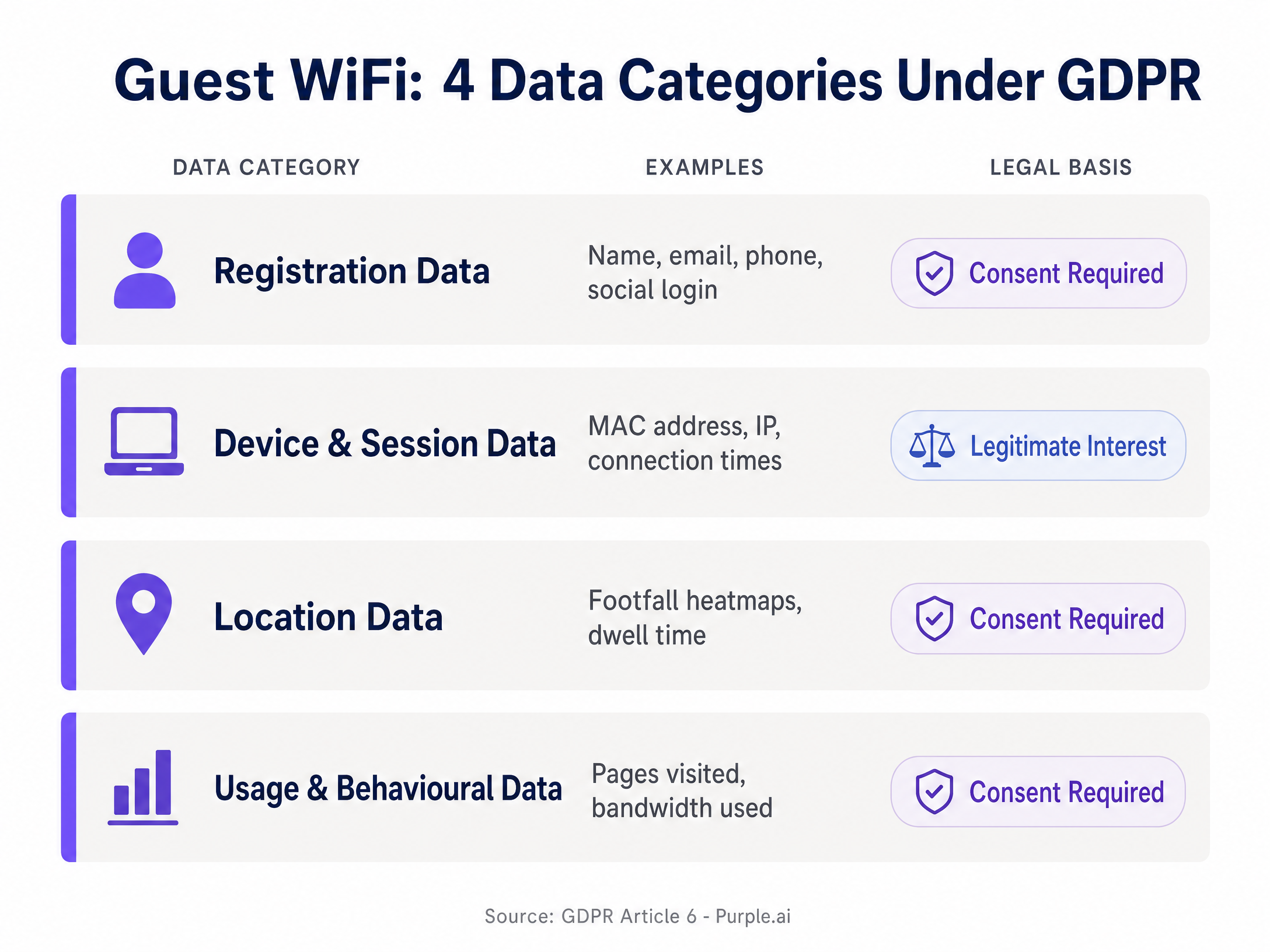
gdpr_data_categories_chart.png

訪客 WiFi 中的資料類別

透過訪客 WiFi 網路收集的資料可分為四個主要類別。每種類別對 GDPR 合規性都有不同的影響,特別是涉及處理的法律依據和所需的保留期限。

  1. 註冊資料:姓名、電子郵件地址、電話號碼和社群媒體個人檔案資料。法律依據為同意。您必須獲得明確的同意才能收集此資料,並應用資料最小化原則,僅要求絕對必要的資訊。
  2. 設備與工作階段資料:MAC 位址、IP 位址、連線時間和工作階段持續時間。法律依據通常是基於網路安全和疑難排解的正當利益(Legitimate Interest),前提是您必須進行並記錄正當利益評估(Legitimate Interest Assessment)。
  3. 位置資料:人流量熱圖和停留時間追蹤。法律依據為同意。即使在聚合後,從個人設備進行的初始收集仍屬於個人資料。
  4. 使用與行為資料:造訪的網頁和消耗的頻寬。法律依據為同意。您必須明確說明您正在收集什麼以及原因。

Captive Portal 同意機制

Captive Portal 是您的主要合規介面。它是賓客在存取網際網路之前看到的歡迎頁面(Splash Page)。最常見的合規失敗是「綑綁」(bundling),即場域要求賓客必須接受行銷電子郵件才能上網。在 GDPR 規範下,同意必須是自由給予的。如果您將網路存取與行銷同意綑綁在一起,該同意即屬無效。

您的 Captive Portal 必須至少呈現兩個獨立的同意元素:

  • 一個用於接受網路存取服務條款的強制性核取方塊。
  • 一個用於同意接收行銷資訊的可選且預設未勾選的核取方塊。

GDPR 序言第 32 條(Recital 32)明確禁止預先勾選的方塊。除了同意結構之外,您的入口網站必須在使用者提交任何資料之前,提供清晰且簡潔的隱私權聲明。它必須說明您收集哪些資料、收集的原因、保留多久以及與誰分享。您的系統必須記錄每一次同意事件:誰同意、何時同意、同意了什麼,以及他們所看到的隱私權聲明的確切版本。此同意稽核軌跡是您的合規證明。

網路架構與安全
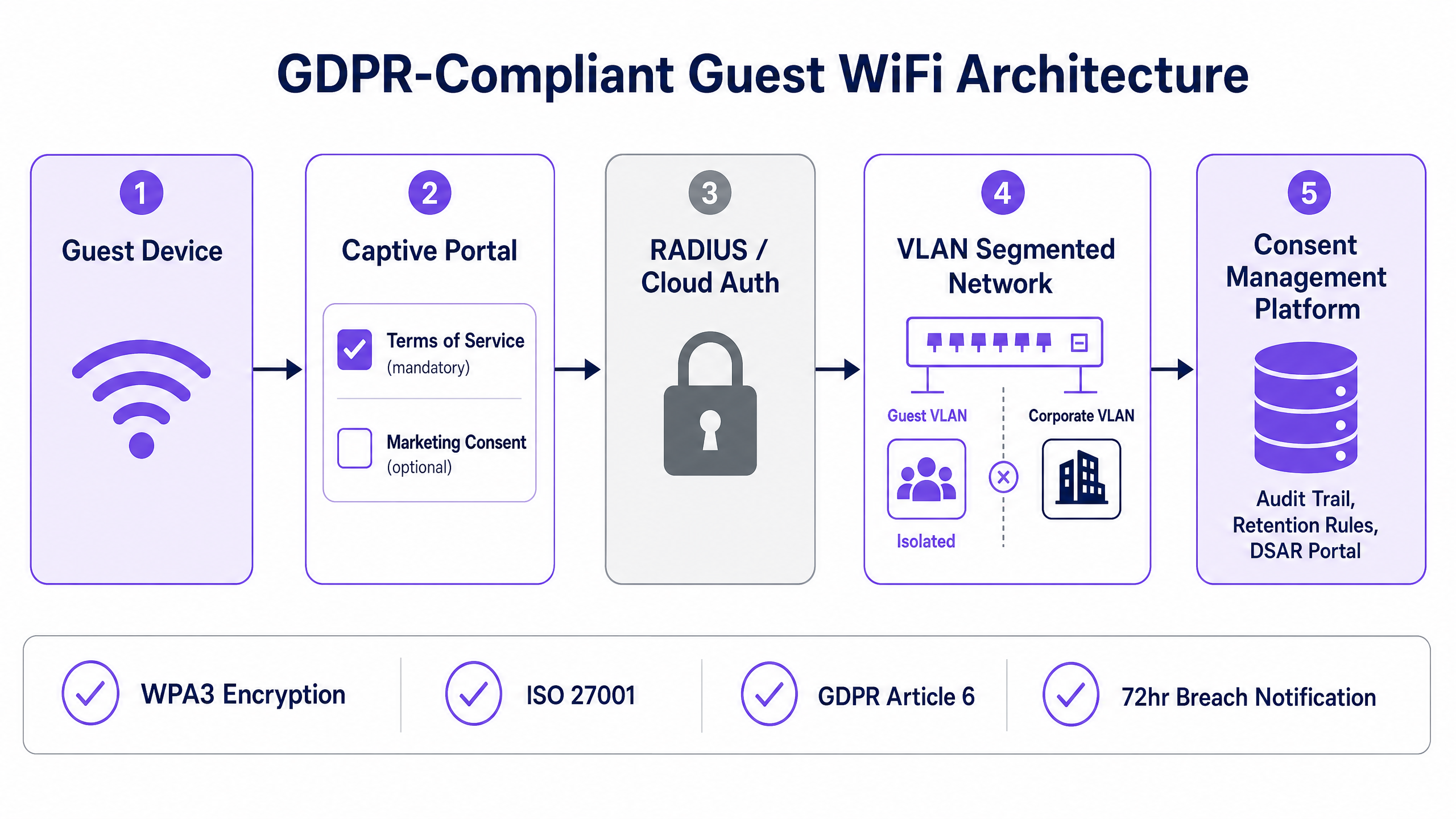
gdpr_compliance_architecture.png

從網路架構的角度來看,VLAN 區隔是不可妥協的。訪客 WiFi 流量必須隔離在專用的 VLAN 上,與您的企業網路完全分開。使用存取控制清單(ACL)阻止訪客設備存取內部子網路,並啟用用戶端隔離(Client Isolation),使訪客設備之間無法互相通訊。無論您部署的是 Cisco Meraki、HPE Aruba、Ruckus、Juniper Mist 還是 Ubiquiti UniFi,這都適用。

在驗證方面,請將您的無線區域網路控制器(WLC)與雲端 RADIUS 伺服器整合。當使用者完成 Captive Portal 流程時,平台會向控制器發送 RADIUS Access-Accept 訊息,從而授予網路存取權限。這在驗證層和資料收集層之間建立了清晰的隔離。

在加密方面:在硬體支援的情況下部署 WPA3。WPA3 使用對等同時驗證(SAE),這消除了 WPA2 四向交握中的漏洞,並針對離線字典攻擊提供更強的保護。至少應強制執行採用 AES 加密的 WPA2。您的 Captive Portal 必須透過帶有有效 TLS 憑證的 HTTPS 提供服務。透過 HTTP 提供收集個人資料的表單是嚴重的安全疏失。

實施指南

部署合規的訪客 WiFi 解決方案需要周密的規劃和執行。以下步驟概述了不綁定特定廠商的實施方法。

步驟 1:稽核目前的資料流

精確對應您目前的訪客 WiFi 網路所收集的資料。識別每個欄位在您的 Captive Portal 上、由您的無線控制器產生的每個記錄檔,以及每個第三方整合。記錄每個資料點的目的。如果您無法證明收集特定資料點的合理性,請將其刪除。

步驟 2:重新設計 Captive Portal

實作符合規範的 Captive Portal,並針對網路條款和行銷同意書提供獨立且未勾選的核取方塊。確保語言通俗易懂且價值交換清晰。直接連結到您完整的隱私權政策。

步驟 3:自動化資料保留

在您的 WiFi 分析 平台中設定自動刪除政策。手動刪除在大規模營運中是不可行的。

  • 工作階段記錄:30 天後清除。
  • 網路安全記錄:保留最多 12 個月。
  • 同意記錄:在服務關係存續期間外加兩年內保留。
  • 行銷設定檔:當使用者撤回同意時立即刪除。

步驟 4:保護網路邊緣

將訪客流量分割到專用的 VLAN。實作用戶端隔離。在支援的情況下強制執行 WPA3 加密。確保您的 Captive Portal 透過 HTTPS 提供服務。

步驟 5:實作偏好設定中心

為訪客提供自助式偏好設定中心,讓他們可以管理自己的同意設定並提交當事人存取請求 (DSAR)。這能減輕您 IT 團隊的營運負擔,並確保您能高效地履行當事人權利。

最佳實踐

為了保持合規性並建立強大的 訪客 WiFi 策略,請遵循以下產業標準最佳實踐:

  • 進行 DPIA:在部署任何大規模位置追蹤或行為剖析功能之前,根據 GDPR 第 35 條,進行資料保護影響評估在法律上是強制性的。
  • 簽署 DPA:確保您與代表您處理訪客資料的每個第三方平台都簽署了資料處理增補協議。
  • 最小化資料收集:只索取您實際需要且打算使用的資料。如果您是 零售 場所,您真的需要訪客的出生日期才能提供網路連線嗎?
  • 為資料外洩做好準備:72 小時的通報時鐘從您意識到外洩的那一刻開始計算。將此時間表納入您的事件應變計劃中,並確保您的團隊知道在 72 小時內通知 ICO,即使調查尚未完成。

疑難排解與風險緩釋

訪客 WiFi 部署中常見的失敗模式通常源於對 GDPR 要求的誤解。

失敗模式:同意疲勞 如果您的入口網站過於複雜,訪客將會放棄連線或盲目點擊。保持語言通俗易懂。清晰解釋價值交換。例如:"提供您的電子郵件以獲取快速、免費的 WiFi 以及我們不定期提供的優惠。"

失敗模式:忽略當事人權利 在 GDPR 規範下,訪客有權存取、更正和刪除其資料。如果您缺乏處理這些請求的流程,您將面臨重大風險。自助式偏好設定中心是最有效的緩釋策略。

失敗模式:無限期保留資料 無限期保留資料直接違反了 GDPR 的儲存限制原則。如果您沒有建立自動刪除政策,您每天都在累積風險。在您的平台中設定保留規則,以便在記錄達到保留期限時自動清除。

投資報酬率與商業影響

訪客 WiFi 的 GDPR 合規性不僅僅是一項成本,更是一個策略推動因素。合規的平台可以降低監管罰款的風險、建立客戶信任,並提供來源合乎道德的商業智慧。

當訪客透過符合規範的 Captive Portal 主動選擇加入行銷傳播時,該聯絡資料的品質顯著高於綑綁式選擇加入。明確表示同意的訪客更有可能參與後續的溝通,從而為您的行銷活動帶來更高的轉換率。

此外,架構良好的訪客 WiFi 平台可提供有關訪客行為的寶貴洞察。在 餐旅 環境中,這些資料可以為人員配置水準提供參考、最佳化佈局並改善整體訪客體驗。透過將合規性視為訪客 WiFi 策略的基礎要素,您可以將監管要求轉化為可衡量的商業資產。

收聽我們的播客以深入探討這些主題:

關鍵定義

Data Controller

The entity that determines the purposes and means of processing personal data. When you provide Guest WiFi, you are the Data Controller.

This designation makes the venue legally responsible for compliance, regardless of which vendor supplies the WiFi hardware or software.

Data Processor

The entity that processes personal data on behalf of the Data Controller. Your WiFi analytics vendor is a Data Processor.

A signed Data Processing Addendum (DPA) is legally required before sharing data with a Processor.

MAC Address

Media Access Control address. A unique identifier assigned to a network interface controller for use as a network address in communications within a network segment.

Under GDPR, a MAC address is considered personal data when it can be linked to an identifiable individual.

Captive Portal

A web page that the user of a public-access network is obliged to view and interact with before access is granted.

This is the primary interface for collecting consent and serving privacy notices to guests.

VLAN Segmentation

The practice of dividing a physical network into multiple logical networks.

Guest WiFi traffic must be isolated on a dedicated VLAN to prevent access to the corporate network.

Legitimate Interest

A lawful basis for processing personal data when the processing is necessary for your legitimate interests or the legitimate interests of a third party, unless there is a good reason to protect the individual's personal data which overrides those legitimate interests.

Often used as the basis for basic session logging for network security and troubleshooting.

Data Subject Access Request (DSAR)

A request made by an individual to access the personal data an organisation holds about them.

Venues must have a process to handle DSARs efficiently, often facilitated by a self-service preference centre.

WPA3

Wi-Fi Protected Access 3. The latest security certification program developed by the Wi-Fi Alliance.

Provides stronger encryption and protection against offline dictionary attacks compared to WPA2. Should be deployed where hardware supports it.

範例

A 200-room hotel wants to collect guest emails to drive loyalty programme sign-ups. Their current system requires guests to accept marketing to get online.

Deploy a compliant captive portal with separate consent checkboxes. The mandatory checkbox covers terms of service. The optional, unticked checkbox covers marketing consent. The hotel will likely see a lower raw volume of marketing opt-ins compared to the bundled approach, but the quality and legality of the list improves dramatically. Guests who actively opt in are far more likely to engage with subsequent communications. Premier Inn, which uses Purple across its estate, operates exactly this model.

考官評語: This approach resolves the GDPR violation of bundled consent. While the raw number of opt-ins may decrease, the resulting database consists of high-intent contacts, improving marketing ROI and ensuring legal compliance.

A stadium IT team wants to use WiFi analytics to monitor crowd density and manage safety, but the legal team is concerned that tracking device locations without consent is a GDPR violation.

Update the captive portal privacy notice to explicitly disclose that location data is processed for crowd management and safety purposes. Implement MAC address pseudonymisation at the edge, on the access points themselves, before the data reaches the cloud analytics platform. The analytics system then works with pseudonymous identifiers rather than raw MAC addresses.

考官評語: By pseudonymising the data at the edge, the venue significantly reduces the privacy risk and the scope of the required Data Protection Impact Assessment (DPIA), while still achieving the operational goal of monitoring crowd density.

練習題

Q1. A retail chain wants to implement WiFi footfall tracking across 50 stores to measure dwell time. The IT Director suggests logging raw MAC addresses centrally for analysis. Is this compliant?

提示:Consider the definition of personal data and the principle of data minimisation.

查看標準答案

No, this is high risk. Raw MAC addresses are personal data. The recommended approach is to implement MAC address pseudonymisation at the edge (on the access points) before transmitting the data to the central analytics platform. Additionally, a Data Protection Impact Assessment (DPIA) must be conducted before deployment, and clear signage must inform shoppers that analytics are in operation.

Q2. During an audit, you discover that your captive portal requires users to accept both the network terms of service and marketing emails via a single checkbox to connect to the WiFi. What is the immediate required action?

提示:Review the requirements for valid consent under GDPR Article 6.

查看標準答案

Immediately redesign the captive portal to unbundle the consent. Implement two separate checkboxes: a mandatory one for the network terms of service, and an optional, unticked checkbox for marketing consent. The current bundled approach renders all collected marketing consent invalid under GDPR.

Q3. A guest submits a Data Subject Access Request (DSAR) asking for all data your venue holds on them, including WiFi session logs. Your current retention policy is to keep session logs indefinitely. What are the implications?

提示:Consider the storage limitation principle.

查看標準答案

Keeping session logs indefinitely violates the GDPR storage limitation principle. You must fulfill the DSAR by providing the requested data, but you must also urgently implement an automated data retention policy. Session logs should typically be purged after 30 days. Holding them indefinitely exposes the venue to significant regulatory risk.