跳至主要內容

飯店顧客 WiFi 管理:整合 PMS、Captive Portal 與品牌標準

本技術指南詳細說明如何規劃企業級飯店 WiFi 網路架構,重點介紹 VLAN 區隔、用於自動化工作階段管理的 PMS 整合,以及符合 GDPR 規範之資料收集的 Captive Portal 最佳化。

📖 5 分鐘閱讀📝 1,015 字數🔧 2 範例3 練習題📚 8 關鍵定義

收聽此指南

查看播客逐字稿
Welcome to the Purple Technical Briefing. Today we're covering hotel guest WiFi management - specifically how to integrate your property management system, your captive portals, and your brand standards into a coherent, compliant, and commercially valuable network architecture. If you're the IT manager at a single property, the network architect across a portfolio, or the CTO signing off on a multi-year infrastructure refresh, this briefing is for you. We're going to be direct and practical. No theory for its own sake. Let's start with the problem. Hotel guest WiFi is one of those infrastructure components that looks straightforward on paper and turns into a significant operational headache in practice. The reason is that a hotel network has to serve at least four distinct populations simultaneously - guests, staff, building systems, and increasingly, in-room IoT devices like smart TVs, thermostats, and voice assistants. Each population has completely different security requirements, performance expectations, and compliance implications. Getting this architecture wrong costs you in three ways: guest satisfaction scores drop, your security posture weakens, and you lose the data asset that authenticated WiFi should be generating. So let's talk architecture. The foundation is network segmentation using VLANs - Virtual Local Area Networks. A VLAN is a Layer 2 construct defined in IEEE 802.1Q that lets you run multiple logically separate networks over the same physical infrastructure. Think of it as multiple lanes on the same motorway, each with its own speed limit and access rules. In a hotel, you want at minimum four VLANs: Guest WiFi on VLAN 10, Staff on VLAN 20, IoT and building systems on VLAN 30, and your PCI-scoped payment network on VLAN 40. Each SSID - that's the network name guests see - maps to a corresponding VLAN. Your firewall enforces a default-deny policy between them. Guest traffic routes to the internet only. It never touches your property management system, your point-of-sale terminals, or your staff communications. Now, the integration that changes everything: connecting your WiFi management platform to your Property Management System - your PMS. Whether you're running Oracle OPERA, Mews, Protel, or another system, your PMS is the ground truth about who is in the building, what room they're in, what loyalty tier they hold, and when they check out. If your WiFi platform isn't talking to your PMS, you're operating blind. A well-integrated deployment works like this. A guest checks in - either at the front desk or via a mobile app. The PMS fires a webhook or API call to the WiFi management platform. The platform pre-provisions the guest's profile: their loyalty tier, their preferred SSID, their bandwidth policy. When they connect to the network, the experience is immediate. When they check out, the session is automatically revoked. No lingering credentials. No security exposure from a guest who checked out three hours ago but whose device is still authenticated on your network. The captive portal - sometimes called a splash page - is where the network transitions from a cost centre to a data asset. Done badly, it's an annoyance that guests abandon. Done well, it's your primary mechanism for first-party data capture. The guest authenticates via email, social login, or SMS verification. You capture a verified identity. That identity links to their device, their visit timestamp, their dwell time, and any return visits. Over time, you build a consented, GDPR-compliant dataset of your actual guests - not inferred data, not third-party data, but first-party data you own. GDPR compliance here is non-negotiable. Your splash page must present a clear privacy notice, explicit consent options for marketing, and a straightforward mechanism for guests to exercise their data rights. Critically, consent to use the WiFi is not the same as consent to receive marketing emails. These must be separate, uncoupled choices. Purple's platform handles this natively, with consent records tied to each user profile and audit trails available for regulatory review. On the security side: WPA3-Enterprise with IEEE 802.1X is the gold standard for staff networks. For guest networks, WPA3-Personal or an open network behind a captive portal with HTTPS enforcement is the standard approach. What you must not do is run an open network without client isolation. Client isolation prevents any guest device from communicating directly with another guest device on the same network. Without it, a guest's compromised smartphone can probe every other device on the same SSID. Enable client isolation on every guest-facing SSID. No exceptions. For authentication on staff networks, 802.1X uses the Extensible Authentication Protocol - EAP - to verify identity against a RADIUS server, which in turn queries your identity provider. Purple integrates with Microsoft Entra ID, Okta, and Google Workspace. When a staff member authenticates, the RADIUS server can return not just a pass or fail, but a VLAN assignment and a QoS policy based on their role. That's the technical mechanism that makes role-based network access work automatically, without manual provisioning. Now let's talk about brand standards and chain-wide consistency - because this is where the governance challenge becomes as important as the technical one. A global hotel brand might have hundreds of properties across dozens of countries, each with different local ISPs, different infrastructure vintages, and different franchise arrangements. Delivering a consistent guest WiFi experience across that estate requires a cloud-managed network architecture with centralised policy management. The model that works is a three-tier hierarchy. Brand headquarters defines the policy templates: the SSIDs, the security standards, the loyalty tier bandwidth allocations, the captive portal branding. Regional hubs apply those templates with local variations. Individual properties inherit from the regional hub and can only customise within the parameters the brand has defined. Properties have flexibility, but they cannot break brand standards. From a technology standpoint, this requires a cloud-managed WiFi platform with a hierarchical policy engine. Access points at each property connect to the cloud controller, pull their configuration, and enforce it locally. If a property's internet connection goes down, the APs continue operating in autonomous mode against their last-known-good configuration. That resilience is critical. Let me walk through the practical implementation sequence. Five phases. Phase one: site survey. Before you touch a single cable, walk the property with a spectrum analyser. Use predictive modelling software to finalise your access point placement before you commit to cable runs. In-room coverage is the target. One AP per room, or at minimum one per two rooms. Corridor placement is a common mistake that creates coverage shadows in rooms. Phase two: VLAN architecture design. Map every device type to a dedicated VLAN before you configure anything. Guest, staff, IoT, payment systems. Your firewall inter-VLAN rules are as important as the VLAN architecture itself. Default-deny, explicit-permit. Phase three: PMS integration scoping. Do this before you select your WiFi platform, not after. Confirm that your chosen platform has a pre-built connector for your PMS, and understand the API integration effort before you commit. Phase four: captive portal and authentication flow. Test the full guest journey end-to-end on iOS, Android, and Windows before go-live. Test the consent flows. Test what happens on a return visit. A captive portal that takes 45 seconds to load or asks for ten fields of personal information is a brand failure, not just a technical one. Phase five: analytics and reporting configuration. Connect your WiFi data layer to your CRM and marketing automation tools. The data asset you've built through authenticated WiFi is only valuable if it feeds into downstream workflows. Now the pitfalls. I see the same ones repeatedly. The first is under-provisioning the internet uplink. Nine times out of ten, slow hotel WiFi is a bandwidth problem at the WAN, not a radio frequency problem. For a 200-room hotel at 80% occupancy with guests streaming video, plan for five to ten megabits per second per room at peak. That's 800 megabits to 1.6 gigabits of committed bandwidth. The second pitfall is misconfigured trunk ports. If a switch port carrying multiple VLANs is accidentally configured as an access port, all traffic collapses onto a single VLAN and your segmentation disappears silently. Audit your switch configurations after every change. The third pitfall is deploying a captive portal that collects data but has no downstream marketing workflow. You've built the data asset. Now use it. Rapid-fire questions. Should I charge guests for WiFi? No. In 2026, paid guest WiFi is a guest satisfaction liability. The data and marketing value of free, authenticated WiFi far exceeds any revenue from access fees. Do I need Wi-Fi 6 or will Wi-Fi 5 do? If you're deploying new infrastructure today, always go Wi-Fi 6. The cost delta is minimal and the performance headroom is significant. How do I handle IoT devices in guest rooms? Segment them onto a dedicated IoT VLAN with no lateral movement capability and strict egress filtering. They should never share a network segment with guest devices. To bring this together. Hotel guest WiFi management is not primarily a bandwidth problem. It's an architecture, integration, and governance problem. The properties that get this right have three things in common: a centralised cloud-managed network with a hierarchical policy model, deep PMS integration that makes session management and loyalty tier differentiation automatic, and they treat WiFi performance data as a first-class operational metric. The three things to take away. One: segment your network properly from day one. Guest, staff, and IoT on separate VLANs, with a firewall between them. Two: integrate your WiFi platform with your PMS before go-live. Automatic session provisioning and revocation is not a nice-to-have. Three: treat your captive portal as a marketing platform, not just an access gateway. The first-party data you capture through authenticated WiFi is one of your most valuable commercial assets. Purple operates across 80,000 venues and has processed 440 million logins in 2024. If you want to explore how Purple's Guest WiFi platform handles PMS integration, chain-wide policy management, and guest data analytics, visit purple.ai. Thanks for listening.

header_image.png

執行摘要

飯店顧客 WiFi 不再只是基礎公用設施,而是關鍵的營運系統,也是收集第一方資料的首要管道。本技術參考指南詳細說明如何在旅宿環境中規劃架構、部署和管理企業級 WiFi。內容涵蓋網路區隔、物業管理系統 (PMS) 整合、Captive Portal 最佳化,以及連鎖品牌標準的全面落實。對於 IT 總監、網路架構師和場域營運總監而言,目標非常明確:提供快速、安全的連線,與您的 Guest WiFi 基礎架構無縫整合,同時收集符合規範的資料以匯入您的 WiFi Analytics 平台。

無論您管理的是精品旅館,還是擁有 500 家物業的全球連鎖品牌,技術需求都是相同的:隔離流量、透過 PMS 自動化工作階段管理,並執行一致的安全原則。Purple 提供了與硬體無關的雲端重疊網路 (cloud overlay),讓您能在 Cisco Meraki、HPE Aruba、Ruckus、Juniper Mist、Ubiquiti UniFi、Cambium、Extreme 和 Fortinet 的部署中實現此目標。

技術深度解析

網路區隔與 VLAN 架構

飯店環境中的扁平網路 (flat network) 是嚴重的安全漏洞,也是合規性上的失敗。飯店網路必須服務不同的群體:顧客、員工、大樓管理系統和 IoT 設備。安全飯店 WiFi 的基礎是使用 IEEE 802.1Q 定義的虛擬區域網路 (VLAN) 進行邏輯區隔。

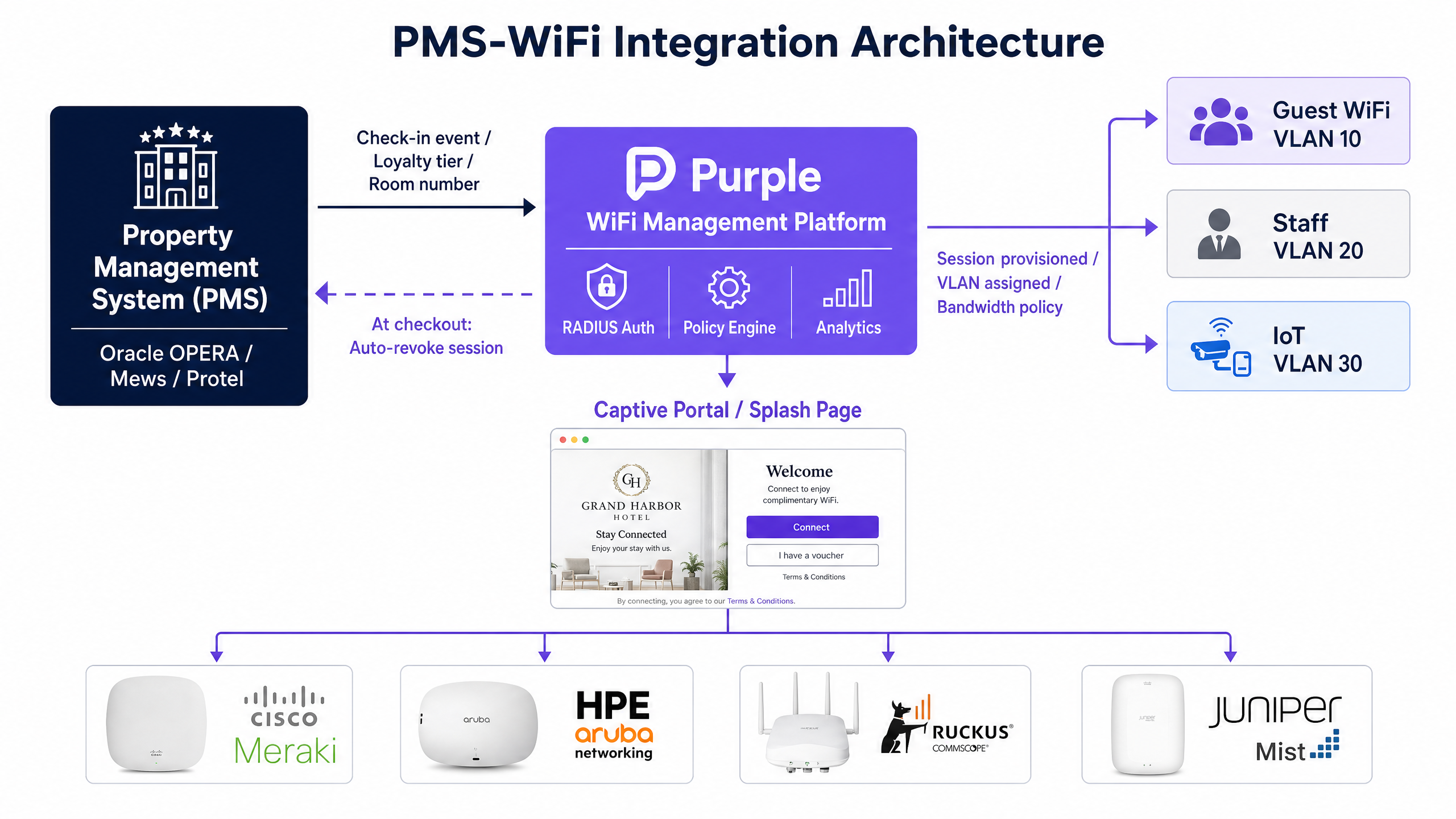
您必須為每個流量類別分配一個專用的 VLAN。標準部署至少需要四個 VLAN:Guest WiFi、員工、IoT/大樓系統,以及用於付款終端機且符合 PCI 範圍的網路。您的防火牆必須在這些區隔之間執行「預設拒絕」(default-deny) 原則。顧客流量必須直接路由到網際網路,與物業管理系統、銷售點 (POS) 終端機和員工通訊完全隔離。

對於無線邊緣,每個服務設定識別碼 (SSID) 都會對應到特定的 VLAN。在顧客 SSID 上,您必須啟用用戶端隔離 (client isolation)。用戶端隔離可防止同一 SSID 上的裝置直接相互通訊,從而降低受駭裝置探測其他顧客裝置的風險。

PMS 整合與自動化工作階段管理

WiFi 管理平台與您的物業管理系統 (PMS)(例如 Oracle OPERA、Mews 或 Protel)之間的整合,是現代旅宿網路的關鍵核心。PMS 掌握了關於顧客身分、客房分配、入住狀態和會員等級的真實數據。

當顧客辦理入住時,PMS 會向 WiFi 平台發送 API 呼叫或 Webhook。平台會預先配置顧客的工作階段,並根據其會員等級套用正確的頻寬原則。當顧客連線時,驗證過程是無縫的。至關重要的是,當顧客退房時,PMS 會通知 WiFi 平台立即撤銷存取權限。這消除了憑證殘留的安全風險,並防止已退房的顧客繼續佔用頻寬。

Captive Portals 與第一方資料收集

Captive Portal 是將基礎架構投資轉化為商業價值的入口。它不僅僅是一種存取控制機制,更是您收集第一方資料的首要引擎。

顧客透過電子郵件、社群登入或簡訊驗證進行身分驗證。這會擷取已驗證的身分,然後將其與其裝置的 MAC 位址、造訪時間戳記和停留時間連結。這些資料會直接匯入您的 CRM,以便發送針對性的入住前電子郵件、退房後問卷調查以及基於位置的優惠。

合規性是不容妥協的。符合 GDPR 規範的 Captive Portal 必須呈現清晰的隱私權聲明,並針對行銷傳播取得明確且未綑綁的同意。同意存取 WiFi 不得與同意接收行銷資訊掛鉤。Purple 原生支援此功能,為每個使用者設定檔保留詳細的稽核軌跡。

實作指南

第一階段:現場勘測與容量規劃

在配置任何硬體之前,請使用預測建模工具進行徹底的射頻 (RF) 現場勘測。對於飯店環境,目標是客房內覆蓋。每間客房部署一個無線基地台 (AP),或至少每兩間客房部署一個 AP。避免將其安裝在走廊,這會產生訊號死角並降低效能。根據尖峰時段的同時使用量來規劃您的網際網路上行鏈路頻寬。規劃每間客房 5 至 10 Mbps;一間擁有 200 間客房的物業需要 800 Mbps 至 1.6 Gbps 的保證頻寬專線。

第二階段:架構與原則設計

將每種裝置類型對應到專用的 VLAN。記錄您的 VLAN 間路由規則和預設拒絕防火牆原則。確定您的驗證標準:員工網路採用支援 IEEE 802.1XWPA3-Enterprise,顧客網路則採用 WPA3-Personal 或強制執行 HTTPS 且啟用用戶端隔離的開放式網路。

第三階段:PMS 與 Captive Portal 整合

設定您的 PMS 與 WiFi 平台之間的 API 連線。設計符合品牌標準的 Captive Portal。在 iOS、Android 和 Windows 裝置上測試端到端的顧客體驗流程。驗證在 PMS 中辦理退房時,是否能正確觸發工作階段撤銷。
pms_wifi_integration_architecture.png

最佳實踐

  • 強制執行用戶端 隔離: 務必在面向賓客的 SSIDs 上啟用用戶端隔離,以防止裝置之間的橫向移動。
  • 自動化角色型存取: 員工網路請使用 IEEE 802.1X 和 RADIUS 驗證。與 Microsoft Entra ID、Okta 或 Google Workspace 整合,以根據使用者角色動態分配 VLAN 和 QoS 策略。
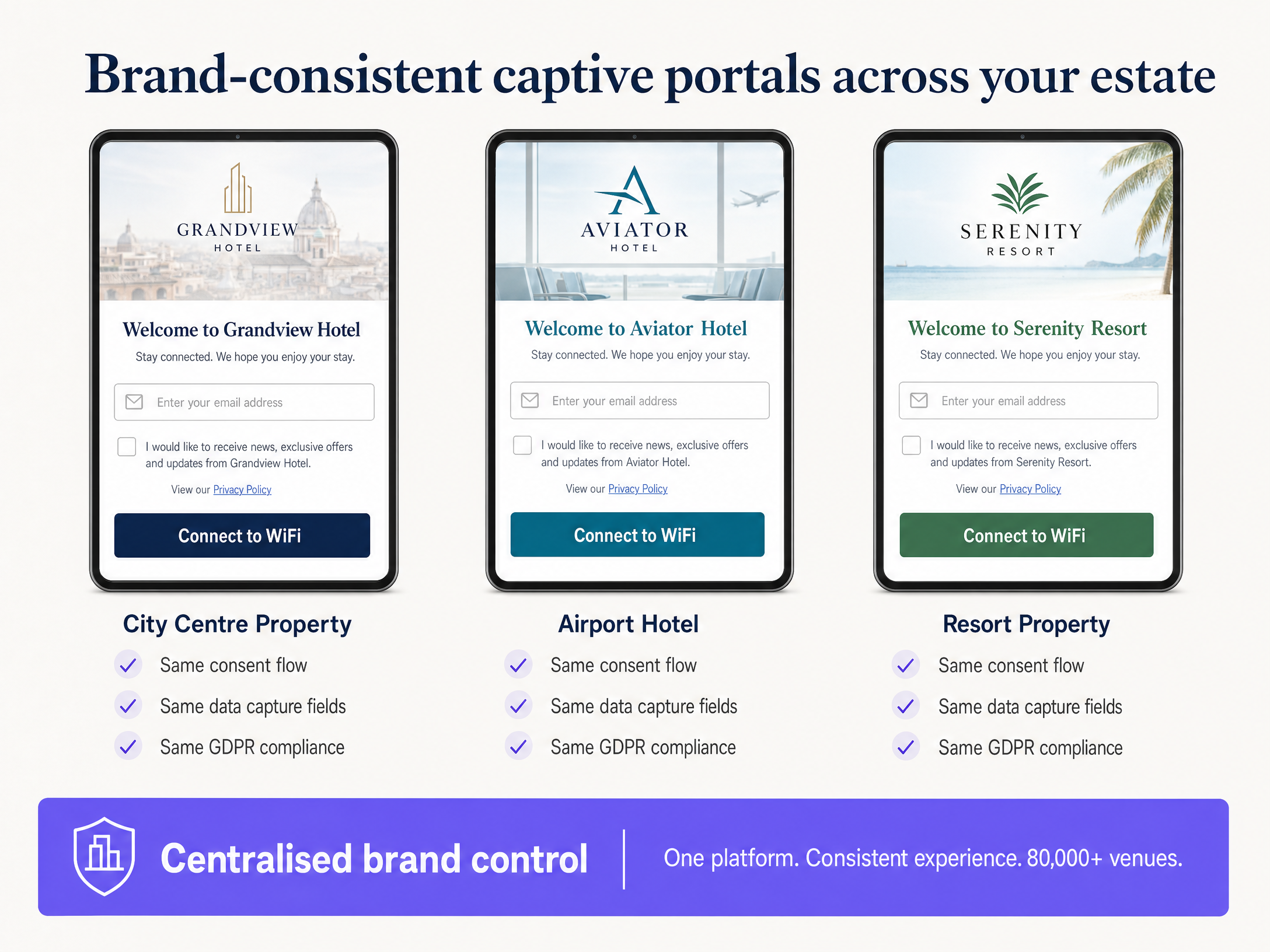
  • 集中化品牌標準: 使用具有階層式策略引擎的雲端管理平台。在總部層級定義 SSIDs、安全性協定和 captive portal 品牌形象,允許區域或飯店層級繼承,且不破壞品牌標準。
  • 隔離 IoT 流量: 將智慧電視、恆溫器和語音助理隔離在具有嚴格出口過濾的專用 IoT VLAN 上。
captive_portal_brand_standards.png

疑難排解與風險緩釋

  • 速度緩慢: 飯店 WiFi 速度緩慢最常見的原因是 WAN 上行鏈路配置不足,而非射頻 (RF) 干擾。請監控您的網際網路線路使用率。如果上行鏈路已飽和,升級無線基地台 (AP) 並不會改善賓客體驗。
  • 區隔失敗: 設定錯誤的交換器 Trunk 連接埠可能會將多個 VLAN 摺疊到單一廣播網域中,從而在無形中破壞您的區隔。請定期稽核交換器設定。
  • 驗證阻力: 需要輸入過多資料的 captive portal 會導致賓客放棄連線程序。請保持表單簡潔。

投資報酬率 (ROI) 與業務影響

架構正確的飯店 WiFi 網路可帶來可衡量的回報。它能減少與連線問題相關的 IT 支援工單,從而提高營運效率。它還能提升與 RevPAR 直接相關的賓客滿意度評分。最重要的是,它能建立一個合規、經驗證的賓客第一方資料庫,減少對線上旅行社 (OTA) 的依賴,並為直接訂房的行銷活動提供動力。

關鍵定義

VLAN (Virtual Local Area Network)

A logical subnetwork that groups a collection of devices from different physical LANs. Essential for isolating guest traffic from operational systems.

Used to separate guest WiFi, staff devices, IoT hardware, and payment terminals onto isolated broadcast domains for security and PCI compliance.

PMS (Property Management System)

The central software platform used by hotels to manage reservations, check-ins, billing, and room status.

Integrating the PMS with the WiFi platform allows for automated session provisioning, loyalty tier bandwidth allocation, and immediate access revocation upon checkout.

Captive Portal

A web page that users must view and interact with before access is granted to a public WiFi network.

Used in hospitality to authenticate guests, present terms of service, and capture first-party marketing data.

Client Isolation

A wireless network security feature that prevents connected devices from communicating directly with each other.

Mandatory on guest SSIDs to stop a compromised device from scanning or attacking other guests on the same network.

IEEE 802.1X

An IEEE Standard for port-based Network Access Control, providing an authentication mechanism to devices wishing to attach to a LAN or WLAN.

The gold standard for staff network authentication, allowing dynamic VLAN assignment based on the user's role defined in an identity provider like Microsoft Entra ID.

RADIUS (Remote Authentication Dial-In User Service)

A networking protocol that provides centralized Authentication, Authorization, and Accounting management for users who connect and use a network service.

Used in conjunction with 802.1X to verify staff credentials and apply specific network policies.

SSID (Service Set Identifier)

The public name of a wireless network.

Hotels typically broadcast multiple SSIDs (e.g., 'Guest WiFi', 'Staff Network'), each mapped to a specific VLAN.

WPA3-Enterprise

The highest level of Wi-Fi security, requiring each user to authenticate with unique credentials rather than a shared password.

Required for staff and operational networks to ensure individual accountability and enable dynamic policy enforcement.

範例

A 150-room boutique hotel using Oracle OPERA requires a secure WiFi deployment that differentiates bandwidth for loyalty members and automatically revokes access at checkout.

Deploy one Wi-Fi 6 access point per room. Configure four VLANs: Guest (VLAN 10), Staff (VLAN 20), IoT (VLAN 30), and POS (VLAN 40). Integrate the Purple platform with Oracle OPERA via API. When a guest checks in, OPERA sends the loyalty tier to Purple. Purple provisions the session, applying a 50 Mbps policy for standard guests and a 100 Mbps policy for premium members. At checkout, OPERA triggers an API call that immediately revokes the MAC address session in Purple.

考官評語: This architecture correctly isolates traffic, satisfying PCI DSS requirements for the POS network. The PMS integration eliminates manual voucher generation and ensures bandwidth is allocated based on commercial value, rather than first-come-first-served contention.

A global hotel brand with 400 properties needs to ensure consistent captive portal branding and GDPR compliance across all venues, despite using different local ISPs and hardware vendors (Cisco Meraki, HPE Aruba, and Ruckus).

Implement a cloud overlay platform like Purple above the heterogeneous hardware layer. Define a global policy template at Brand HQ that dictates the SSID name, the captive portal design, and the specific GDPR consent checkboxes. Apply this template hierarchically to all 400 properties. Local IT teams can manage their specific APs and switches, but they cannot alter the captive portal flow or data capture requirements.

考官評語: This approach solves the governance challenge of multi-vendor, multi-region deployments. By abstracting the captive portal and policy engine away from the underlying hardware, the brand guarantees a uniform guest experience and centralized legal compliance.

練習題

Q1. A hotel is upgrading its network to support mobile check-in and digital room keys. The IT team plans to put the electronic door locks on the same VLAN as the guest WiFi to simplify routing. What is the primary risk of this approach?

提示:Consider the principle of logical segmentation and lateral movement.

查看標準答案

Placing IoT devices like electronic locks on the guest VLAN exposes critical building infrastructure to untrusted devices. A compromised guest smartphone could attempt to probe or attack the locks. The correct approach is to place the locks on a dedicated IoT VLAN (e.g., VLAN 30) with strict ingress/egress filtering, entirely isolated from the guest VLAN.

Q2. A regional manager reports that the WiFi at a 300-room property is 'too slow', despite recent upgrades to Wi-Fi 6 access points in the corridors. What are the two most likely architectural causes of this poor performance?

提示:Consider both WAN capacity and RF propagation principles.

查看標準答案

First, the internet uplink is likely under-provisioned. A 300-room property requires a committed leased line of at least 1.5 Gbps to handle peak concurrent streaming. Second, corridor AP placement is a flawed design; the RF signal degrades significantly when passing through heavy fire doors and bathroom plumbing. APs should be relocated to the guest rooms.

Q3. The marketing team wants to automatically assign returning guests to a higher bandwidth tier to reward loyalty. How should the network architecture be designed to support this requirement?

提示:What system holds the source of truth for guest identity, and how does it communicate with the network?

查看標準答案

The architecture requires an API integration between the Property Management System (PMS) and the WiFi management platform. When the guest connects, the WiFi platform queries the PMS using the device MAC address or authenticated email. The PMS returns the guest's loyalty status, and the WiFi platform dynamically applies a QoS policy to allocate higher bandwidth.

繼續閱讀本系列

如何在 Starlink 上設定 Captive Portal:偏遠與海上場所指南

本指南詳細介紹如何繞過原生 Starlink 硬體,並使用企業級路由設備整合雲端託管的 Captive Portal。您將學習如何克服 CGNAT 限制、強制執行 VLAN 區隔、管理衛星頻寬限制,並確保法規合規性。

閱讀指南 →

Captive Portal 最佳實踐:高轉換率與合規性設計

本技術指南為 IT 經理、網路架構師和場域營運總監提供了部署 captive portals 的完整藍圖,在網路安全與高使用者轉換率之間取得平衡。內容涵蓋從 VLAN 區隔和 RADIUS 驗證,到符合 GDPR 規範的同意書設計以及驗證方法選擇的完整架構。所有建議均源自 Purple 於 2024 年在 80,000 多個場域和 4.4 億次登入中的營運經驗,並以實際部署數據為基礎。

閱讀指南 →

如何最佳化 Captive Portal 以實現最大化網路安全與使用者轉換率

本指南為企業場域最佳化 Captive Portal 提供完整的技術藍圖,涵蓋網路分段架構、驗證方式選擇、符合 GDPR 規範的同意書設計以及轉換率最佳化。本書專為飯店、連鎖零售、體育場館和公共部門機構的 IT 經理、網路架構師及 CTO 撰寫,協助其在網路安全與第一方數據收集之間取得平衡。Purple 在全球超過 80,000 個場域營運 Captive Portal 基礎設施,並於 2024 年處理了 4.4 億次登入,本指南中的框架即反映了這些實務營運經驗。

閱讀指南 →