跳至主要內容

Staff WiFi Terms and Conditions: Legal and Compliance Essentials

本指南涵蓋為企業場域擬定與執行員工 WiFi 使用條款與條件的法律和技術要點。內容詳細說明了可接受使用政策(AUP)中應包含的項目、如何滿足 GDPR 與 PCI DSS 要求,以及如何部署基於身分驗證的機制與網路分段以保護企業資產。飯店、零售連鎖、體育場館和公共部門機構的 IT 經理、HR 團隊及營運總監,將能在此獲得本季度即可實施的具體行動指南。

📖 8 分鐘閱讀📝 1,751 字數🔧 2 範例4 練習題📚 10 關鍵定義

收聽此指南

查看播客逐字稿
Hello and welcome to the briefing. Today we are tackling a critical infrastructure challenge that often slips under the radar until it causes a major incident: Staff WiFi Terms and Conditions, specifically focusing on the legal and compliance essentials. If you are an IT manager, a network architect, or a venue operations director at a hotel, a retail chain, or a large public venue, this session is for you. We are moving past the theory and getting straight into the actionable steps you need to secure your corporate assets, enforce Acceptable Use Policies, and maintain compliance with standards like GDPR and PCI DSS. Let's set the context. As venues scale, the attack surface expands. A single compromised employee device on a shared network can lead to severe operational disruption. We see it constantly. A staff member connects a personal phone to the back-of-house network, that phone has malware, and suddenly the entire corporate subnet is exposed. So, how do we fix this? It starts with the Acceptable Use Policy, or AUP. This is not just an HR document. It is the legal foundation that allows you to monitor your network and take action when necessary. Your AUP needs to be unambiguous. First, define the scope. It applies to everyone connecting to the corporate network. Employees, contractors, whether they are using a company-issued laptop or their own personal smartphone. Second, outline permitted use. The network is for business. Incidental personal use might be fine, but it cannot interfere with productivity or consume excessive bandwidth. Third, explicitly forbid illegal activities, unauthorised software, and bypassing security controls. Now, here is the crucial part for our listeners in the UK and Europe dealing with GDPR: Monitoring Transparency. You cannot just start inspecting traffic. You must inform staff that their activity may be monitored. Detail what you collect. Connection times, MAC addresses, bandwidth usage. Explain that it is used to ensure network security and performance. This establishes your lawful basis for processing that data under the legitimate interest grounds. But a policy without enforcement is just a suggestion. You have to back it up with technical controls. Let's dive into the technical architecture. The days of using a shared WPA2 password for the staff network are over. If you have a password written on a whiteboard in the breakroom, your network is compromised. When an employee leaves, that password stays. That is not a policy problem. That is a structural security failure. Enterprise environments must deploy 802.1X authentication with WPA3-Enterprise encryption. This means every user authenticates with their own unique credentials, usually tied to your central directory like Microsoft Entra ID, Okta, or Google Workspace. This is where solutions like Purple really shine. Purple uses Identity-Based Networks to replace those shared passwords with individual, certificate-based access. When HR removes a staff member from the directory, Purple revokes their WiFi access automatically via SCIM. No manual intervention. No security gaps. No tickets to raise. Next is network segmentation. You must isolate staff traffic from guest and payment networks. Deploy Virtual Local Area Networks, or VLANs. In a retail setting, you need at least three. Guest WiFi, Staff WiFi, and Point of Sale. This isolation is a fundamental requirement of PCI DSS compliance. It ensures that even if a staff device is compromised, it cannot reach the cardholder data environment. Let me give you a concrete example. A two-hundred-room hotel had housekeepers, receptionists, and management all sharing a single WiFi password. When a receptionist left under difficult circumstances, the IT team had no way to revoke just their access without changing the password for everyone. That meant a full estate-wide reset, support calls from every department, and a two-hour productivity loss across the property. After migrating to Purple's 802.1X authentication integrated with their Microsoft Entra ID directory, offboarding became a single click in the HR system. WiFi access was revoked within minutes, automatically, with a full audit trail. Now let's talk about content filtering. You cannot just rely on staff to make good choices. Deploy DNS-level filtering to block malicious sites and inappropriate content. Purple Shield provides AI-driven content filtering that strips out ads and trackers before they load. This secures the network and can reduce bandwidth consumption by up to forty-four percent, keeping your critical business applications running smoothly. Pages load up to fifty-three percent faster, and the number of DNS queries drops by sixty-two percent. That is real headroom for the traffic that actually runs your business. Let me give you a second example from retail. A regional retail chain with fifty locations was experiencing intermittent slowdowns on their cloud-based Point of Sale system during peak trading hours. The root cause was staff streaming video content on the same network segment as the POS terminals. By deploying Purple Shield with time-based policies, streaming services were throttled during trading hours and the POS performance issues disappeared. The fix took less than a day to deploy across all fifty sites from a single dashboard. Now let's talk about common pitfalls. The biggest one is failing to automate offboarding. If IT has to manually remove access, mistakes happen. Tie network access directly to your HR systems. The second pitfall is inadequate segmentation. We still see venues putting staff and POS devices on the same subnet. That is an immediate audit failure. Implement strict VLAN tagging and firewall rules to isolate traffic. The third pitfall is lack of monitoring transparency. Monitoring staff without explicit consent or notification violates GDPR. Include clear clauses in the AUP and employee contracts before you switch on any monitoring tools. Let's do a rapid-fire Q and A on the questions we hear most often. Question: Do I need a separate SSID for staff and guests? Yes. Always. A dedicated staff SSID with WPA3-Enterprise is cleaner and easier to audit than shared SSIDs with credential-based VLAN assignment. Question: Can I use BYOD devices on the staff network? Yes, but you need a BYOD policy within your AUP that specifies minimum security requirements. Devices must run a supported operating system, have up-to-date security patches, and have a screen lock enabled. Question: How often should I review the AUP? At minimum, annually. Also review it after any significant regulatory change, security incident, or major infrastructure upgrade. To wrap up, let's summarise the key actions for this quarter. First, review your Acceptable Use Policy and ensure it includes explicit monitoring transparency clauses. Second, migrate away from shared passwords to 802.1X authentication integrated with your identity provider. Third, verify your VLAN segmentation isolates staff, guest, and payment traffic. Fourth, deploy DNS-level content filtering to enforce the AUP technically and reclaim bandwidth. Fifth, automate offboarding by connecting your HR system to your network access controls. Implementing these controls delivers measurable ROI. Automating onboarding and offboarding through identity provider integration reduces IT support tickets related to WiFi access by up to eighty percent. Purple's infrastructure runs across eighty thousand live venues with ninety-nine point nine nine nine percent uptime, so you are not building this on top of something fragile. Thank you for joining this briefing. Secure your networks, document your policies, and make sure your technical controls actually enforce what your AUP says they do. We will see you next time.

執行摘要

header_image.png

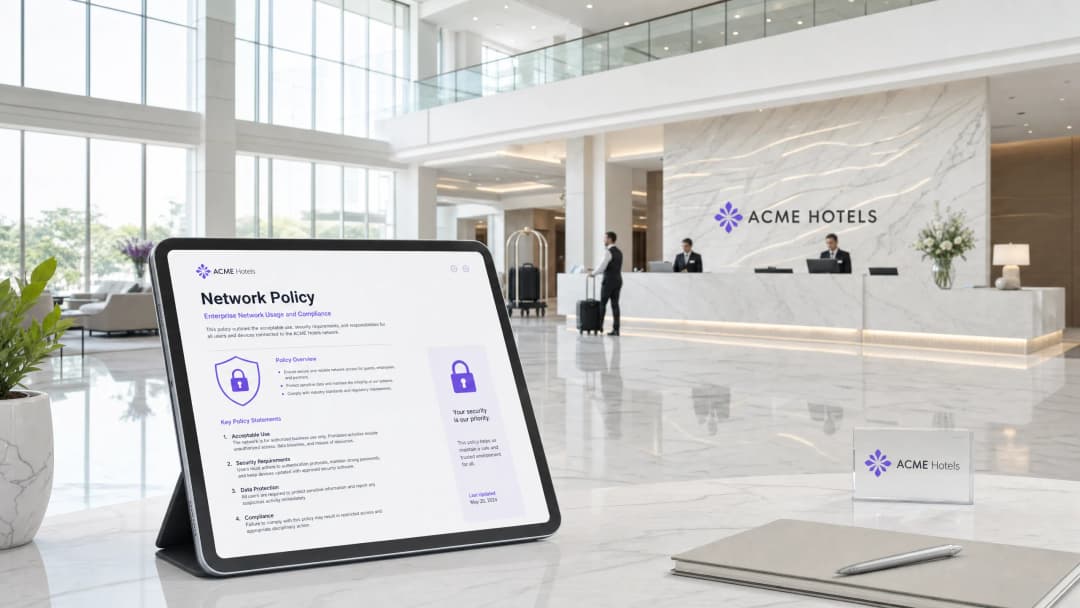
保障員工網路存取安全不僅需要技術控制,還需要一份清晰且可執行的「可接受使用政策」(AUP),並以基於身分的驗證、網路分段和 DNS 層級的內容過濾作為後盾。隨著場域在 餐旅業零售業 和公共部門的規模擴大,風險暴露面也成比例增加。在共享網路上,單一受駭的員工裝置就可能違反 PCI DSS 和 GDPR 要求,從而引發罰款和營運中斷。

本指南為 IT 經理、網路架構師和場域營運總監提供了一個明確的框架,用於擬定和執行員工 WiFi 使用條款與條件。我們涵蓋了員工監控透明度的法律要點、合規所需的技術架構,以及 Purple 的「基於身分的網路」(Identity-Based Networks)如何保護企業資產免受內部濫用。核心原則非常簡單:您的員工 WiFi 政策必須具體、透明且在技術上強制執行。僅存在於紙面上的政策根本稱不上是政策。


技術深度解析

為什麼共享密碼會失效

餐旅業和零售業中,大多數的員工 WiFi 網路仍運行在僅使用單一共享密碼的 WPA2-Personal 上。該密碼被寫在白板上、在 Slack 頻道中共享,且在員工離職時從不更改。這不只是輕微的不便,而是一個結構性的安全失效。當員工離職時,他們對企業網路的存取權限依然無限期保留。這導致沒有稽核軌跡、沒有單一使用者工作階段金鑰,也無法在不影響所有人的情況下隔離受駭裝置。

IEEE 802.1X 標準結合 WPA3-Enterprise 加密解決了這個問題。每位使用者都使用與中央目錄綁定的個人憑證進行驗證。每個工作階段都使用唯一的加密金鑰,因此同一存取點(AP)上的裝置無法攔截其他使用者的流量。Purple 透過「基於身分的網路」來實現這一點,將共享密碼替換為透過 Microsoft Entra ID、Okta、或 Google Workspace 管理的憑證式存取。當 HR 將員工從目錄中移除時,Purple 會在幾分鐘內透過 SCIM(跨網域身分管理系統)撤銷其 WiFi 存取權限。無需建立工單,也無需輪替整個場域的密碼。

網路分段與 PCI DSS 合規性

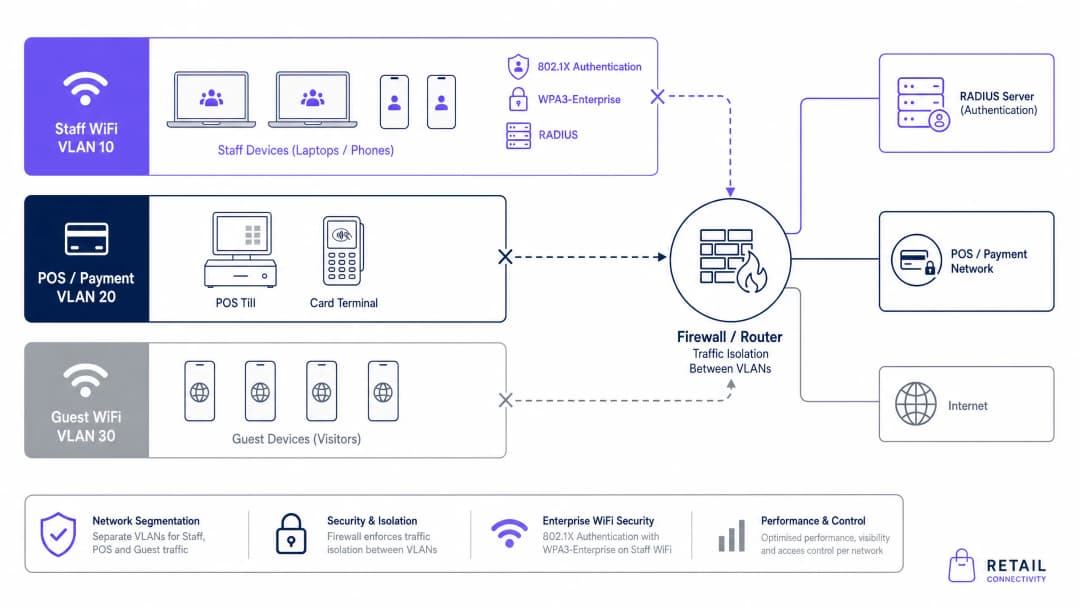
有效的員工 WiFi 安全始於隔離。您必須將員工流量與訪客和支付網路分開,以縮小合規稽核的範圍並圍堵潛在的洩漏。部署 VLAN(虛擬區域網路)是標準做法,也是 PCI DSS 合規性的基本要求。

network_segmentation_diagram.png

對於零售環境,您至少需要三個不同的 VLAN:Guest WiFiStaff WiFi 和銷售點系統(POS)。這種分段可確保受駭的員工裝置無法接觸到持卡人資料環境。PCI DSS v4.0 要求每年將網路分段作為合規性評估的一部分進行驗證。Purple 透過標準 RADIUS 和 VLAN 標記,與所有主要企業無線廠商(Cisco Meraki、HPE Aruba、Ruckus、Juniper Mist、Ubiquiti UniFi、Cambium、Extreme 和 Fortinet)整合,因此您無需更換現有硬體即可實現合規。

GDPR 與監控透明度

UK GDPR 與《2018 年資料保護法》對員工監控施加了嚴格的要求。監控是允許的,但前提是必須合法、適度且透明。資訊專員辦公室(ICO)明確指出:僅僅具備監控員工的技術能力,並不代表您擁有這樣做的法律權利。

為了建立合法依據,大多數組織依賴「合法利益」。這需要證明監控是出於特定的安全或營運目的、是實現該目的所必需的,且對隱私的侵犯是適度的。在僱傭關係中,同意通常是不適用的,因為雇主與員工之間的力量失衡意味著同意無法自由給予。

實際的影響是,您的員工 WiFi 使用條款與條件必須明確說明收集了哪些資料(連線時間、裝置識別碼、頻寬使用量、DNS 查詢)、收集的原因、誰有權存取以及保留多久。這些資訊必須包含在 AUP、員工手冊和僱傭合約中。員工必須對此進行確認。如果您無法證明在監控開始前已告知員工,您將面臨法律風險。


實施指南

擬定可接受使用政策

aup_components_infographic.png

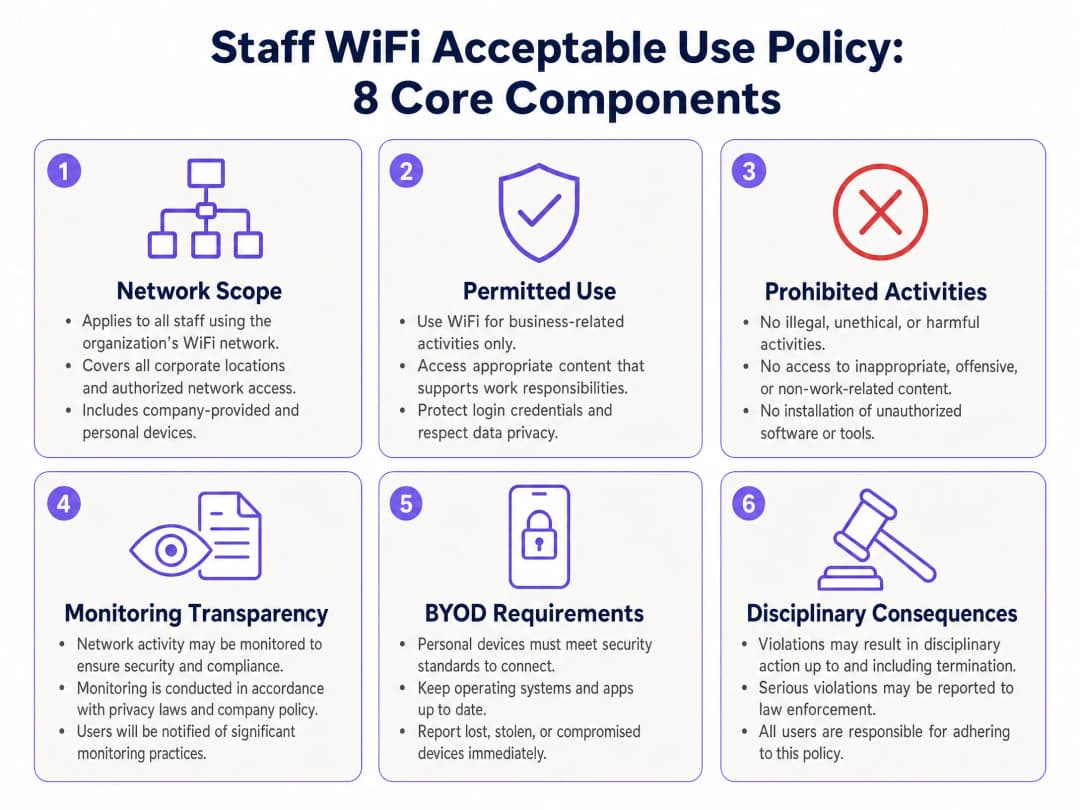
您的 AUP 是網路監控和紀律處分的法律基礎。它必須涵蓋八個核心領域。

1. 網路範圍。 具體說明該政策適用於所有連線到企業網路的員工、承包商和授權使用者,無論他們使用的是公司配發的裝置還是個人裝置(BYOD)。

2. 允許的使用方式。 明確聲明網路是供業務目的使用。偶發的個人使用或許可以容忍,但絕不能干擾工作效率或消耗過多頻寬。

3. 禁止的活動。 明確地禁止非法活動、存取不當內容、安裝未授權軟體、企圖規避安全控制措施,以及利用網路存取競爭對手的系統。

4. 監控透明度。 聲明為了安全和效能管理,可能會對網路活動進行監控。詳細說明收集了哪些數據以及如何使用這些數據。這是您的 GDPR 合法依據聲明。

5. BYOD 要求。 如果員工使用個人裝置,請指定最低安全要求:支援的作業系統、最新的安全修補程式,以及啟用螢幕鎖定。要求員工在裝置遺失或被盜時立即回報。

6. 數據處理義務。 提醒員工不得透過未加密的連線傳輸敏感的客戶或企業數據,且企業網路並不能取代數據分類控制。

7. 懲戒後果。 清楚說明違反政策的後果,從口頭警告到終止聘用,以及針對嚴重違規行為移送執法機關。

8. 政策審查週期。 承諾至少每年審查一次 AUP,並將變更內容傳達給所有員工。

部署技術控制措施

單憑政策是不夠的。您必須從技術層面強制執行。以下步驟適用於大多數企業場域。

第一步,將您的身分識別提供者與 Purple 的雲端 RADIUS 整合。將 Microsoft Entra ID、Okta 或 Google Workspace 連接到 Purple 的驗證基礎架構。這消除了對地端 RADIUS 伺服器的需求,並提供具備 99.999% 可用性 SLA 的多區域容錯移轉(源自 Purple 的自身數據)。

第二步,設定您的無線基地台以廣播專用的員工 SSID,並使用 WPA3-Enterprise 進行安全保護。根據已驗證的身分將員工裝置分配到專用的 VLAN。基於角色的 VLAN 分配可讓您在相同的基礎架構上,為主管、承包商和一般員工提供不同層級的網路存取權限。

第三步,啟用您的目錄與 Purple 之間的 SCIM 同步。這能將入職和離職流程自動化。當新員工加入時,其在目錄中的帳戶會自動授予其 WiFi 存取權限。當他們離職時,存取權限將在幾分鐘內被撤銷。

第四步,部署 Purple Shield 以進行 DNS 層級的內容過濾。Shield 會在惡意網域和不當內容載入前予以封鎖,在無需進行深層封包檢測的情況下,強制執行 AUP 的禁止活動條款。Shield 在 DNS 層級過濾廣告和追蹤器,可減少 44% 的總數據下載量,並減少 62% 的 DNS 查詢(源自 Purple 的自身數據)。在繁忙期間,您可以限制高頻寬串流服務的速度,以保留頻寬給關鍵應用程式。


最佳實踐

自動化離職流程。 將網路存取權限直接與您的 HR 系統連結。當員工的狀態變更為非現職時,其 WiFi 存取權限必須立即終止。手動流程會帶來安全漏洞。使用 Purple 的 IT 團隊在將存取管理自動化後,通常會發現 WiFi 支援工單減少了 80%(源自 Purple 的自身數據)。

進行數據保護影響評估 (DPIA)。 在實施任何新的監控功能之前,請按照英國 GDPR 對高風險處理活動的要求完成 DPIA。員工監控被歸類為高風險,因為它涉及對個人的系統性追蹤。記錄該評估並妥善保存以供審計之用。

按角色細分,而不僅僅是按裝置類型。 使用基於角色的 VLAN 分配,為承包商提供會自動過期的限時存取權限。這在派遣員工和季節性工人很常見的 餐旅 環境中尤為適用。

每年審查政策。 法規在不斷演變。PCI DSS v4.0 在 2024 年引入了新要求。來自 ICO 的英國 GDPR 指南會定期更新。安排年度政策審查,邀請 IT、HR 和法務團隊共同參與。

培訓員工,而不僅僅是主管。 不要將 AUP 埋沒在入職手冊中。舉辦簡短、實用的培訓課程,解釋未加密 WiFi 的風險以及網路政策背後的原因。理解原因的員工遵守政策的可能性要高得多。


疑難排解與風險緩釋

故障模式 風險 緩釋措施
共用 WPA2 密碼 前員工無限期保留存取權限 移轉至與身分識別提供者整合的 802.1X
員工與 POS 位於同一子網路 違反 PCI DSS 範圍、無法圍堵安全漏洞 實施嚴格的 VLAN 區隔
AUP 中未揭露監控資訊 違反 GDPR、證據在懲戒行動中不具可採信性 更新 AUP 並取得簽署確認書
手動離職流程 離職後存取權限依然存在 啟用與 HR 系統的 SCIM 同步
無內容過濾 惡意軟體入侵、頻寬耗盡、AUP 執行漏洞 在 DNS 層級部署 Purple Shield
BYOD 未達最低安全標準 受駭的個人裝置進入企業網路 在 AUP 中定義並強制執行 BYOD 要求

如需更廣泛地瞭解企業 WiFi 安全架構,請參閱我們的 企業 WiFi 安全:2026 年完整指南 。如果您主要關注的是零售業的後勤網路, 零售業員工 WiFi 政策:保障後勤網路安全 指南詳細介紹了零售業特有的部署情境。


投資報酬率與業務影響

實施健全的員工 WiFi 政策和安全架構可帶來可衡量的成效。透過身分識別提供者整合來自動化入職和離職流程,可減少高達 80% 與 WiFi 存取相關的 IT 支援工單(源自 Purple 在 80,000 多個實際場域的自身數據)。這種效率使 IT 團隊能夠專注於策略性工作,而不是重設密碼。

部署 Purple Shield 可減少 44% 的總數據下載量,並將網頁載入時間縮短 53%(源自 Purple 的自身數據)。在員工依賴雲端服務的場域中,應用程式,這能直接提升生產力。在零售環境中,它能在交易尖峰時段保護 POS 的效能。

從合規的角度來看,PCI DSS 稽核失敗或 GDPR 執法行動的成本,遠高於實施適當控制措施的成本。ICO 在 2023 年因違反數據保護規定而開出的罰款總額超過 750 萬英鎊。缺乏透明度的網路監控以及缺乏文件記錄的適當區隔,都是遲早會發生的稽核失敗。

Purple 已獲得 ISO 27001、GDPR、CCPA 和 Cyber Essentials 認證,並在超過 80,000 個實體場所營運,擁有 3.5 億名不重複使用者。對於合規要求特別嚴格的 交通運輸醫療保健 環境中的場所,Purple 的稽核軌跡(記錄每次驗證事件的使用者、裝置、時間和位置)可提供稽核人員所需的文件。

如需深入了解如何衡量 WiFi 基礎設施的成效,請參閱 WiFi 分析

關鍵定義

Acceptable Use Policy (AUP)

A documented set of rules defining the permitted and prohibited uses of an organisation's IT resources, including its WiFi network.

The legal foundation for employee monitoring and disciplinary action. Without a current, signed AUP, monitoring data may be inadmissible in disciplinary proceedings.

IEEE 802.1X

An IEEE standard for port-based network access control that requires individual user authentication before granting network access.

The authentication standard that replaces shared passwords with unique per-user credentials, enabling automated onboarding and offboarding.

WPA3-Enterprise

The latest WiFi security protocol for corporate networks, providing individualised encryption for each user session via 802.1X authentication.

Ensures that even on the same access point, users cannot intercept each other's traffic. Required for enterprise-grade staff WiFi security.

VLAN (Virtual Local Area Network)

A logical subnetwork that groups devices from different physical locations into an isolated broadcast domain.

Used to segment staff traffic from guest and payment networks, containing breaches and satisfying PCI DSS segmentation requirements.

RADIUS (Remote Authentication Dial-In User Service)

A networking protocol providing centralised Authentication, Authorisation, and Accounting (AAA) management for network access.

The engine behind 802.1X, verifying user credentials against a central directory and assigning VLAN membership based on identity.

SCIM (System for Cross-domain Identity Management)

An open standard that automates the exchange of user identity information between IT systems, such as an HR platform and a network access controller.

Allows Purple to instantly revoke WiFi access when an employee is removed from the corporate directory, closing the offboarding gap.

DNS Filtering

The process of blocking access to specific domains at the Domain Name System resolution layer, before a connection is established.

How Purple Shield enforces the AUP by preventing access to malicious or inappropriate content without requiring deep packet inspection.

PCI DSS (Payment Card Industry Data Security Standard)

An information security standard for organisations that process, store, or transmit cardholder data.

Requires strict network segmentation to ensure staff devices cannot access the payment environment. Validated annually as part of the compliance assessment.

DPIA (Data Protection Impact Assessment)

A process required by UK GDPR for processing activities likely to result in high risk to individuals' rights and freedoms.

Mandatory before implementing employee network monitoring. Documents the legitimate interest basis and proportionality of the monitoring.

BYOD (Bring Your Own Device)

A policy permitting employees to use personally owned devices to connect to the corporate network.

Requires specific AUP clauses defining minimum security requirements for personal devices connecting to the staff WiFi network.

範例

A 200-room hotel needs to secure its staff WiFi network. Currently, housekeepers, receptionists, and management all share a single WPA2 password. The IT manager is concerned about former employees retaining access and the risk of staff devices infecting the property management system.

The hotel migrates from a shared password model to 802.1X authentication. First, they integrate their existing Microsoft Entra ID directory with Purple's cloud RADIUS. Next, they configure their Cisco Meraki access points to broadcast a dedicated staff SSID secured with WPA3-Enterprise. Staff authenticate using their individual Microsoft credentials via the Purple app. The network is segmented, placing staff devices on VLAN 10, the property management system on VLAN 20, and guest WiFi on VLAN 30. SCIM synchronisation is enabled so that when HR disables an account, WiFi access is revoked within minutes. Purple Shield is deployed to filter malicious content and throttle high-bandwidth streaming during operational hours.

考官評語: This approach eliminates the shared password vulnerability entirely. By tying access to the corporate directory, offboarding is automated and auditable. VLAN segmentation contains potential threats, ensuring a compromised staff device cannot reach the property management system. The Shield deployment enforces the AUP's prohibited activities clause technically, removing reliance on staff compliance alone.

A retail chain with 50 locations wants to implement a staff WiFi Acceptable Use Policy but is concerned about GDPR compliance regarding employee monitoring across its UK stores. The current policy document is five years old and makes no reference to network monitoring.

The retailer updates its AUP to explicitly state that connection logs, bandwidth usage, and DNS query data are recorded for security and performance management. This updated policy is distributed to all employees, who must sign an acknowledgment. The retailer conducts a DPIA documenting the legitimate interest basis for monitoring. Technically, Purple logs authentication events (user, device, time, location) and Shield logs DNS-level activity, providing a comprehensive audit trail without inspecting encrypted traffic payloads. The retailer limits data retention to 90 days in line with the data minimisation principle.

考官評語: Transparency is a core requirement of UK GDPR. By clearly communicating what is monitored and why before monitoring begins, the retailer establishes a lawful basis and avoids enforcement risk. Limiting monitoring to metadata rather than deep packet inspection demonstrates proportionality. The DPIA provides documented evidence of compliance for any future ICO inquiry.

練習題

Q1. A regional manager requests that the new staff WiFi network use a single password that changes monthly to simplify access for visiting employees from other branches. How should the IT architect respond, and what alternative should they propose?

提示:Consider the operational overhead of rotating passwords across a multi-site estate and the security gap that persists during each monthly cycle.

查看標準答案

The IT architect should reject the request. A shared password, even if rotated monthly, leaves the network exposed for up to 30 days after any departure. Distributing a new password monthly across a multi-site estate creates significant operational overhead and generates support tickets every rotation cycle. The correct alternative is 802.1X authentication integrated with the central directory. Visiting employees use their existing corporate credentials to connect automatically at any site. There is no password to distribute, no rotation cycle to manage, and no access gap when someone leaves. This delivers better security and a better user experience simultaneously.

Q2. During a PCI DSS audit, the assessor notes that staff devices and POS terminals are on the same network segment. What is the immediate risk, and what remediation steps are required?

提示:Focus on the scope implications for the cardholder data environment and the timeline for remediation.

查看標準答案

The immediate risk is that the entire staff network falls within the PCI DSS cardholder data environment scope, significantly expanding the audit surface and the remediation cost. Any compromised staff device could potentially reach the POS terminals. Remediation requires implementing strict VLAN segmentation: a dedicated VLAN for staff devices, a separate VLAN for POS terminals, and firewall rules preventing lateral movement between them. This must be validated and documented before the audit can be closed. Going forward, role-based VLAN assignment through 802.1X ensures that devices are automatically placed on the correct segment based on authenticated identity.

Q3. An organisation wants to implement network monitoring to detect unusual bandwidth consumption that may indicate data exfiltration. Their employee handbook has not been updated in three years and contains no reference to network monitoring. What must happen before monitoring tools are activated?

提示:Consider the sequence of legal requirements under UK GDPR before any monitoring begins.

查看標準答案

Before activating any monitoring tools, the organisation must complete three steps. First, update the Acceptable Use Policy and employee handbook to explicitly state that network activity is monitored, what data is collected, why it is collected, and how long it is retained. Second, conduct a DPIA documenting the legitimate interest basis for the monitoring and demonstrating that the privacy intrusion is proportionate to the security objective. Third, distribute the updated policy to all staff and obtain signed acknowledgment. Only after these steps are complete and documented is it lawful to activate monitoring. Monitoring without prior transparency is a UK GDPR violation regardless of the security justification.

Q4. A hotel's IT team is asked to allow agency housekeeping staff to connect to the staff WiFi during their shifts, but these workers are not in the corporate directory. How should access be provisioned and controlled?

提示:Consider time-limited access, network isolation, and the offboarding challenge for temporary workers.

查看標準答案

Agency staff should be provisioned with time-limited guest credentials that expire automatically at the end of their engagement, rather than being added to the corporate directory. Purple supports contractor access management with automatic expiry, so access terminates without manual intervention. These credentials should grant access to a restricted VLAN with internet access only, isolated from internal systems. The AUP must cover contractors explicitly, and agency staff must acknowledge the policy before receiving credentials. This approach avoids the offboarding risk associated with temporary workers while maintaining a full audit trail.

繼續閱讀本系列

RadSec: How RADIUS over TLS Improves WiFi Authentication Security

這份具權威性的技術參考指南說明了 RadSec (RFC 6614) 如何透過將傳統 RADIUS 流量封裝在 TLS 加密中,來確保企業 WiFi 驗證的安全。本指南專為 IT 經理和網路架構師設計,內容涵蓋架構、部署策略,以及降低企業和訪客網路中未加密 UDP RADIUS 流量風險的實用步驟。

閱讀指南 →

機場 WiFi 安全:如何在公共網路上保護旅客

本技術參考指南詳細說明了機場 WiFi 的具體威脅格局,涵蓋邪惡雙生存取點、非法硬體和中間人攻擊。它為 IT 經理、網路架構師和場地營運總監提供了可據以行動的架構策略——包括 WPA3 實作、VLAN 分割、WIPS 部署和符合 GDPR 的 captive portal 設計——以保護旅客和大規模企業基礎設施。Purple 的訪客 WiFi 和分析平台在整份文件中都具體對應到每個問題領域。

閱讀指南 →

醫療 WiFi:HIPAA、DSPT 與 WiFi 合規性解析

本指南提供給在醫療環境中部署無線網路的 IT 經理、網路架構師和合規官一份權威的技術參考。它將 HIPAA(美國)和 NHS 資料安全與保護工具組(DSPT,英國)的具體要求對映到具體的網路架構決策——涵蓋分割、基於身分的存取、加密標準和 IoMT 裝置處理。Purple 的訪客 WiFi 和分析平台在本指南中作為治理無線環境中管理病患與訪客連線的合規、企業級解決方案貫穿全文。

閱讀指南 →