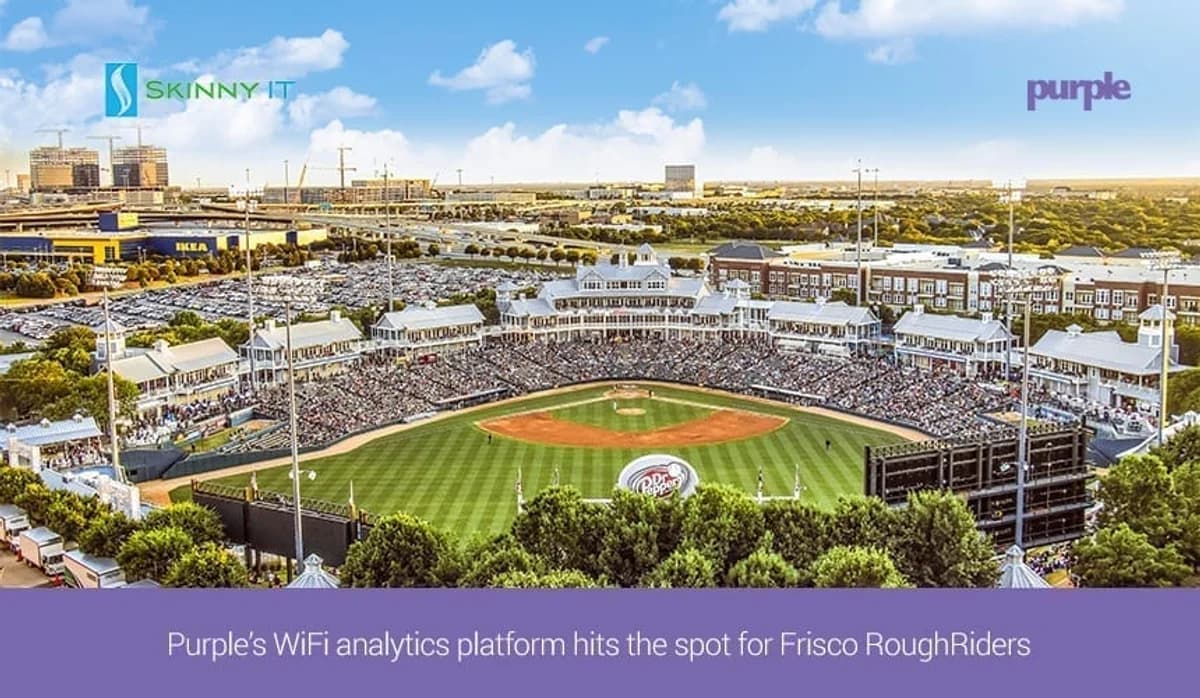
Purple's WiFi fanalytics platform hits the spot for Frisco RoughRiders

By Richard Ellor
10 June 2017
3 min read
Purple's WiFi fanalytics platform hits the spot for Frisco RoughRiders
Interactive stadium toolHigh-density network sizing & fanalytics ROI planner

Stadium WiFi and fanalytics ROI calculator

Model access point density, first-party fan profile generation, and digital sponsorship returns for stadiums, ballparks, and entertainment arenas.

1. Select stadium or venue format
10,600 seats
2,000 seats10,600 (RoughRiders)75,000 seats
72%
70 games
42% connected
15% (Basic splash)42% (Purple standard)75% (High incentive)

Projected gameday fanalytics & network specification

Minor league ballpark configuration
Stadium access points91 APs79 bowl + 12 concourse / suite APs
Verified fan profiles93,492First-party demographic records / season
Sponsor activations560,952Branded captive portal splash views
Estimated annual ROI (USD)$228,868Combined fan data, sponsor & retail lift

Modelled at $1.20 per verified fan profile, $28 CPM on sponsor portal impressions, $0.45 of incremental spend per connected attendee, and 2.4 games per fan per season. Adjust the sliders to your own figures before quoting these numbers.

Hardware standard: Ruckus / Aruba high-density outdoor IP67 APs
Antenna array: Under-seat and handrail directional down-tilt antennas (30° x 30° beamwidth)
Captive portal & fan data integrations:
Social media single sign-onEmail & SMS verificationTicketing API linkClub CRM syncAutomated survey triggerContent filtering

Planning stadium WiFi or fan engagement infrastructure?

Purple runs high-density captive portals, fan analytics, and digital sponsorship monetisation across stadiums, ballparks and arenas, on Cisco Meraki, HPE Aruba, Ruckus and Juniper Mist hardware.

Speak to an expert →
Useful? Link to this tool

Fans of the Frisco RoughRiders can now enjoy free WiFi at all home games thanks to a WiFi and fanalytics solution from Purple, which also improves marketing and fan engagement.

The Dr Pepper Ballpark in Frisco, Texas, is home to the minor-league baseball team and welcomes thousands through its doors each year. Skinny IT installed Purple's cloud-based platform using 85 Ruckus access points, a highly efficient quantity considering the fact that the stadium seats 10,600. This was completed in just three weeks to ensure WiFi was available in time for the 2017 season.

Spectators can now log into the WiFi service via a fully-branded splash page, which enables them to connect via social media or a short form. During the login process, all of their details are securely captured in the Purple portal, including email address, name, age, gender, and social interests. Purple's stadium WiFi solution also tracks foot traffic, frequency of visits, and behavior at the stadium to improve the team's marketing output.

“The information gathered from our fans using the new in-stadium WiFi will help shape our marketing and sales initiatives going forward,” said Matt Ratliff, Senior Director of Marketing and Promotions with the Frisco RoughRiders. “Being able to see in real-time the marketing analytics of our fans is extremely beneficial and the Purple solution provides us that luxury. We were also impressed at the speed and efficiency at which Skinny IT was able to install the WiFi throughout our entire ballpark. We are thrilled to offer this feature to our fans and look forward to Skinny IT's continued technological support throughout the coming years.”

The analytics data will be used to learn about the team's core demographic so they can begin developing marketing communications and offers that appeal to key audience age ranges and interests. The team will also be using the customer relationship management (CRM) data to distribute emails and short message services (SMS) both during and post-game to advertise merchandise, refreshments, season tickets, sponsor offerings, and upcoming games. This will help increase sales and profits, while also providing fans with key updates about the Frisco RoughRiders.

Since the solution was deployed last month, the platform has already captured 4,975 lines of data which can be exported into an existing CRM database and email marketing platform. Purple has identified the team's core demographics are ages 25 to 34 years but WiFi users range from over 65 years to 18 and younger, which is one of the reasons why content filtering was also needed.

Prior to the installation, WiFi was not readily available but was recognized as a solution in high demand from visitors. Skinny IT researched WiFi login software on behalf of their client and determined Purple met the Frisco RoughRiders' expectations of simplicity in terms of login and usage as well as back-end analytics.

“The team at Purple worked closely with us to ensure their analytics engine was communicating effectively with our WiFi,” said Sam Darwish, CEO of Skinny IT. “We now have a state-of-the-art in-stadium WiFi experience for customers that we imagine other stadiums and concert venues across the country will be eager to install as well.”

Commenting on the partnership, Gavin Wheeldon, CEO of Purple said: “We're delighted to be working with the Frisco RoughRiders and I'm confident the team will achieve significant results and profit from using Purple in the stadium. Skinny IT was extremely proficient when installing the solution at the venue and I'm looking forward to working with the company on future projects across the US.”
Frequently asked questions

What is stadium WiFi fanalytics and how does it differ from standard venue analytics?

Stadium fanalytics combines high-density wireless connectivity with captive portal authentication to capture verified first-party fan demographics and behavioral data during live sporting events. While basic venue analytics only measures passive radio signals or probe requests, fanalytics securely captures opt-in fan identities, including age, gender, social interests, and visit frequency. Sports franchises connect this telemetry to CRM systems and marketing automation platforms to personalize gameday communications, optimize stadium operations, and prove tangible return on investment to brand sponsors.

How many access points are required to provide reliable WiFi across a sports stadium?

Stadium bowl coverage requires high-density wireless design, typically deploying one enterprise access point for every 100 to 150 spectator seats depending on seating geometry, bowl enclosure, and roof rigging. For example, Dr Pepper Ballpark deployed 85 Ruckus access points to cover 10,600 seats alongside concourses and premium hospitality suites. High-density stadium environments use directional narrow-beam antennas (such as 30° by 30° patterns) to confine radio frequency cells, prevent co-channel interference, and maintain high signal-to-noise ratios amidst tens of thousands of active mobile devices.

How does Purple capture first-party fan demographic data through captive portals?

When fans connect to the stadium guest network, Purple presents an optimized responsive captive portal splash page. Spectators authenticate using social media profiles, verified email addresses, or short digital forms. During this onboarding process, Purple records explicit marketing consent alongside demographic attributes including age bracket, home postal code, and contact information in compliance with global privacy regulations such as GDPR and CCPA. The data exports automatically via webhooks and REST APIs into club ticketing and CRM systems.

Can stadium WiFi analytics help sports franchises increase sponsorship revenue?

Yes. Stadium WiFi provides digital real estate that sports marketing teams sell as premier sponsorship inventory. Corporate partners can sponsor the guest WiFi SSID, brand the captive portal welcome screens, run interactive video prompts, and present targeted gameday offers. Purple provides granular analytics on total brand impressions, portal interaction rates, and fan click-through rates. This allows stadium commercial directors to deliver verifiable post-game digital activation reporting to partners rather than relying on static billboard estimates.

How do stadium operators prevent network congestion during peak gameday moments?

Sports venues prevent congestion through spectral engineering, intelligent traffic shaping, and bandwidth management. Engineers allocate 20 MHz channel widths across 5 GHz and 6 GHz spectrum to avoid adjacent-channel bleed and disable legacy low-data-rate management frames. At the software layer, Purple integrates with enterprise controllers to enforce per-client bandwidth limits (such as 5 Mbps per device), block high-bandwidth background video streaming, and isolate internal stadium operations, ticketing scanners, and point-of-sale terminals onto dedicated priority VLANs.

Which wireless controller hardware and access point vendors integrate with Purple?

Purple is a cloud-based, hardware-agnostic platform that integrates with major enterprise wireless hardware manufacturers, including Ruckus CommScope, Cisco Catalyst, Cisco Meraki, HPE Aruba Networking, and Extreme Networks. Venues connect their wireless LAN controllers to Purple through standard RADIUS authentication, 802.1X, and controller APIs without replacing existing physical cabling, switches, or antennas. This flexibility allowed venues like the Frisco RoughRiders to deploy fan analytics rapidly in time for opening day.

Ready to get started?

Book a demo with one of our experts to see how Purple can help you achieve your business goals.

Speak to an expert