Venue survey response rate & feedback ROI calculator
Compare traditional receipt and email surveys against automated in-moment WiFi micro-surveys. Calculate real-time response volume and private issue resolution rates for your venue.
High volume shopper footfall seeking fast checkout, stock availability, and helpful staff.
In this blog, we'll be looking at the history of customer surveys, the different types of surveys, the purposes of each, and proof that customer surveys aren't dead!
Jump to the end to see how a Purple customer gained over $600k ROI and more using customer surveys.
What is the definition of a customer survey?
By gathering customer feedback and reviewing the collected information, businesses are left in a position to better understand what their customers think.
Defined by Surveymonkey.com “you use a customer survey or customer feedback form to ask about various aspects of your product or service. You'll find out what your customers think and say about you.”
Having the insights gained from customer feedback means businesses are able to better position themselves when working to benefit the overall customer experience, whether it be about products, services, venue cleanliness, or communication.
The history of gathering customer feedback and improving customer experience
1750s - The earliest record of customer feedback comes over two centuries ago! A merchant tradesman received a clay tablet which displayed their customers' dissatisfaction with service and quality of goods.
1860s > - The post-industrial revolution era generated new ways of thinking for businesses as the idea of efficiency became prominent. Henry Ford posed that the way in which customers are asked questions can heavily influence the answer:
“If I had asked people what they wanted, they would have said faster horses... If asked the right question, they would have said a faster mode of transportation.”
1904 - In 1904 Frank Woodward, the owner of dessert brand Jell-O, was unable to sell enough products to break even, and by 1906 had managed to grow sales to $1 million.
Is this because the public couldn't get enough sweet treats? Nope. Content marketing.
Frank released his own Jell-O-centered recipe book which was a great success and has carried influence to today.
1920s - The American prohibition of the 1920s greatly affected the bars and restaurant industry, so much so that new kinds of restaurants opened to meet public demand which was and is commonly known as a Speakeasy.
1950s - Post-WWII developments resulted in the large spread of suburbs and road transport, making it easier for people far from busy manufacturing areas to have access to goods and electronics such as TVs.
Between WWII and 1959 advertising expenditure tripled seeing a rapid rise in marketing spend. Today, advertising expenditure includes PPC, purchasing media slots, and freelance workers like graphic designers.
1980s & 1990s
Customer satisfaction has been prominent in all major marketing strategies since the 1980s, however, at that time there was no internet. All customer feedback at this time was gathered using pen and paper, face-to-face, and over the telephone.
Fact: Essentially a digital Rolodex, Pat Sullivan, and Mike Muhney released the first-ever CRM in 1987 called ACT!
During the '90s, the introduction of the internet brought a wave of possibilities for marketers and in this era caused the creation of CRM (Customer Relationship Management). As the use of the internet grew and email was increasing in usage popularity, so did email marketing.
Email surveys became the next step for marketers to gather insight from their customers in a more direct, cost-effective manner.
2000s
Online and mobile research started to take off after the start of the Millennium. However, the majority of markets continued to gather customer feedback using traditional methods that during the 2000s were still very effective.
2021 and beyond
The way in which consumers behave is now massively influenced by customer reviews and satisfaction, meaning one negative review could create large losses for businesses, and as a result, we can see a clear shift in where companies will be putting their efforts and resources.
A survey conducted by superoffice.com in June 2021, asked almost 2000 business professionals what their main focuses would be in the next 5 years:
45.9% of respondents are putting their primary focus on Customer experience
33.6% of respondents are putting their primary focus on Product
20.5% of respondents are putting their primary focus on Pricing
The results that were seen in this survey display the significance of having the best experience possible for customers and visitors.
Techniques today and in the future will change in order to best target the user/customer meaning the days of cold calling or signing a piece of paper are over. Today companies can ask questions to gather all kinds of insights.
For example, using a website pop-up to ask what users are looking for is a quick and easy way for businesses to segment and better understand their visitors, and potential customers split.
What are the different types of customer surveys?
Before creating a customer survey, it's important to know what you want to achieve which includes knowing what information you need to collect and the role this information will play in making the campaign successful. You can reward your customers in your loyalty program to incentivize survey completion and try to make profiling feel fun and engaging, too.
According to customer experience platform Delighted.com, there are 7 types of customer surveys, and that each delivers different insights.
1) Net Promoter Score (NPS)
The NPS survey is a great way for brands to understand their customer loyalty and how well perceived their products and services are. Created in 2003 by Fred Reichheld the methodology of Net Promoter has been implemented time and again by businesses from numerous industries.
Benefits of NPS: Due to the natural objective of an NPS survey, businesses can create surveys quickly and send them out frequently. With there very likely only being one question, customers are much more likely to respond, and with a large response, businesses can truly understand their customers' loyalty.
2) Customer Satisfaction Score (CSAT)
Rather than a standalone question such as “Would you recommend our product?” CSAT surveys are a more granular method of NPS.
CSAT surveys enable businesses to see the satisfaction rates of each individual customer and understand whether their experience exceeded, matched, or failed the customer expectations.
This form of customer survey is very time-sensitive, meaning organizations that use this kind of survey should contact customers within 24 hours of their visit - while the experience is still fresh in their mind, and the data is more likely to be accurate.
3) Customer Effort Score (CES)
CES surveys are used to figure out what customers' pains and frustrations are. By collecting insight on what makes a poor customer experience, businesses are geared to make changes effectively and aid the process of building seamless experiences.
Using a ranking system of 1-5 the CES surveys reveal to businesses whether customers have to “jump through hoops” to get the desired outcome. An example of this could be a customer having to go through multiple departments to find a specific product.
4) Visual Rating Survey
QuestionPro defines a rating scale survey as a “closed-ended survey question used to represent respondent feedback... for specific features/products/services”.
Visual rating surveys are made to encourage a response through gamified methods, such as a slider to display levels of satisfaction, 1 - 5 stars to reveal customer satisfaction, or a thumbs up / thumbs down rating as to whether customers would recommend the business's product or service.
5) Custom Survey
Rather than looking to achieve quick responses, custom surveys can generate a deeper level of understanding of the customer experience. Despite being able to see direct and actionable feedback this type of survey is hard to get conversions from without an offering for the customer.
While custom surveys require a lot more effort, they provide businesses with the chance to show customers a greater amount of respect other than only being interested in their money. Custom surveys reveal avenues of opportunity that can't be found with other survey types.
Bonus) MicroSurveys
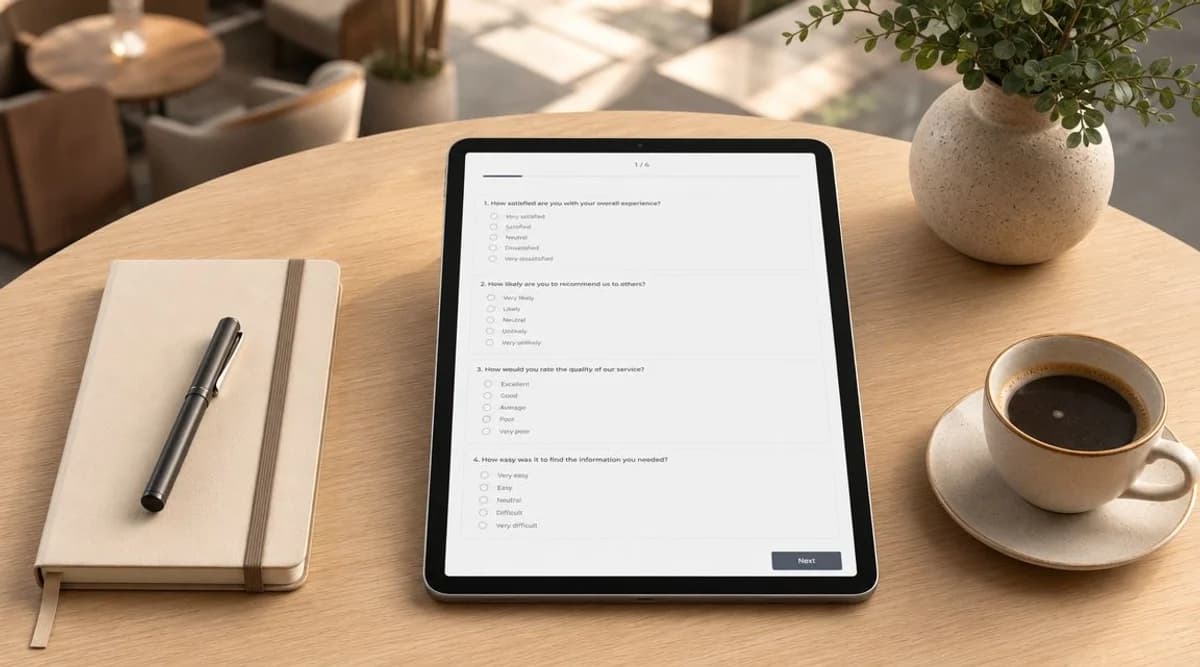
Micro surveys typically follow the same structure to generate quick and reliable responses from customers and can be delivered when a visitor logs into a venue's free guest WiFi. The micro survey functionality within the Purple portal can be utilized by businesses to easily set up their own process of collecting feedback.
One question - In order to maximize the chance of keeping customers interested in completing a survey, micro surveys keep it short and ask easy-to-answer questions.
Tailored to users - The issue with having a one-question survey is that it may not resonate with each customer in the same way. By having questions that are triggered by customer actions, micro surveys can increase the chances of a response by engaging at the right time with the right people.
Again, customer surveys aren't dead!
St George's Hospital NHS, a key healthcare institution, utilized Purple WiFi to implement micro surveys aimed at gathering quick, valuable feedback from patients and visitors. These micro surveys were strategically deployed to capture immediate patient and visitor experiences and sentiment while they were still on the hospital premises. The real-time feedback helped the hospital quickly identify areas needing improvement and make data-driven decisions to enhance service delivery. The ability to rapidly collect and act on patient feedback helped St George's Hospital not only improve patient satisfaction but also streamline operations and resource allocation. The use of micro surveys exemplified the hospital's commitment to continuous improvement and patient-centric care.
- Used Purple WiFi to implement micro surveys for immediate feedback.
- Captured real-time patient and visitor experiences and sentiment.
- Quickly identified improvement areas and made data-driven decisions.
- Enhanced patient satisfaction and streamlined operations.