
Barclays free WiFi in branches: retail banking guest WiFi analysis

Gavin WheeldonBy Gavin Wheeldon
21 February 2013
2 min read
Interactive advisor toolRetail banking and branch digital adoption

Branch WiFi ROI and digital adoption calculator

Model customer captive portal engagement, mobile app onboarding, and counter transaction savings across retail banking estates.

150 locations
55001,000
350 people
501,0002,000
32%
10%40%70%
20%
5%25%50%
£5.50
£1.00£7.50£15.00
Total daily branch footfall
52,500
Across 150 retail locations
Monthly portal connections
420,000
32% connection conversion
Annual digital onboarding lift
1,008,000
Customers guided to app adoption
Projected annual teller savings
£5,544,000
Digital self-service diversion

PCI DSS 4.0 scope and strict branch network segmentation

Retail bank branches house sensitive payment infrastructure, ATM terminals, and teller workstations. Guest WiFi traffic must never cross into banking transaction subnets.

  • VLAN isolation (Requirement 1.2): Guest wireless traffic is isolated onto a separate non-routable DMZ with direct WAN breakout.
  • Client-to-client isolation: Layer 2 peer-to-peer traffic is blocked at the wireless access point to prevent spoofing or packet sniffing between customers.
  • Walled garden DNS filtering: Malicious domains and phishing hosts are filtered at the DNS layer via Friendly WiFi certified blocking.
Enterprise branch consultation

Request a branch network WiFi architecture blueprint

Connect with Purple enterprise financial sector specialists to design a secure guest WiFi service kept out of PCI DSS scope tailored to your branch estate.

Useful? Link to this tool

Have you ever been encouraged to use the self-checkout in a supermarket or airport? You're ushered in and kindly helped by a member of staff who will show you just how easy and fast it is to do things without a member of staff. Take that a stage further and when you're in the Apple Store you use the app, scan your items, pay through the app and away you go - I love it!  But then I'm a bit of  techie geek, so no surprise there. Safe to say though that most people do love it and it makes life much easier.

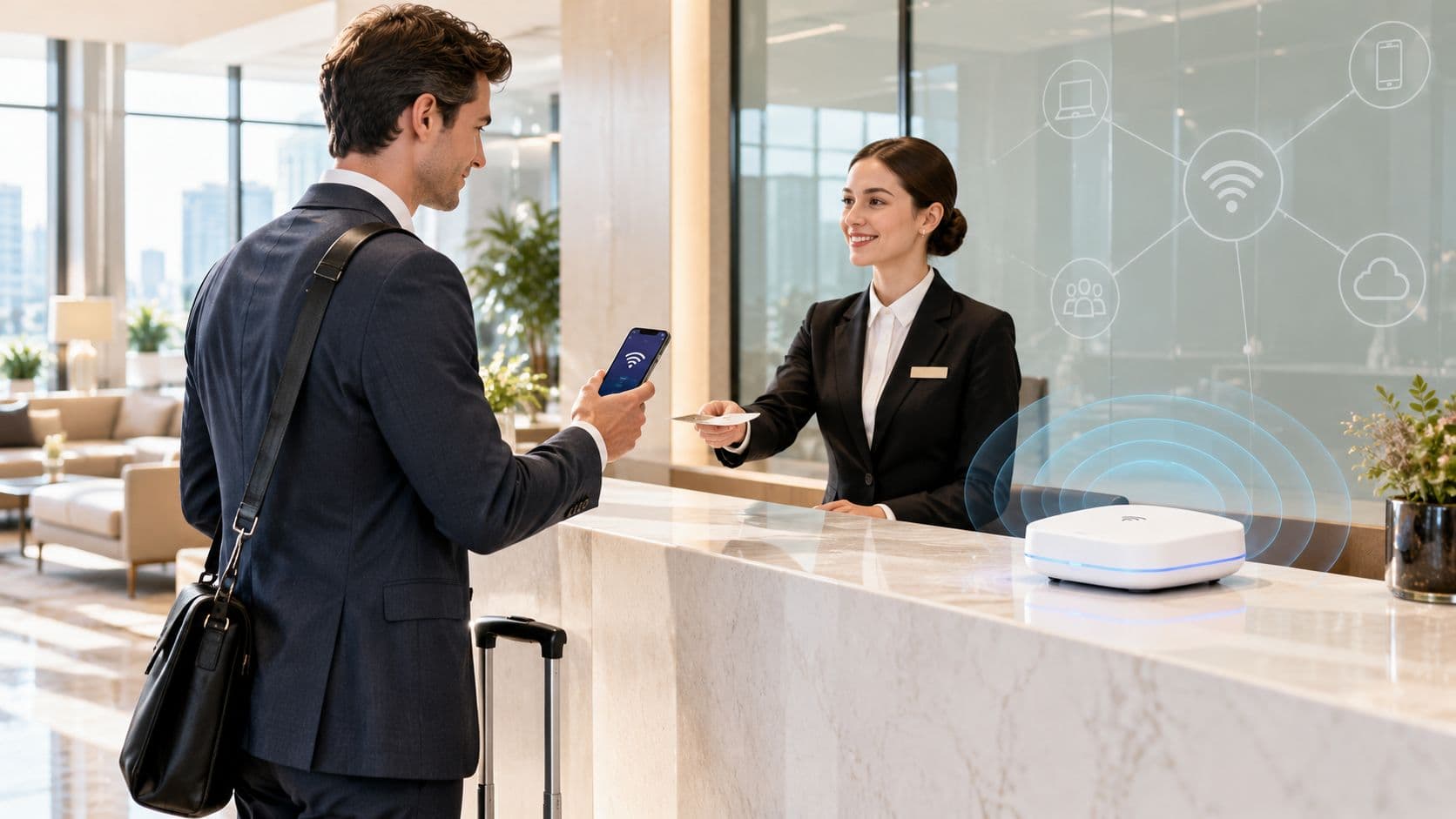
In a fairly unsurprising and somewhat belated move, this experience will now greet you in your local bank. Barclays are clearly an innovator when it comes to technology, as we've seen with Pingit, and now they've stolen first-mover advantage on this. WiFi will be offered on a white-label basis from BT, so when you go to your Barclays branch, you'll connect to "FREE Barclays WiFi", accept terms and conditions and away you go.

I really think this is great to see, and I also hope to see the same thing happening in all the other banks. I would question one thing, and that is if Barclays could have got a bit more value from this. Clearly there is massive benefit in encouraging people into a self-serve mentality, as the cost savings are substantial, and no doubt this will have been the basis of the Business Case and ROI. There could have been a lot more intelligence and interactivity with their customers if they had added a new dynamic with Social WiFi which would have also brought useful retail analytics information. That said, still great news and I am a bit biased given that's what we do.
Frequently asked questions

Why do retail banks like Barclays provide free WiFi in physical branches?

Retail banks provide guest WiFi primarily to accelerate digital adoption. By offering high-speed connectivity in branches, bank staff can actively guide customers through installing the mobile banking app, setting up two-factor authentication, and completing self-service transactions on their personal smartphones. This lowers counter wait times and transitions routine queries to lower-cost digital channels.

How do banks isolate guest WiFi from ATM and teller networks for PCI-DSS compliance?

Banks maintain strict logical and physical separation between public guest traffic and internal payment systems under PCI-DSS 4.0 Requirement 1.2. Guest WiFi operates on a dedicated non-routable VLAN with direct internet breakout via firewall DMZ zones. Access point client isolation blocks device-to-device communication, ensuring visitor smartphones cannot discover or access teller workstations, security cameras, or ATM hardware.

How does in-branch WiFi accelerate mobile banking app adoption?

When visitors connect to the branch captive portal, post-authentication landing pages can deep-link directly to iOS App Store and Google Play listings. Furthermore, in-branch specialists - such as Barclays Digital Eagles - use reliable connectivity to guide less digitally confident customers through paperless statements, mobile check deposits, and online banking verification without consuming personal cellular data.

What captive portal authentication methods are best suited for banking customers?

Leading banking networks use frictionless, privacy-conscious onboarding flows. Customers can connect via one-click terms acceptance, verified email OTP, or through existing banking app credentials via OAuth. Captive portals present clear privacy policies and opt-in consent checkboxes complying with UK GDPR and global data protection regulations.

How does Passpoint Hotspot 2.0 work across national branch estates?

Passpoint (Hotspot 2.0) eliminates repetitive captive portal splash pages across distributed branch networks. Once a banking customer provisions a secure Passpoint profile on their phone, their device automatically detects and joins encrypted WPA3-Enterprise networks at any branch nationwide. This delivers enterprise-grade over-the-air encryption while streamlining in-branch connectivity.

What footfall analytics can banks capture without violating UK GDPR or privacy laws?

Banks capture aggregated, pseudonymized footfall metrics using passive WiFi signal detection. By hashing MAC addresses with rotating salt keys, networks record visitor volume, dwell time, peak branch queuing hours, and repeat visit frequency across the estate. No personally identifiable information (PII) is stored without explicit customer consent.

Ready to get started?

Book a demo with one of our experts to see how Purple can help you achieve your business goals.

Speak to an expert