
網狀網路 (Mesh Network) 對比基地台 (Access Points):哪種更適合大型場地?
本技術指南針對大型場地提供網狀網路與傳統有線基地台之間的決定性比較,內容涵蓋架構、效能折衷以及部署策略。它為 IT 經理、網路架構師和 CTO 提供實用的框架,以便為餐飲旅宿、零售、活動和公共部門環境設計高效能且符合法規的 WiFi 基礎設施。本指南還將這些架構決策與 Purple 的硬體無關型客用 WiFi 和分析平台進行對接,展示正確的基礎設施選擇如何推動可衡量的業務成果。
Video overview
收聽此指南
查看播客逐字稿
核心系列的一部分:客用 WiFi 指南 →
Venue WiFi Architecture Advisor: Mesh vs Wired AP Calculator
Compare wireless mesh backhaul degradation against wired PoE access points. Model throughput loss per hop, latency penalties, roaming handover success, structured cabling investment, and 3-year total cost of ownership.
Multi-floor hospitality venue requiring guest captive portal onboarding, PMS billing integration, and consistent in-room streaming.
A shared radio carries client traffic and backhaul at once, so each hop is half-duplex. This is the largest single determinant of mesh throughput.
25 nodes puts the furthest ones 4 wireless hops from the gateway, where roaming succeeds 68% of the time and the edge keeps 179 Mbps of the 1000 Mbps uplink. A mesh this deep cannot hold a consistent SLA across the estate; cable the APs and let the controller coordinate 802.11k/v/r.
Side-by-Side Technical Comparison for 45,000 sq ft Venue
| Metric / Feature | Wired Enterprise APs (PoE) | Wireless Mesh Network |
|---|---|---|
| Backhaul Type | Dedicated Cat6/Cat6A Gigabit (1G/2.5G/10G) Full Duplex | Shared RF Airtime / Wireless 5GHz or 6GHz Hops |
| Edge Throughput | 1000 Mbps (100% capacity) | 1000 Mbps on the wired root node, falling to 179 Mbps at the edge (4 hops on a dedicated tri-band backhaul, -82%) |
| Network Latency | 14ms (Deterministic switched LAN) | 74ms (+15ms per wireless relay hop) |
| Max Concurrency / AP | 150+ devices (MU-MIMO, OFDMA scheduled) | ~25 devices (Airtime starvation risk) |
| Roaming Protocol | 802.11k/v/r Seamless Fast Transition (<50ms) | Client-driven roaming / Sticky clients common |
| Network Segmentation | 802.1Q Multi-VLAN (Staff, Guest, IoT, POS) | Limited single guest SSID isolation |
| Power Delivery | PoE/PoE+ from central UPS-backed switch | Individual AC wall outlets required per node |
Planning a Venue WiFi Network Upgrade?
Purple pairs with leading enterprise AP vendors to deliver automated guest splash pages, CRM profile capture, and location analytics.
執行摘要
對於管理大型場館 - 體育場、零售 連鎖店、款待業 綜合體、交通 樞紐和會議中心 - 的 IT 經理和 CTO 而言,選擇合適的無線架構是一項高風險的資本決策。部署網狀網路與傳統有線 Access Points (APs) 之間的爭論,從根本上影響了 CapEx、營運可靠性以及終端使用者體驗。
雖然傳統 APs 透過專用的乙太網路回傳提供確定性的效能和無與倫比的吞吐量,但網狀網路在佈線成本高昂或物理上不可能的環境中,提供了快速部署能力和彈性。本指南分析了這兩種架構的技術現實,提供實用的框架來幫助您調整硬體策略,以符合場館的特定密度、延遲和合規性要求。至關重要的是,正確的基礎設施選擇還決定了您如何有效地利用 Guest WiFi 和 WiFi Analytics 等平台來擷取使用者數據並推動可衡量的業務成果。
技術深度剖析
傳統 Access Point 架構
在傳統部署中,每個 access point 都硬線連接回邊緣或核心交換器,通常使用終端連接到 8P8C (RJ-45) 接頭的 Cat6 或 Cat6a 佈線。這種有線回傳確保了 100% 的 AP 射頻 (RF) 容量都專門用於為用戶端設備提供服務。
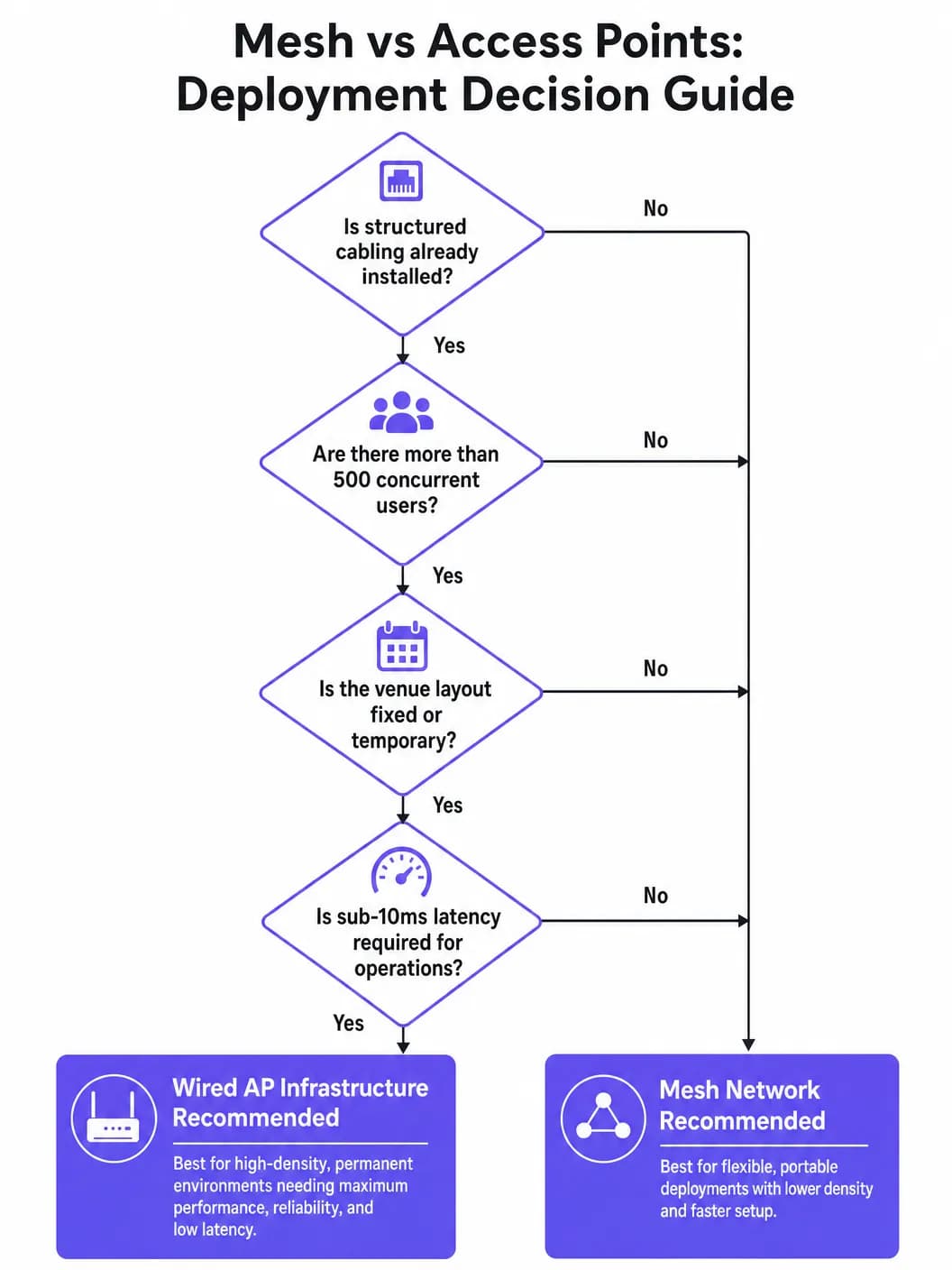
**吞吐量與延遲:**由於回傳流量完全由實體線纜處理,傳統 APs 可提供確定性的多吉位元 (multi-gigabit) 吞吐量。現代 Wi-Fi 6 (IEEE 802.11ax) APs 支援跨多個空間流高達 9.6 Gbps 的總吞吐量,而 Wi-Fi 7 (IEEE 802.11be) 透過多鏈路操作 (MLO) 將此性能進一步提升。對於低於 10 毫秒延遲至關重要的高密度環境,這種架構是必不可少的 - 銷售點 (POS) 系統、即時分析儀表板和 VoWLAN 部署都依賴於它。
**電力與基礎設施:**這種方法需要強大的 Power over Ethernet (PoE) 基礎設施。具備完整射頻鏈的現代 Wi-Fi 6 和 Wi-Fi 7 APs 通常需要 PoE+ (IEEE 802.3at, 30W) 或 PoE++ (IEEE 802.3bt, 高達 90W) 才能以滿載容量運行,因此在進行任何硬體更新之前,必須進行仔細的交換器連接埠和電力預算規劃。
**安全態勢:**有線回傳本質上減少了實體攻擊面。結合 IEEE 802.1X 基於連接埠的驗證和 WPA3-Enterprise 加密,此架構為 PCI-DSS 和 GDPR 合規性提供了最強大的基準。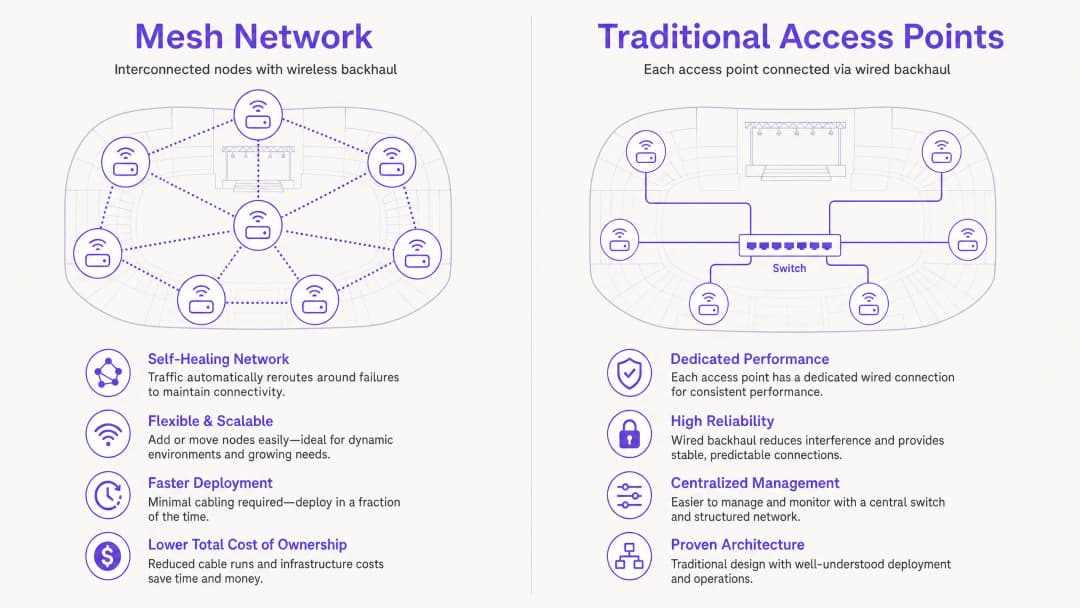
Mesh 網路架構
Mesh 網路以無線鏈路取代了有線回程。典型的企業級部署由一個連接到有線區域網路的 根節點 組成,該節點將數據無線傳輸到分佈在整個場地中的 衛星節點。
半雙工懲罰: WiFi 本質上是半雙工的。在標準的雙頻 Mesh 系統中,無線電必須在服務用戶端裝置與將流量中繼到鏈路中的下一個節點之間輪流進行。每一次無線跳轉實際上都會使可用吞吐量減半,並增加 1 - 5 毫秒的額外延遲。在擁有數千名同時上線使用者的密集環境中,這種延遲會迅速累積並對營運產生重大影響。
三頻緩解方案: 企業級 Mesh 系統透過使用專用的第三個無線電 - 通常在 5GHz 或 6GHz (Wi-Fi 6E) 頻譜中運作 - 專門用於回程流量來緩解此問題。這可以防止回程流量與面向用戶端的無線電爭奪空口時間。雖然這比消費級 Mesh 顯著提高了效能,但它仍然會消耗寶貴的射頻頻譜,並且無法與密集環境中有線連接的原始、確定性容量相媲美。
自我修復拓撲: Mesh 的一個關鍵韌性優勢是其自我修復能力。如果衛星節點失去其主要回程鏈路,它可以自動透過鄰近節點重路由流量。這在極可能發生物理干擾的動態或臨時場地配置中特別有用。
效能並排比較
| 屬性 | 傳統有線 AP | 企業級 Mesh 網路 |
|---|---|---|
| 回程類型 | 有線 (Cat6/Cat6a) | 無線 (專用無線電) |
| 每個 AP 的吞吐量 | 高達 9.6 Gbps (Wi-Fi 6) | 每跳跳轉減少約 50% |
| 延遲 | 5 毫秒以下 (確定性) | 5 - 20 毫秒 (變動) |
| 部署速度 | 慢 (需要佈線) | 快 (僅需電源) |
| 資本支出 (CapEx) | 高 (佈線 + 交換器) | 較低 (極少佈線) |
| 營運成本 (OpEx) | 低 (高可靠性) | 中等 (射頻調校) |
| 高密度適用性 | 極佳 | 有限 |
| 彈性 / 擴充性 | 低 (固定電纜線路) | 高 (節點重新定位) |
| PCI DSS / GDPR 合規性 | 簡單直接 | 可透過配置達成 |
對於您的特定設置有任何疑問嗎?
我們的團隊與超過 80,000 個場域的場域營運商、IT 經理和網路工程師合作。立即預約 20 分鐘的通話,我們將向您展示其他與您相似的用戶是如何解決此問題的。
實作指南
步驟 1:射頻預測性調查與密度規劃
在選擇硬體之前,請使用 Ekahau Pro 或 iBwave 等工具進行預測性射頻場地調查。將您的場地劃分為不同的區域:
- 高密度區域: 會議廳、體育場看台、飯店大廳、零售結帳區。這些區域需要有線 AP。
- 中密度區域: 飯店走廊、零售賣場空間、辦公室側翼。優先選擇有線 AP;Mesh 亦可行。
- **難以拉線 / 臨時區域:**戶外露台、歷史建築側翼、臨時活動空間。Mesh 是最實用的選擇。
步驟 2:架構選擇與混合設計
對於大多數大型場地而言,混合架構是最佳方案:在高密度核心區域部署有線 AP,並透過 Mesh 節點將訊號覆蓋範圍延伸至周邊或受限區域。這種方法在資金效率與效能之間取得了平衡。
步驟 3:骨幹傳輸基礎架構評估
對於有線部署,請確保您的邊緣交換器提供充足的 PoE 預算。配備每埠 90W 預算以及至核心交換器之 2.5GbE 或 10GbE 上行連結的 48 埠 PoE++ 交換器,是現代 Wi-Fi 6/7 部署所建議的基準。對於 Mesh,請確保根節點透過 Multi-Gigabit 上行連結進行連接,以處理來自所有衛星節點的聚合流量。
步驟 4:安全與合規性設定
不論採用何種架構,皆請設定以下內容:
- 在所有企業和營運 SSID 上啟用 WPA3-Enterprise。
- 搭配 RADIUS 伺服器(例如 FreeRADIUS、Cisco ISE 或雲端託管的同等軟體)使用 IEEE 802.1X 進行裝置驗證。
- VLAN 實體隔離,以將訪客流量與 POS 及後台系統隔離開來。這是符合 PCI-DSS 規範的強制性控制措施。
- 無線入侵防禦系統 (WIPS),以偵測並遏制非法 AP。
步驟 5:平台整合
硬體層是基礎,但商業價值是在軟體層釋放的。請確保您所選 AP 廠商的韌體支援您的訪客 WiFi 和分析平台所需的 API 整合。Purple 的平台與硬體無關,支援包括 Cisco Meraki、Aruba、Ruckus 與 Ubiquiti 在內的主要廠商。不論您選擇何種基礎硬體,這都能讓您收集訪客數據、執行 Captive Portal 流程,並匯入 WiFi 數據分析 儀表板。如欲深入瞭解管理架構對此有何影響,請參閱「比較控制器型與雲端管理型 AP」。
最佳實踐
將 Mesh 躍點限制在三次以內。 絕不要設計需要從衛星節點返回根節點超過三次無線躍點的 Mesh 網路。超過三次躍點後,延遲對於企業級應用程式來說將變得無法接受,且吞吐量會降至嚴重影響使用者體驗的程度。
在進行任何硬體更新之前,先執行 PoE 預算稽核。 在未升級邊緣交換器的情況下直接升級到 Wi-Fi 6 或 Wi-Fi 7 AP,是一個常見且昂貴的錯誤。新 AP 通常需要 PoE++ (802.3bt),而現有交換器可能僅支援 PoE+ (802.3at),這會導致 AP 在高負載下重新啟動。
在所有 SSID 中標準化採用 WPA3。WPA3 的對等同等實體驗證 (SAE) 握手消除了 WPA2 中存在的 KRACK 和字典攻擊漏洞。對於處理付款資料或 GDPR 規範下敏感個人資料的場所,這是不可妥協的基本底線。
將 Mesh 回程鏈路視為關鍵基礎設施。在 Mesh 部署中,節點之間的無線鏈路與線纜一樣重要。持續監控回程鏈路品質 (RSSI、SNR 和 MCS 速率)。劣化的回程鏈路會默默地限制所有下游連接用戶端的效能。
利用硬體中立性進行廠商談判。透過將軟體管理層 (Purple 的平台) 與硬體層分離,您保留了在更新週期中更換硬體廠商的能力。在 5 年的總體擁有成本 (TCO) 期間,這種競爭優勢通常可以降低 15 - 25% 的硬體成本。
疑難排解與風險緩解
常見故障模式
隱藏節點問題。在 Mesh 網路中,如果兩個衛星節點無法「聽到」彼此,但同時向同一個根節點進行傳輸,就會發生封包衝突,從而摧毀吞吐量。這在具有複雜射頻環境的場所中尤為常見。緩解措施: 進行精細的射頻調整、調整發射功率電平,並使用 RTS/CTS (發送請求 / 允許發送) 機制。
PoE 預算耗盡。如上所述,在傳統 PoE 基礎設施上部署全新高功率 AP 會導致在高負載下出現間歇性重新啟動。緩解措施: 在部署前進行全面的 PoE 預算稽核。計算所有連接設備在最壞情況下的總功耗,並與交換器的總 PoE 預算進行比對。
惡意 AP 干擾。在相同空間中廣播的未受管家用級設備 - 特別是在參展商或租戶攜帶自備設備的場所 - 將會嚴重降低 Mesh 回程和用戶端存取的效能。緩解措施: 實施持續的 WIPS 掃描,並執行禁止未授權無線設備的明確政策。
將 Mesh 節點放置在訊號死角。常見的部署錯誤是將 Mesh 衛星節點放置在它原本打算解決的收訊死角中。如果節點無法接收到強大的回程訊號,它就無法提供良好的用戶端覆蓋範圍。緩解措施: 將衛星節點放置在根節點與死角之間的中間位置 (此處回程訊號強烈),並依靠衛星節點面向用戶端的無線電波來覆蓋死角。
投資報酬率與商業影響
在評估無線基礎設施的投資報酬率 (ROI) 時,請不要僅看硬體的初始資本支出 (CapEx)。
| 成本類別 | 傳統有線 AP | Mesh 網路 |
|---|---|---|
| 硬體資本支出 (CapEx) | 中等 | 較低 |
| 佈線資本支出 (CapEx) | 高 (每個節點 $150 - $300) | 極低 |
| 安裝人工成本 | 高 | 低 |
| 持續性射頻調整營運支出 (OpEx) | 低 | 中等 |
| 硬體生命週期 | 5 - 7 年 | 3 - 5 年 |
| 停機風險 | 低 | 中等 |
對於一家擁有 500 間客房、部署 300 個 AP 的飯店而言,傳統部署僅佈線成本就可能高達 £60,000 - £90,000。在同一場地進行網狀部署可將此成本降至 £10,000 以下,這代表了顯著的 CapEx 節省 - 前提是效能折衷對於該應用場景是可接受的。
歸根究底,基礎設施是數據的載體。一個強健且設計良好的網路 - 無論是有線、網狀還是混合網路 - 都能讓場地收集具操作價值的顧客分析、推動個人化行銷並提高營運效率。像 Purple 的 Guest WiFi 這樣的平台能將網路從成本中心轉變為創造營收的資產。有關利用此數據的實用策略,請參閱 How To Improve Guest Satisfaction: The Ultimate Playbook。朝向無縫、免密碼驗證的演進進一步提升了這一價值,正如 How a wi fi assistant Enables Passwordless Access in 2026 中所探討的那樣。
對於公共部門場地和智慧城市部署,網路基礎設施在數位包容倡議中也發揮著基礎性作用,這是 Purple 正在積極推動的策略重點,正如 Purple Appoints Iain Fox as VP Growth - Public Sector to Drive Digital Inclusion and Smart City Innovation 所反映的。
語音簡報
聆聽我們的資深解決方案架構師在此 10 分鐘的技術簡報中討論架構細節:
關鍵定義
無線骨幹傳輸 (Wireless Backhaul)
使用無線通訊將數據從基地台傳輸回核心網路,而不是使用實體乙太網路線。
網狀網路(mesh network)的決定性特徵。可節省佈線成本並實現靈活部署,但會消耗射頻頻譜並引入延遲。
三頻無線電
配備三個獨立無線電的基地台 - 通常是一個 2.4GHz 和兩個 5GHz 或 6GHz 無線電 - 允許其中一個無線電專門用於無線回傳流量。
對企業級網狀網路至關重要。如果沒有專用的回傳無線電,由於 AP 必須在服務用戶端與中繼流量之間共享其無線電,用戶端層面的吞吐量將會嚴重下降。
確定性效能
無論環境發生微小變化或負載波動,網路延遲和吞吐量都是可預測且一致的網路行為。
有線基地台的關鍵優勢,對於無線局域網語音(VoWLAN)、即時 POS 系統以及任何對延遲敏感的營運技術等應用至關重要。
根節點
網狀網路中具有實體有線連接到區域網路的基地台,並作為所有下游無線衛星節點的閘道器。
根節點的合理佈局和大小設計對於防止瓶頸至關重要。根節點的上行鏈路容量決定了所有下游網狀流量的上限。
乙太網路供電 (PoE)
一種 IEEE 標準 (802.3af/at/bt),允許乙太網路線同時向連接的設備(例如基地台)傳輸數據和電能。
有線 AP 部署的主要規劃考量因素。IT 團隊必須確保其交換器具備足夠的 PoE 預算(30W 的 PoE+ 或高達 90W 的 PoE++)以支援現代 WiFi 6/7 硬體。
IEEE 802.1X
一種用於基於連接埠之網路存取控制的 IEEE 標準,為嘗試透過 RADIUS 伺服器連接到區域網路或無線區域網路的設備提供身分驗證機制。
對於企業安全性和合規性至關重要。確保只有獲得授權的設備和使用者才能存取公司網路網段,這是符合 PCI DSS 和 ISO 27001 合規性的基準要求。
VLAN 區段分割
將單一實體網路劃分為多個邏輯網路 (VLANs) 的做法,以隔離不同使用者群組或系統之間的流量。
PCI DSS 合規性的強制要求。訪客 WiFi 流量必須與付款終端和後台系統完全隔離。未能正確進行區段分割是最常見的 PCI 稽核失敗原因之一。
多鏈路操作 (MLO)
WiFi 7 (IEEE 802.11be) 的一項關鍵功能,允許設備同時在多個頻段(例如 2.4GHz、5GHz 和 6GHz)上傳輸和接收數據。
顯著提高支援的用戶端設備的吞吐量並降低延遲。隨著 WiFi 7 基礎設施變得更加普及,這對於高密度場地規劃特別重要。
無線入侵防禦系統 (WIPS)
一種安全系統,用於監控無線電頻譜中是否存在未經授權的基地台,並採取自動對策來遏制它們。
對於參展商、租戶或訪客可能會攜帶自己的無線設備的場地至關重要。惡意 AP 是射頻干擾和安全風險的重要來源。
範例
一間擁有 400 間客房的歷史古蹟酒店需要提供全覆蓋的 WiFi。主大廳和會議中心設有懸吊式天花板,但客房翼樓為實心混凝土牆,因古蹟保存法規而禁止鑽孔鋪設新纜線。該酒店還需要收集客群數據以用於其 CRM 和會員計劃。
部署混合式架構。在大廳和會議中心安裝傳統的有線 WiFi 6 基地台(例如 Aruba AP-635 或 Cisco Catalyst 9136),此處的高密度需求需要最大的吞吐量,且懸吊式天花板便於進行 Cat6a 佈線。針對客房翼樓,部署三頻企業級網狀網路,將根節點安裝在走廊現有的舊款乙太網路插座處,並將無線衛星節點放置在走廊壁龕中,以在不進行鑽孔的情況下延伸訊號。在有線和網狀網路基地台(APs)上配置單一 SSID 並採用 802.1X 驗證,並使用 Purple 的客用 WiFi 平台管理 Captive Portal。將 VLAN 10 用於訪客流量,VLAN 20 用於管理。確保網狀網路節點支援 Purple API 整合以進行分析數據收集。
一個大型戶外音樂節預計在為期 3 天的週末中,於 15 公頃的綠地現場迎來 20,000 名參與者。該場地沒有現成的基礎設施。POS 零售商要求交易處理的延遲低於 50 毫秒。活動主辦方還希望提供帶有品牌形象的客用 WiFi,並配有用於贊助商活動推廣的歡迎頁面(Splash Page)。
使用 5GHz 或 60GHz 定向無線電,部署從生產指揮部到音樂節場地周圍燈塔的點對多點 (PtMP) 無線骨幹傳輸。在每個燈塔處,安裝一個透過短 Cat6 纜線連接到 PtMP 無線電的根網狀網路節點。每個區域部署 1 到 2 個衛星網狀網路節點以進行區域覆蓋填補。將 POS 流量細分到專用的隱藏 SSID (VLAN 30),並設定相較於客用流量更嚴格的 QoS 優先級 (DSCP EF 標記)。部署另一個帶有品牌形象的客用 SSID (VLAN 40),並搭配 Purple Captive Portal 用於贊助商活動推廣和客群數據收集。確保所有網狀網路節點都透過每個燈塔處的精簡型網管交換器進行 PoE 供電,並由現場的臨時配電系統供電。
練習題
Q1. 您的團隊正在一個新建的 500,000 平方英尺零售物流中心部署 WiFi。該設施天花板高度為 40 英尺,並設有重型金屬架。主要使用情境是安裝在堆高機上的條碼掃描器,這些掃描器需要無縫漫遊,且與庫存管理伺服器之間的延遲必須低於 20 毫秒。預算不受限制。您會推薦網狀網路還是傳統的有線 AP?
提示:考慮重型金屬架對射頻傳播的影響、條碼掃描器的延遲要求,以及行動設備在網狀網路與有線網路上的漫遊行為。
查看標準答案
傳統的有線 AP 是明確推薦的方案。重型金屬貨架會造成嚴重的多路徑干擾與訊號衰減,這會嚴重降低 mesh 網路的無線回程網路鏈路品質。此外,條碼掃描器低於 20 毫秒的嚴格延遲要求,需要有線回程網路的確定性效能。使用安裝在通道高處的指向性天線,將訊號向下引導至貨架之間。在所有 AP 上實施 802.11r (快速 BSS 轉換) 與 802.11k/v (鄰近報告與 BSS 轉換管理),以確保堆高機掃描器能無縫漫遊。
Q2. 一家精品酒店正在進行擴建,將相鄰的 19 世紀聯排別墅改建為 15 間豪華套房。建築物所有權人拒絕在走廊或客房內鋪設任何新的管線或明線。您在地下室只有一條來自原本主建築的既有 Ethernet 網路線。您要如何為所有 15 間套房提供高速的訪客 WiFi?
提示:您需要跨多個樓層提供訊號覆蓋,且無法從地下室拉設新纜線。請考慮從地下室到高樓層的回程網路路徑。
查看標準答案
部署企業級三頻 mesh 網路。將根節點連接到地下室的單一 Ethernet 網路線上。將衛星節點策略性地放置在每個樓層,位置盡可能與根節點保持垂直對齊,以便透過地板建立強健的無線回程網路。三頻系統可確保專用的 6GHz 回程無線電不會與 5GHz 客戶端接入無線電相互干擾,為豪華套房提供足夠的頻寬。與 Purple 的 Guest WiFi 平台整合,以提供具備品牌形象的 Captive Portal 體驗,並為酒店的 CRM 收集訪客數據。
Q3. 您正在將一座可容納 60,000 人的體育場 WiFi 進行升級,以支援球迷的同時連線。先前的部署混合使用了有線 AP 與 mesh 節點,但球迷一致反映在中場休息期間網路速度慢到無法使用。目前已核准預算進行全面汰換。核心的架構策略是什麼,而中場休息時的效能崩潰其可能原因又是什麼?
提示:高密度是主要的限制條件。當成千上萬的客戶端同時嘗試上傳內容時,mesh 回程網路頻寬會發生什麼變化?
查看標準答案
中場休息時的效能崩潰,幾乎可以肯定是因為 mesh 節點的無線回程網路鏈路,被同時湧入的客戶端流量所飽和 - 數千名球迷同時上傳照片和影片到社群媒體。無線回程網路本身就已消耗射頻頻譜,此時更是難以承受。汰換的核心策略必須是 100% 傳統有線 AP 架構,採用 WiFi 6 或 WiFi 7 存取點,搭配部署在座位下方或懸掛牆面位置的高密度指向性天線。每個 AP 必須有專用的 Multi-Gigabit 有線連接回到核心。在可容納 60,000 人的體育場部署中,絕不應使用 mesh 節點。
常見問題
What is the core architectural difference between a mesh network and wired access points?
In a wired access point (AP) architecture, every AP connects directly to an Ethernet switch via Cat6/Cat6A cabling, providing dedicated full-duplex Gigabit (1G/2.5G/10G) backhaul with Power over Ethernet (PoE). In a wireless mesh network, only the root node connects to physical Ethernet; satellite mesh nodes relay client data across intermediate wireless hops over radio frequencies. This wireless backhaul shares airtime with client transmissions unless isolated on a dedicated 6GHz or secondary 5GHz backhaul radio.
How much throughput is lost across wireless mesh backhaul hops?
On single or dual-band mesh systems sharing a radio between client access and backhaul, throughput halves (50% reduction) with every wireless hop due to half-duplex radio contention. Even modern tri-band or WiFi 7 mesh systems with dedicated wireless backhaul experience a 20% to 35% throughput penalty per hop from channel contention, packet retransmissions, and RF interference. In venues larger than 10,000 sq ft requiring multi-hop relays, edge nodes often deliver less than 25% of baseline ISP speeds.
Why do wireless mesh networks struggle with high device density in commercial venues?
Commercial venues concentrate hundreds or thousands of active mobile devices. Mesh nodes saturate available radio airtime rapidly because each data frame must be transmitted twice across the same RF environment - once from client to mesh node, and once from node to upstream uplink. Furthermore, consumer and prosumer mesh systems lack enterprise radio resource management (RRM), dynamic channel assignment, and OFDMA spatial reuse, resulting in co-channel interference and bufferbloat under heavy concurrency.
How does client roaming compare between enterprise access points and mesh systems?
Enterprise AP architectures use centralized controllers or cloud platforms supporting 802.11k (radio resource measurement), 802.11v (BSS transition management), and 802.11r (fast BSS transition). These standards coordinate seamless sub-50ms handoffs with pre-authentication, eliminating VoIP jitter and video call drops. In contrast, wireless mesh systems rely primarily on client-initiated roaming or aggressive 802.11v deauthentication, which frequently causes 'sticky client' syndrome and disconnects as guests walk between coverage zones.
When is wireless mesh suitable versus dedicated wired access points?
Wireless mesh is appropriate for temporary pop-up retail, historical buildings where running structured cabling is structurally prohibited or cost-prohibitive, and low-density branch offices with under 25 concurrent users. Dedicated wired access points are mandatory for hotels, shopping centers, stadiums, corporate campuses, healthcare facilities, and multi-tenant MDUs where continuous uptime, multi-VLAN segmentation, SLA bandwidth guarantees, and enterprise security compliance (WPA3-Enterprise, 802.1X) are required.
What are the cabling and total cost of ownership (TCO) tradeoffs between mesh and wired APs?
While wireless mesh avoids initial structured cabling costs (typically $150 to $300 per Ethernet drop), its long-term total cost of ownership (TCO) in large venues is frequently higher due to troubleshooting labor, client churn from dead zones, hardware lifecycle churn, and lack of enterprise monitoring. Dedicated wired AP deployments require higher upfront CapEx for PoE switches and cabling, but deliver 5 to 7 year operational lifespans, zero backhaul airtime degradation, and centralized operational control.
繼續閱讀本系列
什麼是 WLC (無線區域網路控制器)?您現在還需要它嗎?
本全方位指南探討了無線區域網路控制器 (WLC) 的演進,並提供在 2026 年確定合適架構的技術框架。內容涵蓋傳統硬體、雲端管理和無控制器模式,並詳細說明其對合規性、擴充性以及賓客體驗的影響。
Cisco Meraki 對決 Aruba:訪客 WiFi 的技術性比較
針對企業級訪客 WiFi 部署,對 Cisco Meraki 與 HPE Aruba 進行權威性的技術比較。本指南為 IT 經理和架構師在架構、驗證、網路分段以及與硬體無關的分析整合方面,提供具體可行的見解。
比較控制器架構與雲端管理 Access Point
本技術參考指南針對企業環境比較了控制器架構與雲端管理的 Access Point 架構。本指南為 IT 決策者提供了一個廠商中立的評估框架,用以評估部署模式、整體擁有成本以及與 Purple 等訪客智慧平台的整合能力。
對於您的特定設置有任何疑問嗎?
我們的團隊與超過 80,000 個場域的場域營運商、IT 經理和網路工程師合作。立即預約 20 分鐘的通話,我們將向您展示其他與您相似的用戶是如何解決此問題的。